Arthur Hayes is positioning for a 2026 liquidity rebound, arguing that Bitcoin’s weak 2025 wasn’t a referendum on “crypto narratives” so much as a straightforwardArthur Hayes is positioning for a 2026 liquidity rebound, arguing that Bitcoin’s weak 2025 wasn’t a referendum on “crypto narratives” so much as a straightforward

Arthur Hayes Bets On MSTR, Metaplanet And Zcash As Bitcoin Liquidity Turns

2026/01/15 18:00
4 min read

Arthur Hayes is positioning for a 2026 liquidity rebound, arguing that Bitcoin’s weak 2025 wasn’t a referendum on “crypto narratives” so much as a straightforward dollar-credit story. In his latest essay, “Frowny Cloud,” the Maelstrom CIO says he is adding risk via Strategy (MSTR), Japan’s Metaplanet, and Zcash (ZEC) as he expects US dollar liquidity to inflect higher after a year in which Bitcoin lagged both gold and US tech stocks.

Hayes frames 2025 as an awkward year for the standard cross-asset shorthand that treats Bitcoin as either digital gold or a high-beta proxy for US tech. In his telling, Bitcoin behaved “as expected” under tightening conditions, while gold and the Nasdaq 100 rose for different reasons despite falling dollar liquidity.

He argues gold’s bid is being driven by sovereign balance sheets rather than retail mania, rooted in distrust of US Treasury exposure after prior asset-freeze precedents. “If the US president steals your money, it’s an instant zero. Does it then matter what price you buy gold at?” he writes, casting central banks as price-insensitive buyers.

On equities, Hayes leans into an industrial-policy interpretation of the AI trade. His claim is that the US and China have effectively treated “winning AI” as strategic, dulling the usual market discipline and helping explain why the Nasdaq decoupled from his dollar-liquidity index in 2025. That divergence matters because it sets up his core takeaway for 2026: Bitcoin needs expanding dollar liquidity to regain momentum.

“Bitcoin and the Nasdaq rise when dollar liquidity expands. The only problem is the recent divergence,” Hayes writes, before returning to the “vicissitudes of dollar liquidity” as the primary driver he wants to track.

The Three-Pillar Liquidity Pitch

Hayes’ 2026 outlook hinges on a sharp rebound in dollar credit creation. He cites three channels: a growing Fed balance sheet via Reserve Management Purchases (RMP), commercial-bank lending into “strategic industries,” and lower mortgage rates catalyzed by policy-driven demand for mortgage-backed securities.

In his account, quantitative tightening faded as a dominant headwind in late 2025, with QT ending in December and RMP beginning as a new, steady buyer. He claims RMP “at a minimum” expands the balance sheet by $40 billion per month, and expects that pace to rise as government funding needs increase.

The second leg is bank credit creation, which he says accelerated in 4Q25, with large lenders willing to extend loans where government equity stakes or offtake agreements reduce default risk. The third is housing: Hayes points to Trump-backed directives for Fannie Mae and Freddie Mac to deploy $200 billion toward MBS purchases, arguing that lower mortgage rates could unlock a familiar wealth effect and, by extension, more credit.

He ties the pieces together with a simple conclusion: if liquidity turns, Bitcoin should follow. “Bitcoin … and dollar liquidity bottomed around the same time,” he writes, arguing that the next major leg depends less on sentiment than on renewed credit expansion.

MSTR, Metaplanet, And ZCash

Hayes describes himself as a “degen speculator” and says Maelstrom is already “nearly fully invested,” but he still wants “MOAR risk” to capture upside convexity if Bitcoin reclaims higher levels. Rather than using perpetuals or options, he says he’s long Strategy and Metaplanet for levered exposure via corporate balance sheets.

His timing argument is valuation-relative: he compares each company’s “DAT” to Bitcoin priced in the relevant currency (yen for Metaplanet, dollars for Strategy) and says those ratios sit near the low end of the past two years, after being “down substantially” from mid-2025 peaks. He adds a key condition: “If Bitcoin can retake $110,000, investors will get the itch to go long Bitcoin through these vehicles. Given the leverage embedded in the capital structure of these businesses, they will outperform Bitcoin on the upside.”

He also flags continued accumulation of Zcash. Hayes argues the departure of developers at Electric Coin Company (ECC) is not bearish: “We continue to add to our Zcash position. The departure of the devs at ECC is not bearish. I firmly believe they will ship better, more impactful products within their own for-profit entity. I’m thankful for the opportunity to buy discounted ZEC from weak hands.”

At press time, MSTR traded at $179.33.
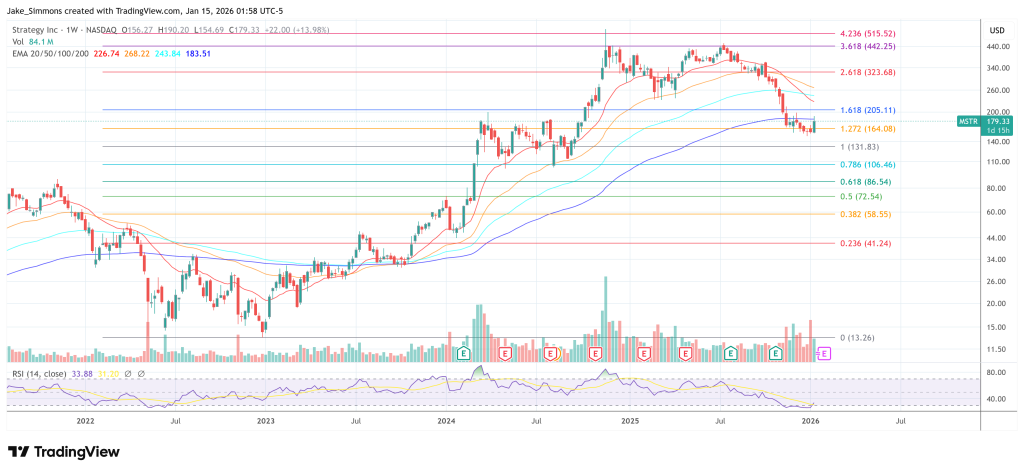
MSTR price chart
Market Opportunity
Octavia Logo
Octavia Price(VIA)
$0.0016
$0.0016$0.0016
-50.00%
USD
Octavia (VIA) Live Price Chart
Disclaimer: The articles reposted on this site are sourced from public platforms and are provided for informational purposes only. They do not necessarily reflect the views of MEXC. All rights remain with the original authors. If you believe any content infringes on third-party rights, please contact service@support.mexc.com for removal. MEXC makes no guarantees regarding the accuracy, completeness, or timeliness of the content and is not responsible for any actions taken based on the information provided. The content does not constitute financial, legal, or other professional advice, nor should it be considered a recommendation or endorsement by MEXC.

You May Also Like

Botanix launches stBTC to deliver Bitcoin-native yield

Botanix launches stBTC to deliver Bitcoin-native yield

The post Botanix launches stBTC to deliver Bitcoin-native yield appeared on BitcoinEthereumNews.com. Botanix Labs has launched stBTC, a liquid staking token designed to turn Bitcoin into a yield-bearing asset by redistributing network gas fees directly to users. The protocol will begin yield accrual later this week, with its Genesis Vault scheduled to open on Sept. 25, capped at 50 BTC. The initiative marks one of the first attempts to generate Bitcoin-native yield without relying on inflationary token models or centralized custodians. stBTC works by allowing users to deposit Bitcoin into Botanix’s permissionless smart contract, receiving stBTC tokens that represent their share of the staking vault. As transactions occur, 50% of Botanix network gas fees, paid in BTC, flow back to stBTC holders. Over time, the value of stBTC increases relative to BTC, enabling users to redeem their original deposit plus yield. Botanix estimates early returns could reach 20–50% annually before stabilizing around 6–8%, a level similar to Ethereum staking but fully denominated in Bitcoin. Botanix says that security audits have been completed by Spearbit and Sigma Prime, and the protocol is built on the EIP-4626 vault standard, which also underpins Ethereum-based staking products. The company’s Spiderchain architecture, operated by 16 independent entities including Galaxy, Alchemy, and Fireblocks, secures the network. If adoption grows, Botanix argues the system could make Bitcoin a productive, composable asset for decentralized finance, while reinforcing network consensus. This is a developing story. This article was generated with the assistance of AI and reviewed by editor Jeffrey Albus before publication. Get the news in your inbox. Explore Blockworks newsletters: Source: https://blockworks.co/news/botanix-launches-stbtc
Share
BitcoinEthereumNews2025/09/18 02:37
Unprecedented Surge: Gold Price Hits Astounding New Record High

Unprecedented Surge: Gold Price Hits Astounding New Record High

BitcoinWorld Unprecedented Surge: Gold Price Hits Astounding New Record High While the world often buzzes with the latest movements in Bitcoin and altcoins, a traditional asset has quietly but powerfully commanded attention: gold. This week, the gold price has once again made headlines, touching an astounding new record high of $3,704 per ounce. This significant milestone reminds investors, both traditional and those deep in the crypto space, of gold’s enduring appeal as a store of value and a hedge against uncertainty. What’s Driving the Record Gold Price Surge? The recent ascent of the gold price to unprecedented levels is not a random event. Several powerful macroeconomic forces are converging, creating a perfect storm for the precious metal. Geopolitical Tensions: Escalating conflicts and global instability often drive investors towards safe-haven assets. Gold, with its long history of retaining value during crises, becomes a preferred choice. Inflation Concerns: Persistent inflation in major economies erodes the purchasing power of fiat currencies. Consequently, investors seek assets like gold that historically maintain their value against rising prices. Central Bank Policies: Many central banks globally are accumulating gold at a significant pace. This institutional demand provides a strong underlying support for the gold price. Furthermore, expectations around interest rate cuts in the future also make non-yielding assets like gold more attractive. These factors collectively paint a picture of a cautious market, where investors are looking for stability amidst a turbulent economic landscape. Understanding Gold’s Appeal in Today’s Market For centuries, gold has held a unique position in the financial world. Its latest record-breaking performance reinforces its status as a critical component of a diversified portfolio. Gold offers a tangible asset that is not subject to the same digital vulnerabilities or regulatory shifts that can impact cryptocurrencies. While digital assets offer exciting growth potential, gold provides a foundational stability that appeals to a broad spectrum of investors. Moreover, the finite supply of gold, much like Bitcoin’s capped supply, contributes to its perceived value. The current market environment, characterized by economic uncertainty and fluctuating currency values, only amplifies gold’s intrinsic benefits. It serves as a reliable hedge when other asset classes, including stocks and sometimes even crypto, face downward pressure. How Does This Record Gold Price Impact Investors? A soaring gold price naturally raises questions for investors. For those who already hold gold, this represents a significant validation of their investment strategy. For others, it might spark renewed interest in this ancient asset. Benefits for Investors: Portfolio Diversification: Gold often moves independently of other asset classes, offering crucial diversification benefits. Wealth Preservation: It acts as a robust store of value, protecting wealth against inflation and economic downturns. Liquidity: Gold markets are highly liquid, allowing for relatively easy buying and selling. Challenges and Considerations: Opportunity Cost: Investing in gold means capital is not allocated to potentially higher-growth assets like equities or certain cryptocurrencies. Volatility: While often seen as stable, gold prices can still experience significant fluctuations, as evidenced by its rapid ascent. Considering the current financial climate, understanding gold’s role can help refine your overall investment approach. Looking Ahead: The Future of the Gold Price What does the future hold for the gold price? While no one can predict market movements with absolute certainty, current trends and expert analyses offer some insights. Continued geopolitical instability and persistent inflationary pressures could sustain demand for gold. Furthermore, if global central banks continue their gold acquisition spree, this could provide a floor for prices. However, a significant easing of inflation or a de-escalation of global conflicts might reduce some of the immediate upward pressure. Investors should remain vigilant, observing global economic indicators and geopolitical developments closely. The ongoing dialogue between traditional finance and the emerging digital asset space also plays a role. As more investors become comfortable with both gold and cryptocurrencies, a nuanced understanding of how these assets complement each other will be crucial for navigating future market cycles. The recent surge in the gold price to a new record high of $3,704 per ounce underscores its enduring significance in the global financial landscape. It serves as a powerful reminder of gold’s role as a safe haven asset, a hedge against inflation, and a vital component for portfolio diversification. While digital assets continue to innovate and capture headlines, gold’s consistent performance during times of uncertainty highlights its timeless value. Whether you are a seasoned investor or new to the market, understanding the drivers behind gold’s ascent is crucial for making informed financial decisions in an ever-evolving world. Frequently Asked Questions (FAQs) Q1: What does a record-high gold price signify for the broader economy? A record-high gold price often indicates underlying economic uncertainty, inflation concerns, and geopolitical instability. Investors tend to flock to gold as a safe haven when they lose confidence in traditional currencies or other asset classes. Q2: How does gold compare to cryptocurrencies as a safe-haven asset? Both gold and some cryptocurrencies (like Bitcoin) are often considered safe havens. Gold has a centuries-long history of retaining value during crises, offering tangibility. Cryptocurrencies, while newer, offer decentralization and can be less susceptible to traditional financial system failures, but they also carry higher volatility and regulatory risks. Q3: Should I invest in gold now that its price is at a record high? Investing at a record high requires careful consideration. While the price might continue to climb due to ongoing market conditions, there’s also a risk of a correction. It’s crucial to assess your personal financial goals, risk tolerance, and consider diversifying your portfolio rather than putting all your capital into a single asset. Q4: What are the main factors that influence the gold price? The gold price is primarily influenced by global economic uncertainty, inflation rates, interest rate policies by central banks, the strength of the U.S. dollar, and geopolitical tensions. Demand from jewelers and industrial uses also play a role, but investment and central bank demand are often the biggest drivers. Q5: Is gold still a good hedge against inflation? Historically, gold has proven to be an effective hedge against inflation. When the purchasing power of fiat currencies declines, gold tends to hold its value or even increase, making it an attractive asset for preserving wealth during inflationary periods. To learn more about the latest crypto market trends, explore our article on key developments shaping Bitcoin’s price action. This post Unprecedented Surge: Gold Price Hits Astounding New Record High first appeared on BitcoinWorld.
Share
Coinstats2025/09/18 02:30
China Bans Nvidia’s RTX Pro 6000D Chip Amid AI Hardware Push

China Bans Nvidia’s RTX Pro 6000D Chip Amid AI Hardware Push

TLDR China instructs major firms to cancel orders for Nvidia’s RTX Pro 6000D chip. Nvidia shares drop 1.5% after China’s ban on key AI hardware. China accelerates development of domestic AI chips, reducing U.S. tech reliance. Crypto and AI sectors may seek alternatives due to limited Nvidia access in China. China has taken a bold [...] The post China Bans Nvidia’s RTX Pro 6000D Chip Amid AI Hardware Push appeared first on CoinCentral.
Share
Coincentral2025/09/18 01:09