Total visits to U.S. crypto-native sites fell by approximately 33% quarter-over-quarter. Despite overall traffic shrinking, direct traffic accounted for almost Total visits to U.S. crypto-native sites fell by approximately 33% quarter-over-quarter. Despite overall traffic shrinking, direct traffic accounted for almost

Direct traffic accounts for 44% of US crypto media visits — even as overall traffic falls

2026/01/29 21:21
6 min read

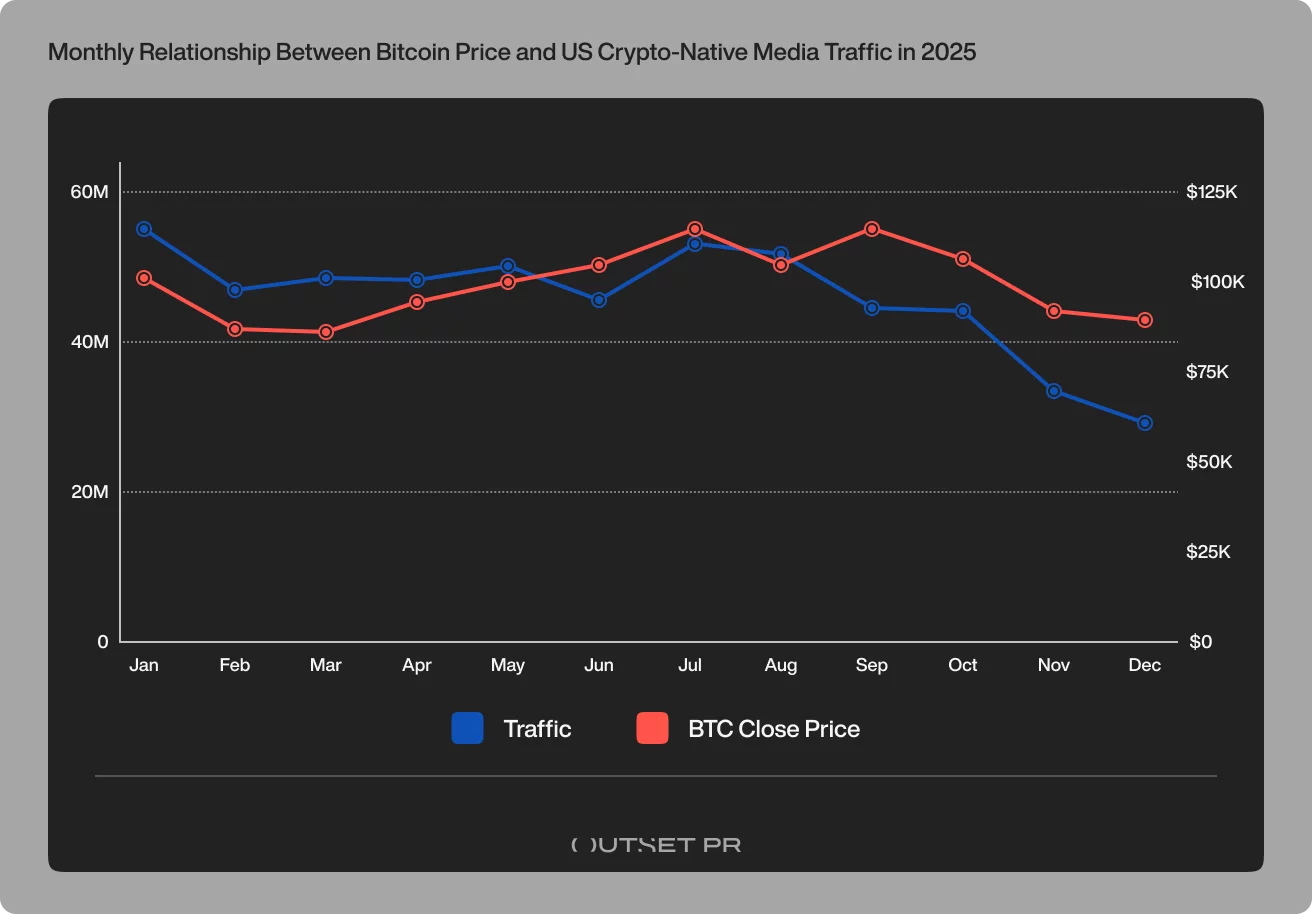
After a fairly optimistic mid-year performance, U.S. crypto media visits fell by roughly one-third in the fourth quarter of 2025. 

This coincided with the market’s sharp downturn and Bitcoin’s abandonment of hopes of hitting $150,000 by the end of the year. 

Summary
  • Total visits to U.S. crypto-native sites fell by approximately 33% quarter-over-quarter.
  • Despite overall traffic shrinking, direct traffic accounted for almost half of all visitors – 44%.
  • The casual crowd pulled back, but loyal readers kept showing up.

What mattered most was where the remaining attention came from: readers who stayed were coming directly, out of habit. When markets are hot, attention comes from everywhere. When things cool down, most of that traffic disappears, and what’s left is the steady reader base that comes back on purpose, not by accident. 
Direct traffic accounts for 44% of US crypto media visits — even as overall traffic falls - 2

That’s why direct traffic became the anchor in Q4, even as casual discovery faded out. 

Naturally, the extra eyeballs that were very interested during the peak of the bull run started disappearing when markets soured.

Our latest Outset Data Pulse analysis indicates that what is described as “summer tourists,” that is, casual readers drawn by the bull market, left as quickly as they came. Earlier in the year, many of these readers were searching on Google for topics like “Should I buy Bitcoin now?” or clicking on trending links on X and Reddit.

By the fourth quarter, with no new all-time highs or memecoin rags-to-riches story dominating headlines, that influx of casual traffic simply evaporated. Once the casual audience dropped off, the real shape of the U.S. crypto media market came into focus. This trend played out nearly identically in Asia throughout the third quarter. The summer hype brought an influx of visitors for a few months before it ended.

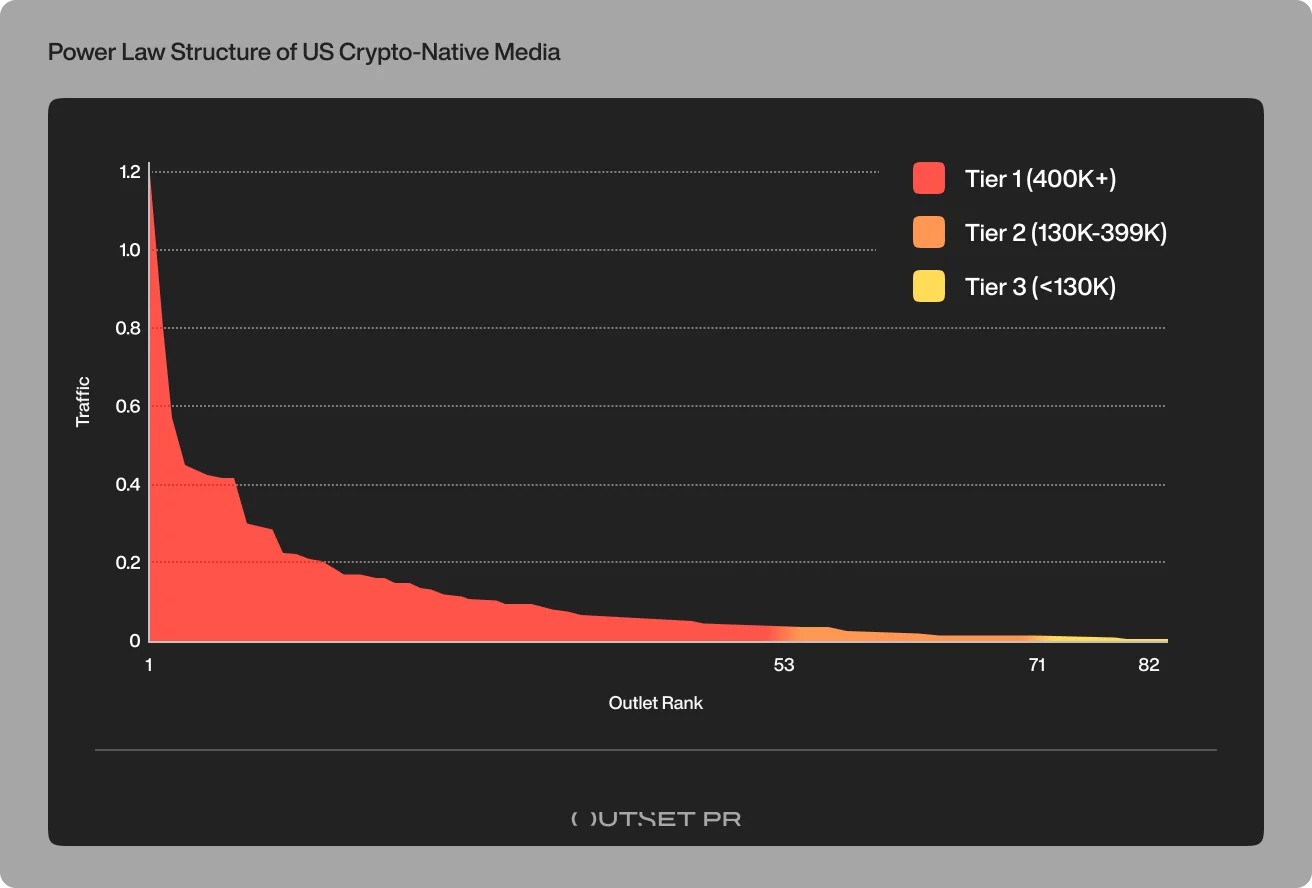
What remained was a market increasingly defined by concentration: in Q4, just 53 publishers captured more than 95% of all crypto-native traffic, underscoring how uneven visibility has become. Latin America wasn’t much different. In our earlier report, just six sites pulled in nearly 70% of all traffic across 38 crypto-only outlets.

Q4’s traffic crash hid surge in direct-only readers

Search and social traffic were the first channels to give way. That makes sense: when crypto is moving fast, casual readers often arrive through whatever is circulating on social media.

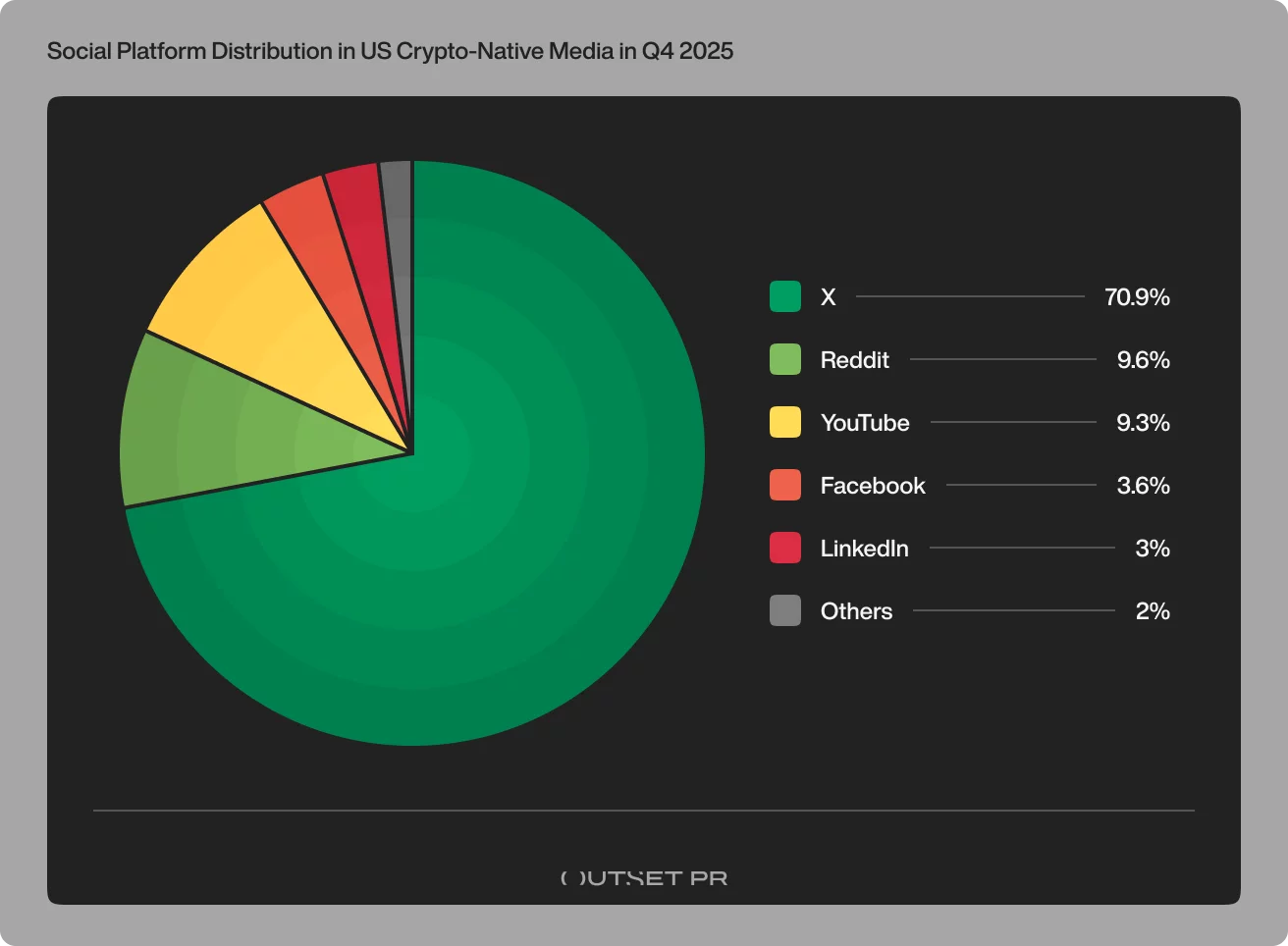
But in the U.S., “social discovery” effectively meant X. In Q4, more than 70% of all social traffic across crypto-native outlets came from a single platform, while the remaining networks: Reddit, YouTube, Facebook, LinkedIn contributed only small fractions.
Direct traffic accounts for 44% of US crypto media visits — even as overall traffic falls - 3

Social itself was a relatively thin layer overall, representing only about 6% of total traffic, which meant most publishers were exposed to a small channel that was almost entirely dependent on one platform.

“Once the feeds quiet down, what’s left is the audience that comes deliberately, the people who already know where to go,” said Maximilian Fondé, senior media analyst at Outset PR. “That’s when direct traffic stops being just another channel and becomes the main thing holding publishers up.”

The Q4 numbers bear this out in dramatic fashion. As search and social weakened, another discovery layer began to stand out: AI tools already drove roughly 25% of all referral traffic across U.S. crypto-native media, creating a new visibility filter alongside direct readership.

Even as total visits plunged, nearly half of all remaining traffic came from readers navigating directly to crypto sites. This was the strongest direct share we observed across any region in recent data.

What this means is nearly one out of two visits to American crypto press websites came from a reader who meant to be there, not through some external search or prompt. That’s the overall picture, but for some outlets, direct traffic was basically the whole story. Bankless pulled in almost 58% direct visits, which is about as close as crypto media gets to a built-in audience.

These aren’t accidental clicks but a more crypto-savvy crowd, consisting of traders checking the news, analysts keeping up with industry updates, or long-term investors making sure they never miss an opportunity.

Why direct readers are the loyal core of crypto media

Direct traffic in Q4 reflected a committed reader base that continued returning even as broader interest cooled. As Maximilian Fondé previously observed, 

“Every direct visit reflects intent, not chance.”

Even when speculative interest wanes, there’s still a major audience for crypto news. At the same time, the broader ecosystem operates under a strict power law: below the top tier, smaller outlets face rising barriers to discovery regardless of output or quality.

If fewer newbies are googling “next 100x coin”, the sites that thrive are the ones with a bookmark on their loyal reader’s browser. This is a testament to the stickiness of crypto brands that offer trust, reliability, fair reporting, and credibility.

They might not be sharing as many articles on Facebook or ranking on Reddit, but they are still attracting readers. This is the base of users who will visit their favorite crypto news sites through thick and thin.

When direct loyalty becomes the only real moat

The rise in direct traffic doesn’t just reflect stronger reader habits. It also reflects how concentrated the U.S. crypto media market has become.

Our tier analysis shows that this is no longer an ecosystem where attention is broadly distributed. In Q4, tier-1 outlets (publishers with more than 400,000 monthly visits) absorbed 95% of all crypto-native demand. That top tier alone accounted for more than 101 million visits across the quarter.
Direct traffic accounts for 44% of US crypto media visits — even as overall traffic falls - 4

Below that, the picture changes sharply. Tier-2 outlets, despite operating at meaningful scale, accounted for just over 4% of total traffic, while tier-3 publishers accounted for less than 1%. The “middle class” of crypto media has largely vanished.

“At this point, competition mostly happens inside the top tier,” said Fondé. “Below that, catching up becomes structurally difficult, regardless of editorial quality.”

This is why direct readership matters so much. In a market shaped by compounding visibility, publishers cannot rely on discovery alone. Search, social, and now AI referrals increasingly reinforce the same incumbents. Direct traffic is one of the few channels that smaller or mid-tier outlets can truly own.

In practice, the Q4 contraction clarified what keeps outlets alive. The publishers that held up best weren’t the ones chasing volatility-driven clicks. They were the ones with readers who still typed the URL, opened a bookmark, or returned out of routine.

In a market like this, the readers who come straight to you are the only attention you really own. With that said, the implications are clear for crypto websites: cater to your core audience. These are the readers who value substantive reporting, because that’s what keeps them coming back.

Disclaimer: The articles reposted on this site are sourced from public platforms and are provided for informational purposes only. They do not necessarily reflect the views of MEXC. All rights remain with the original authors. If you believe any content infringes on third-party rights, please contact service@support.mexc.com for removal. MEXC makes no guarantees regarding the accuracy, completeness, or timeliness of the content and is not responsible for any actions taken based on the information provided. The content does not constitute financial, legal, or other professional advice, nor should it be considered a recommendation or endorsement by MEXC.

You May Also Like

Bad News for European Crypto Holders? EU Calls For Harsher Crypto Regulation Despite MiCA

Bad News for European Crypto Holders? EU Calls For Harsher Crypto Regulation Despite MiCA

EU regulators push stricter crypto rules beyond MiCA, seeking ESMA oversight, cybersecurity audits, and AMLR bans on privacy tokens. European regulators are now calling louder for stricter crypto rules.  France’s AMF, Austria’s FMA and Italy’s CONSOB are now arguing that the Markets in Crypto-Assets Regulation (also known as MiCA framework) is not enough to manage […] The post Bad News for European Crypto Holders? EU Calls For Harsher Crypto Regulation Despite MiCA appeared first on Live Bitcoin News.
Share
LiveBitcoinNews2025/09/18 13:00
Here’s Why This Analyst Predicts Shiba Inu 568% Surge
Here’s Why This Analyst Predicts Shiba Inu 568% Surge

Popular community member Heber Mayen suggests that Shiba Inu is poised for an explosive breakout. In a tweet yesterday, Mayen shared Shiba Inu’s one-month price chart, showing the asset up 3.65% over the past 30 days to $0.00001345.Visit Website
Share
The Crypto Basic2025/09/19 14:59
AVAX One Unveils Ambitious $550M Avalanche Reserve Plan

AVAX One Unveils Ambitious $550M Avalanche Reserve Plan

BitcoinWorld AVAX One Unveils Ambitious $550M Avalanche Reserve Plan In a groundbreaking move that’s sending ripples across both traditional finance and the cryptocurrency world, Nasdaq-listed AgriFORCE (AGRI) is making waves with its audacious plan to rebrand as AVAX One. This strategic pivot marks a significant first: a publicly traded company on a major exchange explicitly dedicating its core strategy to investing in Avalanche (AVAX) reserves. For anyone tracking the evolving landscape of digital assets, the emergence of AVAX One signals a bold new chapter. What Does the AVAX One Rebrand Mean for Investors? The decision by AgriFORCE to transform into AVAX One is far more than just a name change; it’s a complete strategic overhaul. The company will now focus intensely on accumulating and managing Avalanche (AVAX) reserves. This commitment positions AVAX One as a unique player in the public market, offering traditional investors a direct avenue to exposure in a prominent layer-1 blockchain. Pioneering Public Exposure: AVAX One is set to become the first Nasdaq-listed entity to center its operations around a specific cryptocurrency, offering a new model for institutional crypto adoption. Significant Capital Commitment: The firm has already secured a substantial $300 million through a private investment in public equity (PIPE) deal. This initial capital infusion demonstrates strong investor confidence in the new direction. Targeting Growth: The ambition doesn’t stop there. AVAX One intends to raise an additional $250 million, aiming for a total of $550 million dedicated to building its AVAX reserves. This aggressive strategy underscores the company’s belief in Avalanche’s long-term potential. Powering Up AVAX One: The Role of Key Advisors To navigate this innovative venture, AVAX One is bringing in some heavy hitters from both traditional finance and the crypto industry. The caliber of these individuals speaks volumes about the serious intent behind this rebranding. The company has announced that two highly respected figures are expected to join its advisory board: Anthony Scaramucci: Founder of SkyBridge Capital, a global investment firm. Scaramucci is well-known for his insights into financial markets and his increasing involvement in the crypto space. His presence lends significant credibility and strategic guidance to AVAX One. Brett Tejpaul: Head of Coinbase Institutional. Tejpaul brings extensive experience from one of the leading cryptocurrency exchanges, offering invaluable expertise in digital asset markets, custody, and institutional trading strategies. These appointments suggest a robust framework for governance and strategic direction, blending deep financial acumen with specialized cryptocurrency knowledge. Their collective wisdom will be crucial in guiding AVAX One‘s investment decisions and market positioning. The Ambitious $550M Target for AVAX One Reserves – A Bold Move? The ambitious target for AVAX One‘s Avalanche reserves, aiming for a total of $550 million, is a testament to the company’s conviction in the Avalanche ecosystem. This substantial capital allocation positions AVAX One to potentially become a major holder of AVAX, with significant implications for both the company and the broader Avalanche network. Investing directly in a digital asset like AVAX comes with both opportunities and considerations: Potential for Appreciation: If Avalanche continues to grow and gain adoption, the value of AVAX One‘s reserves could appreciate significantly, benefiting shareholders. Ecosystem Participation: Holding substantial AVAX could allow AVAX One to participate in Avalanche’s governance, staking, and decentralized finance (DeFi) activities, potentially generating additional yield. Market Volatility: Like all cryptocurrencies, AVAX is subject to market volatility. AVAX One‘s strategy will need to account for these fluctuations and manage risk effectively. This strategic shift highlights a growing trend where traditional companies are seeking direct exposure to the crypto market, recognizing its potential for innovation and financial growth. In conclusion, AgriFORCE’s transformation into AVAX One is a landmark event, showcasing a Nasdaq-listed company’s full embrace of the digital asset economy. With substantial funding already secured, an ambitious reserve target, and a stellar advisory board, AVAX One is poised to be a significant player in the Avalanche ecosystem and a bellwether for institutional crypto adoption. This bold move will undoubtedly be watched closely by investors and the crypto community alike, as it charts new territory for public companies in the digital age. Frequently Asked Questions (FAQs) What is AVAX One? AVAX One is the new name for AgriFORCE (AGRI), a Nasdaq-listed company that is rebranding to focus its core business strategy on investing in and holding Avalanche (AVAX) cryptocurrency reserves. Why is AgriFORCE rebranding to AVAX One? AgriFORCE is rebranding to AVAX One to pivot its business model entirely towards the digital asset space, specifically focusing on Avalanche (AVAX) as its primary investment vehicle. This strategic shift aims to capitalize on the growth potential of the cryptocurrency market. Who are the key advisors for AVAX One? The advisory board for AVAX One is expected to include high-profile figures such as Anthony Scaramucci, founder of SkyBridge Capital, and Brett Tejpaul, head of Coinbase Institutional. Their expertise will guide the company’s new direction. What is Avalanche (AVAX)? Avalanche (AVAX) is a high-performance blockchain platform designed for decentralized applications (dApps) and custom blockchain networks. It is known for its speed, security, and scalability, making it a prominent player in the layer-1 blockchain space. What does the $550M target for AVAX One reserves mean? The $550 million target signifies the total amount of capital AVAX One aims to raise and dedicate to acquiring and holding Avalanche (AVAX) tokens. This includes $300 million already raised and an additional $250 million targeted for future fundraising. Did you find this article insightful? Share it with your network and help spread the word about this pioneering move in the crypto investment landscape! To learn more about the latest crypto market trends, explore our article on key developments shaping Avalanche price action. This post AVAX One Unveils Ambitious $550M Avalanche Reserve Plan first appeared on BitcoinWorld.
Share
Coinstats2025/09/22 19:40