

XRP Tests Structure, Not Collapse, as Fibonacci History Repeats
XRP is trading near $1.7 on the monthly timeframe, where price is interacting with a structurally important zone defined by long-term cycle behavior rather than short-term volatility.
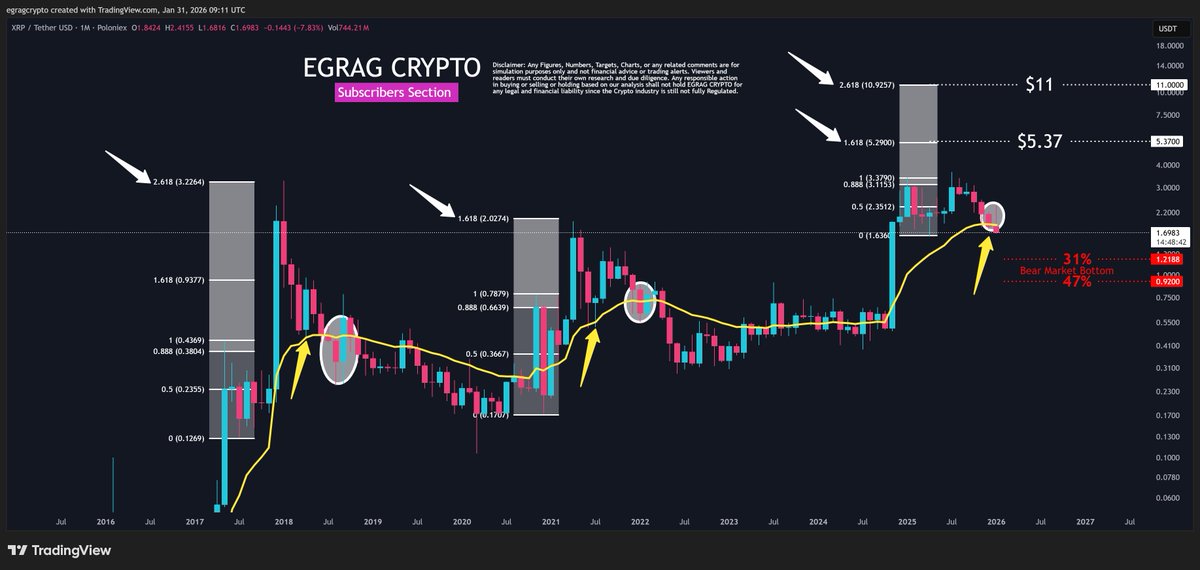
According to analysis shared by EGRAG CRYPTO, the current phase mirrors earlier market cycles, placing XRP at a decision point between continuation and structural failure.
The significance of this moment lies in cycle symmetry. Historically, XRP’s largest expansions have not occurred on the first impulse, but on the second surge, with Fibonacci extensions acting as probabilistic guides rather than guarantees.
 Source: https://twitter.com/egragcrypto/status/2017526186671325463
Cycle Structure and Fibonacci Context
EGRAG’s analysis highlights a repeating pattern across prior cycles:
- 2017 cycle: After the first surge, XRP’s second impulse topped near the Fib 2.618 extension.
- 2021 cycle: The second surge was truncated at Fib 1.618, which the analyst attributes to external disruption rather than structural failure.
The key takeaway is that XRP has consistently respected Fibonacci extensions on the second impulse, not the first. At present, XRP remains in what EGRAG defines as a macro correction following the first surge, suggesting the second impulse has not yet activated.
The Role of the 21 EMA
A central technical reference in the analysis is the monthly 21 EMA, which XRP is currently testing. In both 2018 and 2021, the first touch of the 21 EMA after the initial surge produced a major relief bounce, followed later by a broader structure breakdown.
On the chart, this first-touch interaction is marked by white circles, showing near-identical positioning across cycles. The implication is not that a breakdown is imminent, but that this zone historically acts as a reaction point, where probability temporarily shifts in favor of a bounce before longer-term direction is resolved.
Scenarios and Risk Balance
EGRAG outlines two structurally valid scenarios, with uneven probability weighting based on historical symmetry:
Primary continuation scenario (estimated 65–70%):
- Monthly price holds near the 21 EMA
- Market structure remains intact
- A second impulse activates
- Fibonacci-based upside reference levels:
- Fib 1.618 near $5.37
- Fib 2.618 near $11
Structural failure scenario (estimated 30–35%):
- Monthly closes decisively below the 21 EMA
- Acceptance develops below roughly $1.20–$1.30
- Cycle symmetry breaks, invalidating the second-impulse framework
Importantly, the bearish scenario is framed as a structure break, not an open-ended collapse, with downside risk described as comparatively limited if symmetry fails.
Professional Takeaway
XRP is not currently signaling collapse, but testing structure at a level that has historically mattered across cycles. Fibonacci extensions provide probabilistic guidance, while the 21 EMA acts as the structural arbiter.
As long as price maintains acceptance above the $1.20–$1.30 zone, the long-term framework supporting a second impulse remains viable.
For now, outcome depends less on narrative and more on monthly confirmation. Fibonacci guides probability, but structure ultimately decides direction.
The post XRP Tests Structure, Not Collapse, as Fibonacci History Repeats appeared first on ETHNews.
You May Also Like

How to earn from cloud mining: IeByte’s upgraded auto-cloud mining platform unlocks genuine passive earnings

USDC Treasury mints 250 million new USDC on Solana
