

Litecoin Price Drops 12% as Network Usage and Adoption Rise

This article was first published on The Bit Journal. Litecoin price is at the lowest point it has been in over four months, falling almost 12 percent over the last seven days as the larger crypto market persists in putting pressure on altcoins. Although the decline in price movement has been the focus of attention, events outside the charts give reason to believe Litecoin has strong underlying demand and utility.
Litecoin Price Rebounds Slightly Amid Bearish Trend
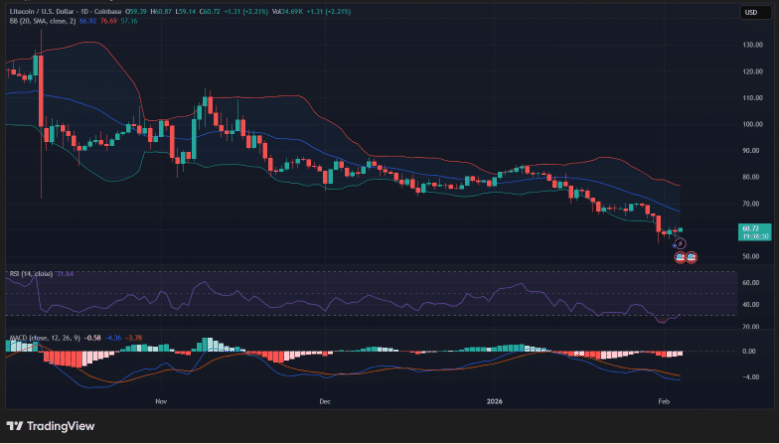
The Litecoin price experienced a slight rebound on the daily chart since it had dropped in October to its lowest point. This temporary restoration notwithstanding, the overall technical picture is still bearish. LTC is trading below its key moving averages, signalling that there is continued pressure on the downside and it is not easy to gain the momentum that is lost.
Momentum indicators also confirm the pessimistic view. The Relative Strength Index (RSI) indicates high selling, and the Moving Average Convergence Divergence (MACD) is still in the negative, indicating that the downslope momentum has not fully decelerated. The volatility has also risen and the Litecoin price has been moving through the lower Bollinger Band several times in the past few sessions.
 Source:TradingView
Litecoin Gains Institutional Backing Despite Weak Price
Although the Litecoin price is weak, developments in the network testify to increased confidence in the long-term applicability of the asset. Japanese financial conglomerate SBI Holdings has its own cryptocurrency exchange, SBI VC Trade, which has included Litecoin to its crypto lending program. The Lending Coin program now allows users of Japan to lend LTC and earn a set of interest, positioning it on the same level as more traditional cryptocurrencies, including Bitcoin, Ethereum, and XRP.
Over 30 digital assets are already supported by the platform, and the addition of Litecoin is broadly seen as a good omen to its legitimacy and institutional adoption, even in times of uncertainty in the market.
Litecoin Price Weakens as Payments Usage Rises
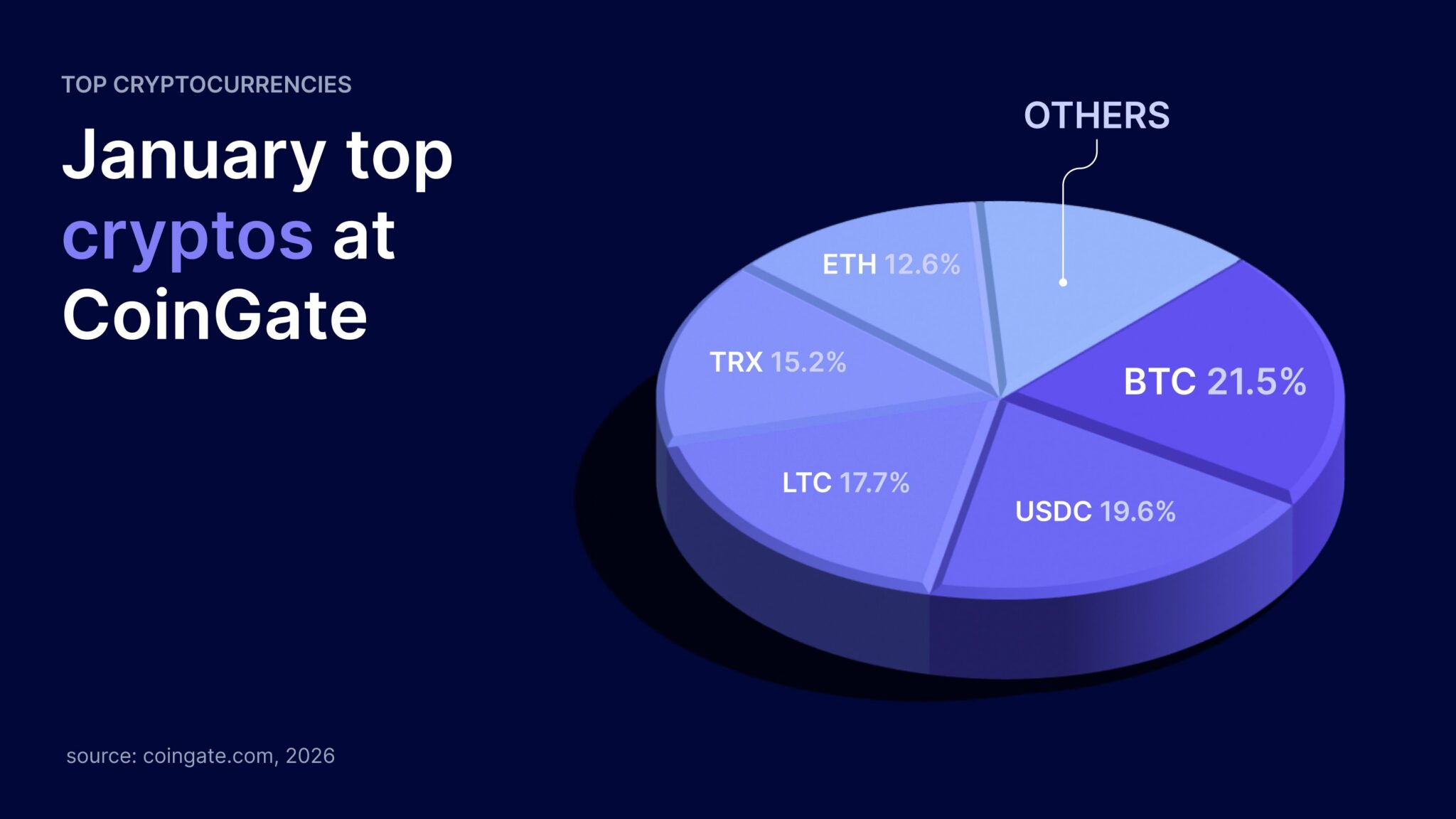
Other than the institutional support, Litecoin is still showing potential as a payment-oriented cryptocurrency. According to the data provided by CoinGate, LTC became the third most utilized cryptocurrency in terms of payments in January, as it made up 17.7 percent of all operations on the platform. This leaves Litecoin trailing behind only Bitcoin and USD Coin, and represents an improvement on the 16.4 percent share in December.
The increase in payment usage shows that the real-world usage is not declining, despite Litecoin price failing to reclaim its upward momentum in the market.
 Source:Coingate
MWEB Adoption Drives Litecoin Ecosystem Growth
Meanwhile, Litecoin based opt-in privacy Layer, MimbleWimble Extension Blocks (MWEB), saw its adoption increase to an all-time high. LTC locked in to MWEB rose sharply in the past month, with the sharp rise in peg-in transactions. This is an indication of an increased privacy-focused transactions in the Litecoin ecosystem.
Collectively, this implies that there is a definite disconnect between short run market performance and network health. Although the Litecoin price is under pressure due to the wider bearish sentiment, adoption metrics, usage of payment and ecosystem development still shine through under the hood.
Conclusion
Despite ongoing weakness in the Litecoin price and persistent bearish technical signals, the network’s fundamentals remain resilient. The growing popularity of its use in payments, its privacy layer being more active, and the recent institutional backing in the form of crypto lending service imply that Litecoin remains an item with consistent demand, although the short-term market mood remains reserved.
Follow us on Twitter and LinkedIn, and join our Telegram channel to be instantly informed about breaking news!
Summary
- Litecoin price drops nearly 12%, hitting October lows.
- Institutional support grows as SBI VC Trade adds LTC lending.
- Adoption rises with record payments and MWEB activity.
Glossary of Key Terms
Litecoin (LTC): A fast, low-fee cryptocurrency used for payments.
MACD: Trend indicator comparing two moving averages.
Bollinger Bands: Price range indicator showing volatility.
SBI VC Trade: Japanese crypto exchange offering trading and lending.
MWEB: Litecoin privacy layer for confidential transactions.
Peg-ins: Locking LTC into MWEB for privacy use.
Institutional Support: Backing from large financial entities.
Adoption Metrics: Data showing network usage and payments.
Frequently Asked Questions about Litecoin Price
1. Why is the Litecoin price falling?
LTC fell almost 12 percent in a week to four-month lows on bearish moods and market pressure on altcoins.
2. Why is Litecoin still strong?
Institutional support, rising payments, and MWEB adoption show steady demand despite weak prices.
3. How is Litecoin used for payments?
Litecoin became the third most-utilized crypto in January to make payments after Bitcoin and USDC.
4. What is MWEB?
MWEB is Litecoin’s privacy layer, with record peg-ins showing growing usage.
References
Sbivc
Read More: Litecoin Price Drops 12% as Network Usage and Adoption Rise">Litecoin Price Drops 12% as Network Usage and Adoption Rise
You May Also Like

Woman shot 5 times by DHS to stare down Trump at State of the Union address

What is Play-to-Earn Gaming? Unlocking New Possibilities
