TLDR Ronin plans to transition to Ethereum Layer 2 using Arbitrum Orbit for gaming and DeFi. The upgrade will improve transaction throughput and support Web3 gaming ecosystems. Ronin’s native token RON will play a larger role in the L2 ecosystem post-migration. The migration supports Ronin’s goal to become the “gamification engine” for Ethereum. Ronin, the [...] The post Ronin to Migrate to Ethereum Layer 2 on Arbitrum Orbit in New Proposal appeared first on CoinCentral.TLDR Ronin plans to transition to Ethereum Layer 2 using Arbitrum Orbit for gaming and DeFi. The upgrade will improve transaction throughput and support Web3 gaming ecosystems. Ronin’s native token RON will play a larger role in the L2 ecosystem post-migration. The migration supports Ronin’s goal to become the “gamification engine” for Ethereum. Ronin, the [...] The post Ronin to Migrate to Ethereum Layer 2 on Arbitrum Orbit in New Proposal appeared first on CoinCentral.

Ronin to Migrate to Ethereum Layer 2 on Arbitrum Orbit in New Proposal

4 min read

TLDR

  • Ronin plans to transition to Ethereum Layer 2 using Arbitrum Orbit for gaming and DeFi.
  • The upgrade will improve transaction throughput and support Web3 gaming ecosystems.

  • Ronin’s native token RON will play a larger role in the L2 ecosystem post-migration.

  • The migration supports Ronin’s goal to become the “gamification engine” for Ethereum.


Ronin, the blockchain network designed by Sky Mavis, is considering a significant change to its architecture. A recent proposal suggests that Ronin will migrate from its current layer-1 model to Ethereum Layer 2 (L2) via the Arbitrum Orbit chain by 2026. This move would align Ronin with the broader Ethereum ecosystem while enhancing its capabilities, especially within the Web3 gaming sector.

The proposal outlines the benefits of leveraging Arbitrum’s ecosystem for Ronin’s transition. With Arbitrum Orbit’s strong support for gaming and decentralized applications (DApps), Ronin stands to gain faster transaction speeds, better scalability, and a deeper integration into the Ethereum ecosystem. These improvements could help accelerate the adoption of Web3 gaming platforms.

Arbitrum Orbit’s Role in Ronin Migration

Arbitrum Orbit is an Ethereum-compatible Layer 2 stack that is uniquely suited to support Ronin’s transition. Unlike other Ethereum L2 solutions, Arbitrum Orbit provides native support for all key ecosystem functions without relying on technical compromises or reduced upgradeability. This makes it an ideal solution for Ronin’s goals of providing faster, more secure transactions for Web3 gaming.

By integrating with Arbitrum Orbit, Ronin will benefit from features such as customizable infrastructure, self-governance, and optimized validator fee revenue.

These factors are crucial for enhancing Ronin’s long-term sustainability and ensuring that it remains a competitive platform in the rapidly evolving space of decentralized finance (DeFi) and Web3 gaming.

Strengthening RON’s Utility in the Layer 2 Ecosystem

The proposed migration is expected to enhance the utility of Ronin’s native token, RON. Currently, RON plays a key role in Ronin’s governance and transaction processes.

However, the shift to Layer 2 will expand its role significantly, integrating it further into Ethereum’s ecosystem. This will make RON more central to a variety of activities, from gaming to DeFi protocols, as the network scales and grows.

Ronin’s adoption of Arbitrum Orbit would also enable developers to build more sophisticated gaming applications and services that can seamlessly integrate with Ethereum’s broader Web3 ecosystem. This can increase RON’s demand, as it will be needed for transaction fees, staking, and governance within the ecosystem.

Ronin’s Evolution Beyond Gaming

Originally launched in 2021 to support the popular game Axie Infinity, Ronin has evolved from a gaming-focused blockchain to a more expansive platform. In 2023, it transitioned from a proof-of-authority (PoA) consensus model to delegated proof-of-stake (DPoS) and became Ethereum Virtual Machine (EVM)-compatible. These updates enabled Ronin to support more than just gaming, opening the door to DeFi applications, NFT interoperability, and cross-chain token transfers.

Sky Mavis also expanded Ronin’s scope with Project Leviosa, which aims to broaden the chain’s reach beyond gaming into sectors like DeFi, infrastructure, and consumer applications. The planned migration to Arbitrum Orbit fits within Ronin’s broader goal of becoming the “gamification engine” of Ethereum, facilitating the next generation of decentralized applications and games on Ethereum’s network.

If the migration proposal is approved, Ronin will take a major step in becoming a key player in Ethereum’s Layer 2 ecosystem. This move would not only support the continued growth of Web3 gaming but also position Ronin as an influential force in the broader blockchain ecosystem. Furthermore, Sky Mavis has announced a $10 million grant initiative to encourage innovation in gaming, DApps, and DeFi protocols, further driving the adoption of Ronin as an Ethereum-aligned blockchain.

The post Ronin to Migrate to Ethereum Layer 2 on Arbitrum Orbit in New Proposal appeared first on CoinCentral.

Market Opportunity
PlaysOut Logo
PlaysOut Price(PLAY)
$0.09219
$0.09219$0.09219
-9.02%
USD
PlaysOut (PLAY) Live Price Chart
Disclaimer: The articles reposted on this site are sourced from public platforms and are provided for informational purposes only. They do not necessarily reflect the views of MEXC. All rights remain with the original authors. If you believe any content infringes on third-party rights, please contact service@support.mexc.com for removal. MEXC makes no guarantees regarding the accuracy, completeness, or timeliness of the content and is not responsible for any actions taken based on the information provided. The content does not constitute financial, legal, or other professional advice, nor should it be considered a recommendation or endorsement by MEXC.

You May Also Like

Once Upon a Farm Announces Pricing of Initial Public Offering

Once Upon a Farm Announces Pricing of Initial Public Offering

BERKELEY, Calif.–(BUSINESS WIRE)–Once Upon a Farm today announced the pricing of its initial public offering of 10,997,209 shares of its common stock, 7,631,537
Share
AI Journal2026/02/06 08:15
Forward Industries Bets Big on Solana With $4B Capital Plan
Forward Industries Bets Big on Solana With $4B Capital Plan

The firm has filed with the U.S. Securities and Exchange Commission to launch a $4 billion at-the-market (ATM) equity program, […] The post Forward Industries Bets Big on Solana With $4B Capital Plan appeared first on Coindoo.
Share
Coindoo2025/09/18 04:15
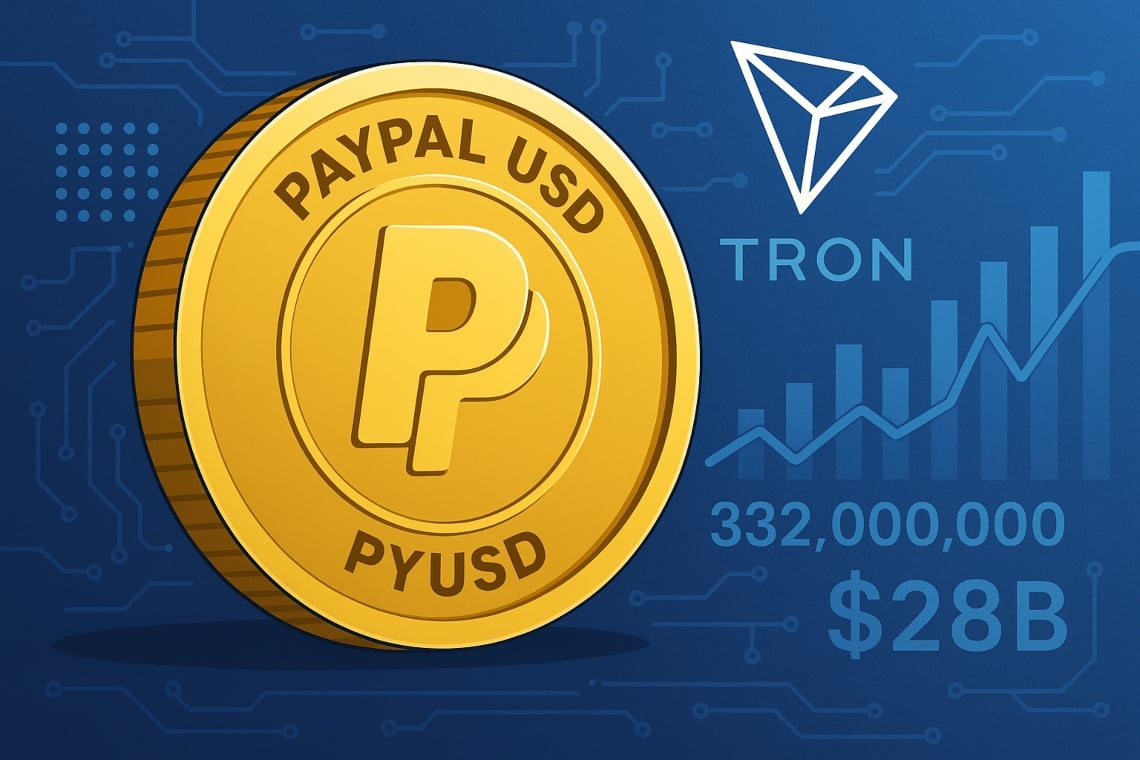
332M accounts and $28B TVL,

332M accounts and $28B TVL,

The post 332M accounts and $28B TVL, appeared on BitcoinEthereumNews.com. PayPal USD debuts on TRON as a permissionless token PYUSD0, enabled by LayerZero’s OFT standard and the Stargate Hydra extension. The announcement on September 18, 2025 (Geneva) introduces native interoperability between chains and transfers without manual steps for users; the news echoes elements already communicated by PayPal at the launch of PYUSD PayPal Newsroom. The move concerns an ecosystem that includes 332 million accounts and over $28 billion in TVL. In this context, the fungibility of a stablecoin regulated across multiple networks and the use of TRON as a settlement layer for payments and remittances is at stake. According to the data collected by TRONSCAN updated as of September 18, 2025, the network metrics confirm the cited volumes and highlighted traffic patterns. Our editorial team has verified the transaction logs and monitored the public chain metrics to corroborate the reported figures; the observations on daily flows and TVL are consistent with the network dashboards. Industry analysts observe that the entry of a regulated issuer like PayPal tends to increase institutional interest, provided there is transparency on reserves and compliance checks. What is PYUSD0 on TRON and why is it relevant PYUSD0 is the representation of PayPal USD on TRON. It is pegged one-to-one to PYUSD through the OFT standard: the two tokens remain a single stablecoin, fungible and reconciled across chains. The integration is made possible by Stargate Hydra, now operational through LayerZero. According to the founder of TRON, Justin Sun, the extension on TRON expands access and trust for users and institutions. For Bryan Pellegrino (CEO of LayerZero Labs), stablecoins represent a pillar of global payments and remittances, as the native compatibility between chains enables their operational scalability. It must be said that the alignment between issuer, cross-chain infrastructure, and settlement network is a key element. Key Numbers: TRON…
Share
BitcoinEthereumNews2025/09/19 08:18