Anchorage Digital, Kamino, and Solana Company are piloting a structure that could ease a longtime friction between traditional finance and DeFi: the ability to Anchorage Digital, Kamino, and Solana Company are piloting a structure that could ease a longtime friction between traditional finance and DeFi: the ability to

Anchorage, Kamino Let Firms Borrow Against SOL Without Moving Custody
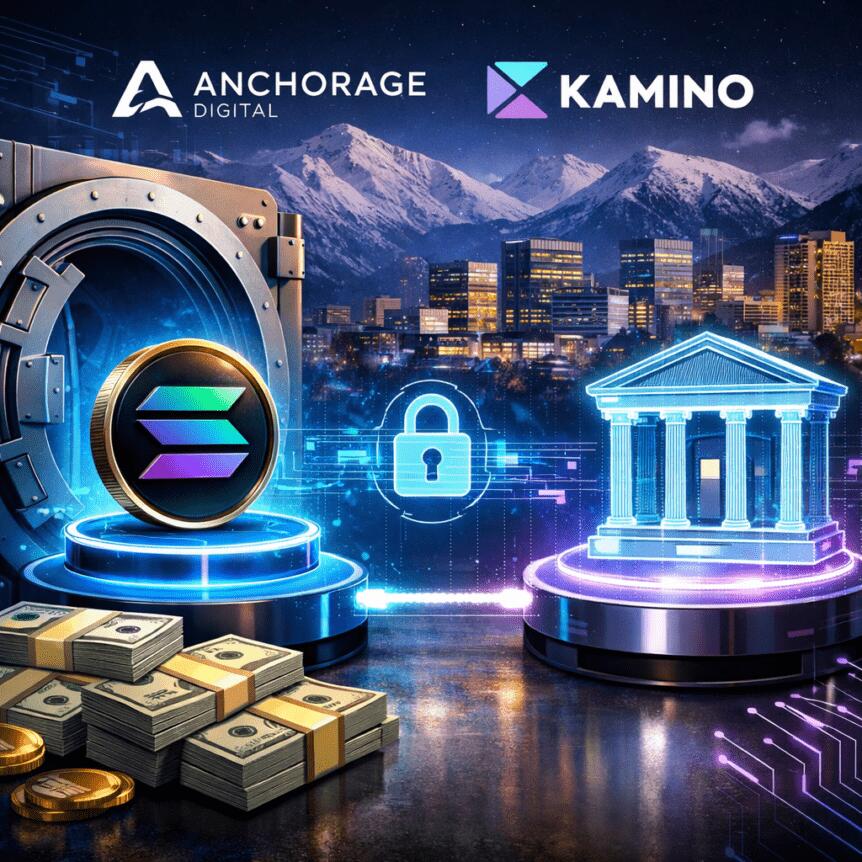
Anchorage, Kamino Let Firms Borrow Against Sol Without Moving Custody

Anchorage Digital, Kamino, and Solana Company are piloting a structure that could ease a longtime friction between traditional finance and DeFi: the ability to borrow against staked tokens without moving assets out of regulated custody. The collaboration expands Anchorage’s Atlas collateral management platform by integrating Kamino, a Solana-based decentralized lending protocol, with a framework that keeps collateral in custodial control. Solana (SOL) ((CRYPTO: SOL)) sits at the center of the arrangement, as the Solana Company treasury—an on-chain asset pool backed by Pantera Capital and Summer Capital—provides a tangible anchor for the program. The goal is to give financial institutions liquidity without forcing them to relinquish staking rewards or move assets into smart contracts that may carry higher regulatory or operational risk.

Key takeaways

  • Atlas’s collateral management is being extended to support native staking positions, enabling lenders to use staked SOL as collateral while assets remain in Anchorage’s custody.
  • Anchorage acts as collateral manager, setting loan-to-value ratios and margin requirements, and performing liquidation if necessary, removing the direct on-chain custody burden from regulated entities.
  • The involved treasury, Solana Company, holds a large SOL position and participates in governance and risk disclosures through its custodial framework and public partnerships.
  • The move unfolds amid a broader regulatory debate in the United States around DeFi, with the CLARITY Act aiming to clarify jurisdiction and standards for digital-asset activities.
  • Industry groups warn that early draft language does not fully distinguish between centralized intermediaries and decentralized protocols, adding a layer of regulatory risk to institutional adoption.

Tickers mentioned: $SOL

Sentiment: Neutral

Market context: The development mirrors growing institutional interest in DeFi-enabled liquidity while regulators weigh how to apply traditional securities and banking rules to on-chain lending and custody models.

Why it matters

The Anchorage-Kamino-Solana Company arrangement represents a tangible path for institutions to engage with decentralized lending markets without altering their custody and compliance posture. By keeping the collateral in segregated, regulated custody at Anchorage Digital Bank, lenders can maintain certainty around asset segregation, reporting, and risk controls that are typically required for regulated entities. The model reduces a historical hurdle: moving assets into on-chain, non-custodial environments that can complicate lending approvals, risk management, and auditability for banks and asset managers.

From a risk-management perspective, Anchorage’s role as collateral manager—determining loan-to-value caps, margin calls, and potential liquidations—adds a familiar, governance-backed framework to on-chain lending. It gives institutions a governance layer that complements Kamino’s DeFi lending markets, potentially expanding the universe of assets that institutions are comfortable using as collateral. The custody-first approach aims to preserve staking rewards, which for SOL holders can mean ongoing yield while accessing liquidity. This is particularly salient for large treasuries such as Solana Company, which has built a sizable SOL position and participates in ecosystem funding and governance through its holdings.

Regulators, on the other hand, watch closely. The CLARITY Act, which seeks to establish clearer jurisdiction and regulatory standards for digital assets, has become a focal point in policy debates. While supporters argue the bill would reduce uncertainty for market participants, critics counter that it does not fully delineate how decentralized protocols, developers, and governance frameworks should be treated under the law. The tension is evident in industry discussions and public commentary, underscoring that even innovative custody-friendly DeFi solutions must operate within an evolving regulatory landscape. In this context, the Anchorage-Kamino-Solana Company collaboration can be seen as a practical test case: it demonstrates what regulated institutions are willing to try, and where policy gaps may need to be filled to broaden safe participation.

Solana Company’s position—reported to be one of the largest SOL-based treasuries—adds another layer of credibility to the experiment. Its holdings, and the associated disclosures, underscore the willingness of specialized treasury teams to explore on-chain lending as a liquidity tool, provided that custodial safeguards remain intact. The project’s public materials also point to Solana’s ecosystem ambitions and the role of strategic treasury management in supporting on-chain liquidity without destabilizing staking yields or governance processes.

Solana Company is the second-largest SOL-based digital asset treasury, holding 2.3 million SOL. Source: CoinGecko

The technical structure hinges on integrating Kamino’s lending protocol with Atlas’s collateral framework. Under the program, a loan would be issued against natively staked SOL, but the actual SOL remains in Anchorage’s segregated custody. That separation matters because it preserves the institution’s regulatory, accounting, and risk-management controls while granting access to liquidity through Kamino’s on-chain markets. Anchorage’s oversight includes monitoring collateral value relative to loan size, maintaining margin requirements, and triggering liquidations if risk thresholds are breached. This model avoids the conventional requirement for institutions to transfer assets into smart-contract-based vaults, a sticking point that has historically limited regulated participation in DeFi lending markets.

The integration was announced in a period when Solana’s ecosystem, including its treasury vehicles, has been under scrutiny for both performance and risk. The Solana ecosystem’s public-facing information notes that the Solana Company treasury holds a substantial stake in SOL, reinforcing the relevance of this development to how large on-chain holders think about liquidity and risk. This event aligns with broader industry interest in on-chain lending, especially where custody remains in regulated environments. For market participants, the arrangement signals a potential template for expanding institutional DeFi exposure without eroding the protections and oversight that banks and trust companies emphasize.

What to watch next

  • Regulatory clarity progress on the CLARITY Act and related DeFi governance provisions, including any committee votes or amendments that clarify custody vs. on-chain lending.
  • Milestones in the Atlas-Kamino integration, such as go-live dates, onboarding of initial institutional users, and risk-management enhancements.
  • Solana Company’s ongoing SOL portfolio disclosures and any new risk disclosures tied to staking yields and on-chain liquidity use.
  • Updates from Anchorage Digital Bank on custody controls, compliance reporting, and risk-management metrics as more institutions engage with the structure.

Sources & verification

  • Anchorage Digital’s expansion of Atlas collateral management through Kamino integration with Solana Company’s treasury.
  • Solana Company treasury data and public disclosures via CoinGecko.
  • CLARITY Act overview and DeFi market-structure discussions.
  • Public policy discussions and industry meetings surrounding DeFi oversight, including high-level regulatory engagement by the Trump administration.

Market reaction and key details

The collaboration between Anchorage Digital, Kamino, and Solana Company illustrates how institutions may bridge custody-grade risk controls with DeFi liquidity pools. By enabling native staking positions to serve as collateral without a custody transfer, the program could unlock new liquidity channels for regulated entities. The emphasis on collateral management, risk controls, and segregated custody is consistent with a broader trend: institutions seeking to participate in on-chain lending while preserving traditional compliance and reporting regimes. The Solana ecosystem’s treasury dynamics, including Solana Company’s substantial SOL holdings, will be watched closely to see how risk disclosures evolve as the program expands. For practitioners, the approach could inform future collaborations that pair regulated custody with decentralized markets, potentially shaping how banks, asset managers, and corporate treasuries view DeFi liquidity tools.

Key figures and next steps

The project’s practical implications hinge on governance, custody risk controls, and the speed at which regulated institutions feel comfortable expanding their DeFi participation. If the pilot proves scalable and appropriately regulated, it may pave the way for broader adoption of staking-backed liquidity facilities that keep assets under regulated custody while granting on-chain access to lending markets. Observers will be watching for formal go/no-go decisions from participating institutions, any changes to Atlas collateral parameters, and additional asset classes considered for similar custody-preserving lending structures.

This article was originally published as Anchorage, Kamino Let Firms Borrow Against SOL Without Moving Custody on Crypto Breaking News – your trusted source for crypto news, Bitcoin news, and blockchain updates.

Market Opportunity
Solana Logo
Solana Price(SOL)
$84.93
$84.93$84.93
+2.06%
USD
Solana (SOL) Live Price Chart
Disclaimer: The articles reposted on this site are sourced from public platforms and are provided for informational purposes only. They do not necessarily reflect the views of MEXC. All rights remain with the original authors. If you believe any content infringes on third-party rights, please contact service@support.mexc.com for removal. MEXC makes no guarantees regarding the accuracy, completeness, or timeliness of the content and is not responsible for any actions taken based on the information provided. The content does not constitute financial, legal, or other professional advice, nor should it be considered a recommendation or endorsement by MEXC.

You May Also Like

Solid growth outlook supports Ringgit – Standard Chartered

Solid growth outlook supports Ringgit – Standard Chartered

The post Solid growth outlook supports Ringgit – Standard Chartered appeared on BitcoinEthereumNews.com. Standard Chartered’s Edward Lee and Jonathan Koh highlight
Share
BitcoinEthereumNews2026/02/14 03:14
IP Hits $11.75, HYPE Climbs to $55, BlockDAG Surpasses Both with $407M Presale Surge!

IP Hits $11.75, HYPE Climbs to $55, BlockDAG Surpasses Both with $407M Presale Surge!

The post IP Hits $11.75, HYPE Climbs to $55, BlockDAG Surpasses Both with $407M Presale Surge! appeared on BitcoinEthereumNews.com. Crypto News 17 September 2025 | 18:00 Discover why BlockDAG’s upcoming Awakening Testnet launch makes it the best crypto to buy today as Story (IP) price jumps to $11.75 and Hyperliquid hits new highs. Recent crypto market numbers show strength but also some limits. The Story (IP) price jump has been sharp, fueled by big buybacks and speculation, yet critics point out that revenue still lags far behind its valuation. The Hyperliquid (HYPE) price looks solid around the mid-$50s after a new all-time high, but questions remain about sustainability once the hype around USDH proposals cools down. So the obvious question is: why chase coins that are either stretched thin or at risk of retracing when you could back a network that’s already proving itself on the ground? That’s where BlockDAG comes in. While other chains are stuck dealing with validator congestion or outages, BlockDAG’s upcoming Awakening Testnet will be stress-testing its EVM-compatible smart chain with real miners before listing. For anyone looking for the best crypto coin to buy, the choice between waiting on fixes or joining live progress feels like an easy one. BlockDAG: Smart Chain Running Before Launch Ethereum continues to wrestle with gas congestion, and Solana is still known for network freezes, yet BlockDAG is already showing a different picture. Its upcoming Awakening Testnet, set to launch on September 25, isn’t just a demo; it’s a live rollout where the chain’s base protocols are being stress-tested with miners connected globally. EVM compatibility is active, account abstraction is built in, and tools like updated vesting contracts and Stratum integration are already functional. Instead of waiting for fixes like other networks, BlockDAG is proving its infrastructure in real time. What makes this even more important is that the technology is operational before the coin even hits exchanges. That…
Share
BitcoinEthereumNews2025/09/18 00:32
Facts Vs. Hype: Analyst Examines XRP Supply Shock Theory

Facts Vs. Hype: Analyst Examines XRP Supply Shock Theory

Prominent analyst Cheeky Crypto (203,000 followers on YouTube) set out to verify a fast-spreading claim that XRP’s circulating supply could “vanish overnight,” and his conclusion is more nuanced than the headline suggests: nothing in the ledger disappears, but the amount of XRP that is truly liquid could be far smaller than most dashboards imply—small enough, in his view, to set the stage for an abrupt liquidity squeeze if demand spikes. XRP Supply Shock? The video opens with the host acknowledging his own skepticism—“I woke up to a rumor that XRP supply could vanish overnight. Sounds crazy, right?”—before committing to test the thesis rather than dismiss it. He frames the exercise as an attempt to reconcile a long-standing critique (“XRP’s supply is too large for high prices”) with a rival view taking hold among prominent community voices: that much of the supply counted as “circulating” is effectively unavailable to trade. His first step is a straightforward data check. Pulling public figures, he finds CoinMarketCap showing roughly 59.6 billion XRP as circulating, while XRPScan reports about 64.7 billion. The divergence prompts what becomes the video’s key methodological point: different sources count “circulating” differently. Related Reading: Analyst Sounds Major XRP Warning: Last Chance To Get In As Accumulation Balloons As he explains it, the higher on-ledger number likely includes balances that aggregators exclude or treat as restricted, most notably Ripple’s programmatic escrow. He highlights that Ripple still “holds a chunk of XRP in escrow, about 35.3 billion XRP locked up across multiple wallets, with a nominal schedule of up to 1 billion released per month and unused portions commonly re-escrowed. Those coins exist and are accounted for on-ledger, but “they aren’t actually sitting on exchanges” and are not immediately available to buyers. In his words, “for all intents and purposes, that escrow stash is effectively off of the market.” From there, the analysis moves from headline “circulating supply” to the subtler concept of effective float. Beyond escrow, he argues that large strategic holders—banks, fintechs, or other whales—may sit on material balances without supplying order books. When you strip out escrow and these non-selling stashes, he says, “the effective circulating supply… is actually way smaller than the 59 or even 64 billion figure.” He cites community estimates in the “20 or 30 billion” range for what might be truly liquid at any given moment, while emphasizing that nobody has a precise number. That effective-float framing underpins the crux of his thesis: a potential supply shock if demand accelerates faster than fresh sell-side supply appears. “Price is a dance between supply and demand,” he says; if institutional or sovereign-scale users suddenly need XRP and “the market finds that there isn’t enough XRP readily available,” order books could thin out and prices could “shoot on up, sometimes violently.” His phrase “circulating supply could collapse overnight” is presented not as a claim that tokens are destroyed or removed from the ledger, but as a market-structure scenario in which available inventory to sell dries up quickly because holders won’t part with it. How Could The XRP Supply Shock Happen? On the demand side, he anchors the hypothetical to tokenization. He points to the “very early stages of something huge in finance”—on-chain tokenization of debt, stablecoins, CBDCs and even gold—and argues the XRP Ledger aims to be “the settlement layer” for those assets.He references Ripple CTO David Schwartz’s earlier comments about an XRPL pivot toward tokenized assets and notes that an institutional research shop (Bitwise) has framed XRP as a way to play the tokenization theme. In his construction, if “trillions of dollars in value” begin settling across XRPL rails, working inventories of XRP for bridging, liquidity and settlement could rise sharply, tightening effective float. Related Reading: XRP Bearish Signal: Whales Offload $486 Million In Asset To illustrate, he offers two analogies. First, the “concert tickets” model: you think there are 100,000 tickets (100B supply), but 50,000 are held by the promoter (escrow) and 30,000 by corporate buyers (whales), leaving only 20,000 for the public; if a million people want in, prices explode. Second, a comparison to Bitcoin’s halving: while XRP has no programmatic halving, he proposes that a sudden adoption wave could function like a de facto halving of available supply—“XRP’s version of a halving could actually be the adoption event.” He also updates the narrative context that long dogged XRP. Once derided for “too much supply,” he argues the script has “totally flipped.” He cites the current cycle’s optics—“XRP is sitting above $3 with a market cap north of around $180 billion”—as evidence that raw supply counts did not cap price as tightly as critics claimed, and as a backdrop for why a scarcity narrative is gaining traction. Still, he declines to publish targets or timelines, repeatedly stressing uncertainty and risk. “I’m not a financial adviser… cryptocurrencies are highly volatile,” he reminds viewers, adding that tokenization could take off “on some other platform,” unfold more slowly than enthusiasts expect, or fail to get to “sudden shock” scale. The verdict he offers is deliberately bound. The theory that “XRP supply could vanish overnight” is imprecise on its face; the ledger will not erase coins. But after examining dashboard methodologies, escrow mechanics and the behavior of large holders, he concludes that the effective float could be meaningfully smaller than headline supply figures, and that a fast-developing tokenization use case could, under the right conditions, stress that float. “Overnight is a dramatic way to put it,” he concedes. “The change could actually be very sudden when it comes.” At press time, XRP traded at $3.0198. Featured image created with DALL.E, chart from TradingView.com
Share
NewsBTC2025/09/18 11:00