In crypto, signing means using your private key to approve a transaction. Your private key stays hidden, but the signature you create shows that you are the owner of the wallet. One common mistake is signing something you don’t understand.In crypto, signing means using your private key to approve a transaction. Your private key stays hidden, but the signature you create shows that you are the owner of the wallet. One common mistake is signing something you don’t understand.

What Happens When You Sign a Crypto Transaction (And What Could Go Wrong)

5 min read

\ If you’ve used a crypto wallet connected to networks with smart contract features, you’ve probably seen a button that says “Sign.” It might come up when you send tokens, log into a decentralized app (like an exchange), or try to claim an airdrop. It feels simple, like clicking “Accept” on a website. But in crypto, signing is much more than that. It’s a powerful action that tells the network, “I approve this.”

Understanding what happens when you sign can help you stay in control. It also helps you avoid common mistakes that could put your funds at risk. Let’s take a closer look at what signing means and how to stay safe.

You’re Proving Ownership, Not Just Clicking a Button

In crypto, signing means using your private key to approve a transaction. This is how a chain confirms that the person behind the wallet agrees to move funds or interact with code. Your private key stays hidden, but the signature you create shows that you are the owner of the wallet.

When you sign a transaction, you’re approving a message or action. Those might include the address you’re sending funds to, the amount being sent, and other data. If you’re using a decentralized app, that message might also include instructions for a smart contract.

Wallets like MetaMask or Phantom help create and sign these messages for you. They make it possible to interact with the network (Ethereum, Polygon, etc.) without ever showing your private key. The signature confirms that you approved the action.

This process is similar to signing a digital contract. You don’t need to understand all the math behind it, but it helps to know that your approval carries weight. The network takes your signature as proof that the transaction is valid and came from you.

What Could Go Wrong When You Sign

While signing is essential for using certain features in numerous crypto networks, it can also open the door to problems if you’re not paying attention. One common mistake is signing something you don’t understand. Some wallets show long strings of code or confusing prompts that make it hard to know what you’re agreeing to. This is often called blind signing.

Blind signing makes it easy for bad actors to trick users. You might think you're approving a harmless transaction, but you could be giving permission to move all the tokens in your wallet. Some scams involve fake versions of trusted websites that prompt you to sign in. Others involve smart contracts that request unlimited spending rights without clearly showing it.

There are also cases where you sign a message not to send funds, but to log into a platform or prove ownership of your address. That kind of signing is common and can be safe, but it still creates a link between your wallet and a specific action. If a site turns out to be dishonest or poorly designed, even those simple messages can expose you to tracking or phishing attempts.

Some wallets offer ways to view what you’re about to sign, but the information shown is often hard to understand. If the message is unreadable or looks suspicious, it’s always better to pause and investigate before moving forward.

How Obyte Helps You Avoid Signing Mistakes

Obyte is a crypto platform that takes a different approach. Instead of leaving users to guess what they’re signing, the Obyte wallet gives clear previews of what will happen. When you send funds to a smart contract or “Autonomous Agent” (like a DEX or bridge) on this ecosystem, the wallet shows you a full description of the expected outcome.

For example, if you use a bridge like Counterstake to send assets to another chain, the wallet will tell you the name of the agent you’re sending to, the address you’ll receive the funds on, the amount, fees, the reward you’re getting, and even a timestamp. It also shows you the website of the agent and a link to its source code. This makes it easier to confirm that you’re interacting with the right service, with predictable results.

\ Transaction Preview in the Obyte WalletObyte also lets users build smart contracts using templates written in plain language. You don’t need to know how to code. You fill out a form, define the conditions, and send it to the other person to review and approve. Whether you’re making a one-time payment, setting up a delayed transfer, or creating an agreement involving two or more parties, you can understand what the contract says before you commit to it.
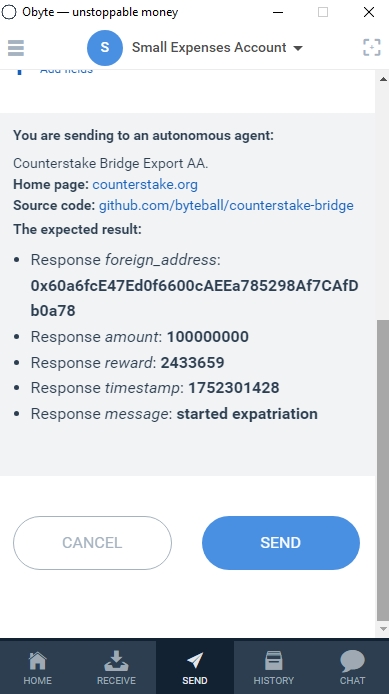
This level of transparency helps users avoid blind signing. Instead of trusting a vague prompt, you see the details laid out in a way that makes sense. You can approve the transaction with more confidence because you know what’s going to happen next.

Why It Pays to Read Before You Sign

Remember: signing is how you approve actions on a chain or network, from sending funds to using apps. But mistakes often happen not from hacks, but from signing too fast without checking the details. If you’re unsure what a wallet is asking, it’s smart to pause and review. Ask around, make a Google or AI search, and you’ll find out.

Platforms like Obyte help make this safer. They show clear previews of what will happen before you sign, so you’re not left guessing. With simple tools and transparent design, they make it easier to understand what you’re agreeing to—no technical background needed.

\


Featured Vector Image by vectorjuice / Freepik

\n

Market Opportunity
Threshold Logo
Threshold Price(T)
$0.006841
$0.006841$0.006841
-2.34%
USD
Threshold (T) Live Price Chart
Disclaimer: The articles reposted on this site are sourced from public platforms and are provided for informational purposes only. They do not necessarily reflect the views of MEXC. All rights remain with the original authors. If you believe any content infringes on third-party rights, please contact service@support.mexc.com for removal. MEXC makes no guarantees regarding the accuracy, completeness, or timeliness of the content and is not responsible for any actions taken based on the information provided. The content does not constitute financial, legal, or other professional advice, nor should it be considered a recommendation or endorsement by MEXC.

You May Also Like

Wormhole launches reserve tying protocol revenue to token

Wormhole launches reserve tying protocol revenue to token

The post Wormhole launches reserve tying protocol revenue to token appeared on BitcoinEthereumNews.com. Wormhole is changing how its W token works by creating a new reserve designed to hold value for the long term. Announced on Wednesday, the Wormhole Reserve will collect onchain and offchain revenues and other value generated across the protocol and its applications (including Portal) and accumulate them into W, locking the tokens within the reserve. The reserve is part of a broader update called W 2.0. Other changes include a 4% targeted base yield for tokenholders who stake and take part in governance. While staking rewards will vary, Wormhole said active users of ecosystem apps can earn boosted yields through features like Portal Earn. The team stressed that no new tokens are being minted; rewards come from existing supply and protocol revenues, keeping the cap fixed at 10 billion. Wormhole is also overhauling its token release schedule. Instead of releasing large amounts of W at once under the old “cliff” model, the network will shift to steady, bi-weekly unlocks starting October 3, 2025. The aim is to avoid sharp periods of selling pressure and create a more predictable environment for investors. Lockups for some groups, including validators and investors, will extend an additional six months, until October 2028. Core contributor tokens remain under longer contractual time locks. Wormhole launched in 2020 as a cross-chain bridge and now connects more than 40 blockchains. The W token powers governance and staking, with a capped supply of 10 billion. By redirecting fees and revenues into the new reserve, Wormhole is betting that its token can maintain value as demand for moving assets and data between chains grows. This is a developing story. This article was generated with the assistance of AI and reviewed by editor Jeffrey Albus before publication. Get the news in your inbox. Explore Blockworks newsletters: Source: https://blockworks.co/news/wormhole-launches-reserve
Share
BitcoinEthereumNews2025/09/18 01:55
Kalshi debuts ecosystem hub with Solana and Base

Kalshi debuts ecosystem hub with Solana and Base

The post Kalshi debuts ecosystem hub with Solana and Base appeared on BitcoinEthereumNews.com. Kalshi, the US-regulated prediction market exchange, rolled out a new program on Wednesday called KalshiEco Hub. The initiative, developed in partnership with Solana and Coinbase-backed Base, is designed to attract builders, traders, and content creators to a growing ecosystem around prediction markets. By combining its regulatory footing with crypto-native infrastructure, Kalshi said it is aiming to become a bridge between traditional finance and onchain innovation. The hub offers grants, technical assistance, and marketing support to selected projects. Kalshi also announced that it will support native deposits of Solana’s SOL token and USDC stablecoin, making it easier for users already active in crypto to participate directly. Early collaborators include Kalshinomics, a dashboard for market analytics, and Verso, which is building professional-grade tools for market discovery and execution. Other partners, such as Caddy, are exploring ways to expand retail-facing trading experiences. Kalshi’s move to embrace blockchain partnerships comes at a time when prediction markets are drawing fresh attention for their ability to capture sentiment around elections, economic policy, and cultural events. Competitor Polymarket recently acquired QCEX — a derivatives exchange with a CFTC license — to pave its way back into US operations under regulatory compliance. At the same time, platforms like PredictIt continue to push for a clearer regulatory footing. The legal terrain remains complex, with some states issuing cease-and-desist orders over whether these event contracts count as gambling, not finance. This is a developing story. This article was generated with the assistance of AI and reviewed by editor Jeffrey Albus before publication. Get the news in your inbox. Explore Blockworks newsletters: Source: https://blockworks.co/news/kalshi-ecosystem-hub-solana-base
Share
BitcoinEthereumNews2025/09/18 04:40
Optimizely Named a Leader in the 2026 Gartner® Magic Quadrant™ for Personalization Engines

Optimizely Named a Leader in the 2026 Gartner® Magic Quadrant™ for Personalization Engines

Company recognized as a Leader for the second consecutive year NEW YORK, Feb. 5, 2026 /PRNewswire/ — Optimizely, the leading digital experience platform (DXP) provider
Share
AI Journal2026/02/06 00:47