The post Can BTCfi Keep Miners Secure? appeared on BitcoinEthereumNews.com. Daily transaction fees on the Bitcoin network have collapsed by more than 80% since April, according to a report from Galaxy Digital. As of August 2025, nearly 15% of blocks are “free,” meaning they’re being mined with minimal or no transaction fees, just one satoshi per virtual byte or less. Lower Bitcoin (BTC) transaction fees benefit users but reduce miners’ revenue, raising concerns about the sustainability of the network’s long-term security model. Bitcoin’s incentive structure relies on miners being compensated for their work through block rewards and transaction fees. But with the April 2024 halving cutting rewards to 3.125 BTC per block, miners are leaning heavily on the fee market, and it’s drying up. “As block rewards shrink, more weight falls on transaction fees,” Pierre Samaties, chief business officer at the Dfinity Foundation, told Cointelegraph. “If usage does not grow, that base thins, and the guarantees weaken. Sustained throughput is essential for the system to defend itself.” Average Bitcoin transaction fees. Source: Galaxy Digital Related: Bitcoin 2025 builders predict DeFi will unseat traditional finance Bitcoin onchain activity slumps Bitcoin’s onchain activity has slowed significantly since the decline of non-monetary trends like Ordinals and Runes. Galaxy’s report notes that OP_RETURN transactions, used heavily during the 2024 Ordinals boom, now account for just 20% of daily volume, down from over 60% at their peak. Meanwhile, alternative layer 1s like Solana are gaining traction for high-frequency use cases like memecoins and NFTs. Furthermore, the rise of spot Bitcoin ETFs, which now hold over 1.3 million BTC, has pushed more BTC volume offchain, limiting movement that would otherwise generate fees. Bitcoin’s fee market is elastic by design, meaning that fees rise when demand surges and fall when activity slows. However, if demand continues to shrink, miners may be left with too little incentive to… The post Can BTCfi Keep Miners Secure? appeared on BitcoinEthereumNews.com. Daily transaction fees on the Bitcoin network have collapsed by more than 80% since April, according to a report from Galaxy Digital. As of August 2025, nearly 15% of blocks are “free,” meaning they’re being mined with minimal or no transaction fees, just one satoshi per virtual byte or less. Lower Bitcoin (BTC) transaction fees benefit users but reduce miners’ revenue, raising concerns about the sustainability of the network’s long-term security model. Bitcoin’s incentive structure relies on miners being compensated for their work through block rewards and transaction fees. But with the April 2024 halving cutting rewards to 3.125 BTC per block, miners are leaning heavily on the fee market, and it’s drying up. “As block rewards shrink, more weight falls on transaction fees,” Pierre Samaties, chief business officer at the Dfinity Foundation, told Cointelegraph. “If usage does not grow, that base thins, and the guarantees weaken. Sustained throughput is essential for the system to defend itself.” Average Bitcoin transaction fees. Source: Galaxy Digital Related: Bitcoin 2025 builders predict DeFi will unseat traditional finance Bitcoin onchain activity slumps Bitcoin’s onchain activity has slowed significantly since the decline of non-monetary trends like Ordinals and Runes. Galaxy’s report notes that OP_RETURN transactions, used heavily during the 2024 Ordinals boom, now account for just 20% of daily volume, down from over 60% at their peak. Meanwhile, alternative layer 1s like Solana are gaining traction for high-frequency use cases like memecoins and NFTs. Furthermore, the rise of spot Bitcoin ETFs, which now hold over 1.3 million BTC, has pushed more BTC volume offchain, limiting movement that would otherwise generate fees. Bitcoin’s fee market is elastic by design, meaning that fees rise when demand surges and fall when activity slows. However, if demand continues to shrink, miners may be left with too little incentive to…

Can BTCfi Keep Miners Secure?

3 min read

Daily transaction fees on the Bitcoin network have collapsed by more than 80% since April, according to a report from Galaxy Digital. As of August 2025, nearly 15% of blocks are “free,” meaning they’re being mined with minimal or no transaction fees, just one satoshi per virtual byte or less.

Lower Bitcoin (BTC) transaction fees benefit users but reduce miners’ revenue, raising concerns about the sustainability of the network’s long-term security model.

Bitcoin’s incentive structure relies on miners being compensated for their work through block rewards and transaction fees. But with the April 2024 halving cutting rewards to 3.125 BTC per block, miners are leaning heavily on the fee market, and it’s drying up.

“As block rewards shrink, more weight falls on transaction fees,” Pierre Samaties, chief business officer at the Dfinity Foundation, told Cointelegraph. “If usage does not grow, that base thins, and the guarantees weaken. Sustained throughput is essential for the system to defend itself.”

Average Bitcoin transaction fees. Source: Galaxy Digital

Related: Bitcoin 2025 builders predict DeFi will unseat traditional finance

Bitcoin onchain activity slumps

Bitcoin’s onchain activity has slowed significantly since the decline of non-monetary trends like Ordinals and Runes. Galaxy’s report notes that OP_RETURN transactions, used heavily during the 2024 Ordinals boom, now account for just 20% of daily volume, down from over 60% at their peak.

Meanwhile, alternative layer 1s like Solana are gaining traction for high-frequency use cases like memecoins and NFTs. Furthermore, the rise of spot Bitcoin ETFs, which now hold over 1.3 million BTC, has pushed more BTC volume offchain, limiting movement that would otherwise generate fees.

Bitcoin’s fee market is elastic by design, meaning that fees rise when demand surges and fall when activity slows. However, if demand continues to shrink, miners may be left with too little incentive to secure the network. Galaxy noted that nearly 50% of recent blocks haven’t been full, and mempool activity remains sluggish.

Rising free blocks on Bitcoin network. Source: Galaxy Digital

Against this backdrop, a new hope is emerging in the form of BTCfi, Bitcoin-native DeFi. Unlike DeFi on Ethereum or Solana, which uses smart contracts on those chains, BTCfi uses Bitcoin as the base asset while building financial applications like lending, trading and yield generation on layers or protocols that interact directly with the Bitcoin network.

“Every BTCfi action requires moving Bitcoin,” Samaties explained. “Movement drives computation, computation consumes block space, and space carries cost.” In other words, if BTCfi grows, so does onchain activity and fee revenue.

Related: The future of DeFi isn’t on Ethereum — it’s on Bitcoin

From digital gold to financial primitive

Samaties noted that Bitcoin has long been viewed as “digital gold,” a store of value more than a usable asset. However, he sees it evolving into something more foundational: a financial primitive.

“A financial primitive is a building block developers can use to design flows, tools, and logic,” he said. “In that role, Bitcoin becomes more than an asset to hold, it becomes a programmable component within broader financial systems.”

Julian Mezger, chief marketing officer of Liquidium, also said that infrastructure improvements are setting the stage for change. “The last five years have transformed Bitcoin’s infrastructure from a simple settlement layer into a multi-layered ecosystem,” he said. “We’re now seeing the foundations for true Bitcoin-native DeFi being laid.”

Magazine: Bitcoin is ‘funny internet money’ during a crisis: Tezos co-founder

Source: https://cointelegraph.com/news/bitcoin-fee-crisis-miners-btcfi-2025?utm_source=rss_feed&utm_medium=feed&utm_campaign=rss_partner_inbound


Market Opportunity
Bitcoin Logo
Bitcoin Price(BTC)
$65,236.74
$65,236.74$65,236.74
-3.35%
USD
Bitcoin (BTC) Live Price Chart
Disclaimer: The articles reposted on this site are sourced from public platforms and are provided for informational purposes only. They do not necessarily reflect the views of MEXC. All rights remain with the original authors. If you believe any content infringes on third-party rights, please contact service@support.mexc.com for removal. MEXC makes no guarantees regarding the accuracy, completeness, or timeliness of the content and is not responsible for any actions taken based on the information provided. The content does not constitute financial, legal, or other professional advice, nor should it be considered a recommendation or endorsement by MEXC.

You May Also Like

Once Upon a Farm Announces Pricing of Initial Public Offering

Once Upon a Farm Announces Pricing of Initial Public Offering

BERKELEY, Calif.–(BUSINESS WIRE)–Once Upon a Farm today announced the pricing of its initial public offering of 10,997,209 shares of its common stock, 7,631,537
Share
AI Journal2026/02/06 08:15
Forward Industries Bets Big on Solana With $4B Capital Plan

Forward Industries Bets Big on Solana With $4B Capital Plan

The firm has filed with the U.S. Securities and Exchange Commission to launch a $4 billion at-the-market (ATM) equity program, […] The post Forward Industries Bets Big on Solana With $4B Capital Plan appeared first on Coindoo.
Share
Coindoo2025/09/18 04:15
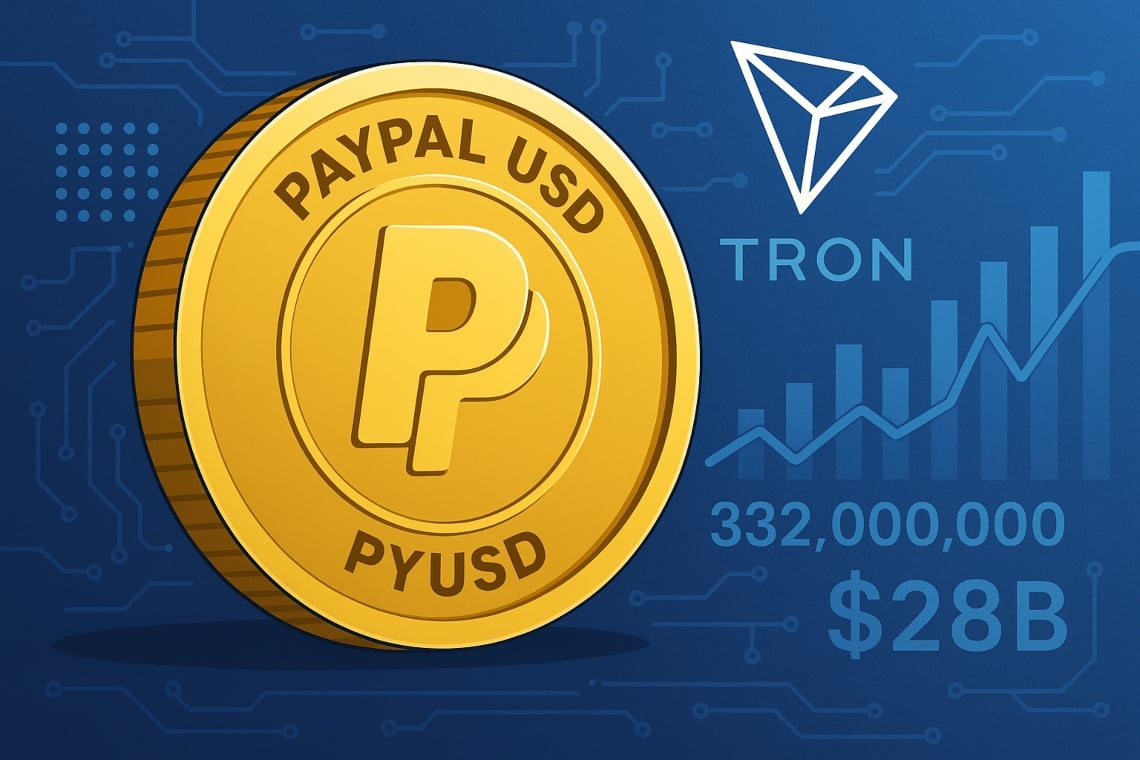
332M accounts and $28B TVL,

332M accounts and $28B TVL,

The post 332M accounts and $28B TVL, appeared on BitcoinEthereumNews.com. PayPal USD debuts on TRON as a permissionless token PYUSD0, enabled by LayerZero’s OFT standard and the Stargate Hydra extension. The announcement on September 18, 2025 (Geneva) introduces native interoperability between chains and transfers without manual steps for users; the news echoes elements already communicated by PayPal at the launch of PYUSD PayPal Newsroom. The move concerns an ecosystem that includes 332 million accounts and over $28 billion in TVL. In this context, the fungibility of a stablecoin regulated across multiple networks and the use of TRON as a settlement layer for payments and remittances is at stake. According to the data collected by TRONSCAN updated as of September 18, 2025, the network metrics confirm the cited volumes and highlighted traffic patterns. Our editorial team has verified the transaction logs and monitored the public chain metrics to corroborate the reported figures; the observations on daily flows and TVL are consistent with the network dashboards. Industry analysts observe that the entry of a regulated issuer like PayPal tends to increase institutional interest, provided there is transparency on reserves and compliance checks. What is PYUSD0 on TRON and why is it relevant PYUSD0 is the representation of PayPal USD on TRON. It is pegged one-to-one to PYUSD through the OFT standard: the two tokens remain a single stablecoin, fungible and reconciled across chains. The integration is made possible by Stargate Hydra, now operational through LayerZero. According to the founder of TRON, Justin Sun, the extension on TRON expands access and trust for users and institutions. For Bryan Pellegrino (CEO of LayerZero Labs), stablecoins represent a pillar of global payments and remittances, as the native compatibility between chains enables their operational scalability. It must be said that the alignment between issuer, cross-chain infrastructure, and settlement network is a key element. Key Numbers: TRON…
Share
BitcoinEthereumNews2025/09/19 08:18