

Sonic Labs Secures Community Approval for Historic $200M Traditional Finance Expansion

Sonic Labs has achieved a major milestone in blockchain-traditional finance integration after its community overwhelmingly approved a $200 million governance proposal designed to bridge decentralized and traditional financial markets.
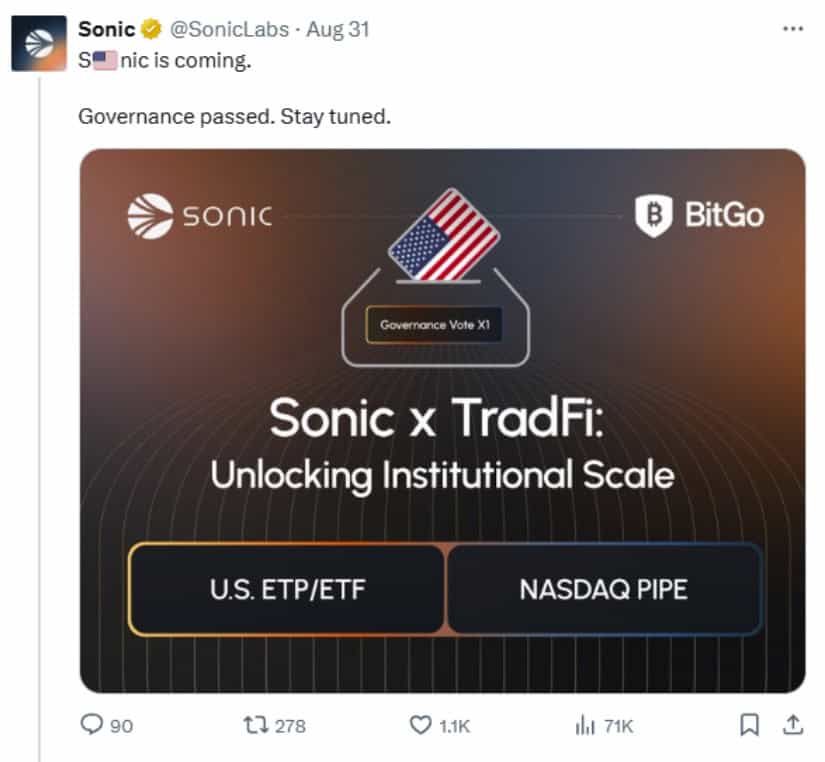
This unprecedented move positions Sonic Labs among the first major blockchain projects to actively pursue regulated financial products while maintaining decentralized governance structures. The approved plan allocates funds across three strategic initiatives: a Nasdaq-listed investment vehicle, an exchange-traded product, and establishing a dedicated U.S. entity.
Three-Pronged Financial Strategy
The $200 million allocation breaks down into specific components targeting different aspects of traditional finance integration. The largest portion, $100 million in S tokens, will fund a Nasdaq PIPE (Private Investment in Public Equity) vehicle designed to attract institutional capital.
Another $50 million will support an exchange-traded product that tracks S token performance. This ETP will be managed by a regulated provider with over $10 billion in assets under management, with BitGo handling custody services for the underlying assets.
Source: @SonicLabs
The remaining allocation of 150 million S tokens (approximately $47.7 million) will bootstrap Sonic USA LLC operations. This new entity will establish a New York office, hire a U.S.-based CEO and team, and lead regulatory engagement in Washington, D.C.
Addressing Historical Limitations
Sonic Labs inherited significant structural challenges from its predecessor, Fantom. Unlike many blockchain projects that retain 50% or more of their token supply for strategic initiatives, Sonic held less than 3% following its August 2024 rebrand from the Fantom Opera network.
This limited treasury allocation forced the company to purchase tokens on the open market rather than using reserves for partnerships or exchange listings. The team specifically cited missed opportunities with major platforms like GameStop, Robinhood, and Polymarket due to insufficient token availability.
“We have 2018 tokenomics. We need 2025 tokenomics,” Sonic Labs stated in their proposal, highlighting the need for updated economic models that can compete with modern blockchain projects.
Enhanced Tokenomics and Deflationary Mechanisms
To address dilution concerns from the new token issuance, Sonic Labs plans significant updates to its fee structure. The protocol will redirect a larger portion of transaction fees toward token burning, creating deflationary pressure to offset new supply.
These adjustments represent a technical but potentially impactful change to the network’s economics. The gas fee mechanism will allocate higher percentages to burning with each transaction, while dynamic mechanisms will maintain deflationary pressure during periods of increased network activity.
The burn rate will scale with network throughput—assuming one million daily transactions, the increased burn percentage could help counteract selling pressure from the new token allocation. However, the net impact depends on actual network usage and the specific implementation of these mechanisms.
Government Data Integration Partnership
Sonic Labs has secured participation in the U.S. Department of Commerce program for publishing economic data on-chain. This initiative leverages Chainlink and Pyth oracle services to make official U.S. macroeconomic statistics directly accessible to developers building on Sonic.
This integration enables sophisticated financial product development using official GDP, inflation, and consumption data for credit protocols, derivatives instruments, and risk management tools. Developers can now reference these statistics directly on-chain rather than relying on external websites.
Market Response and Performance
The S token has faced significant challenges since launching in December 2024, declining nearly 69% from its initial levels. Currently trading around $0.31 with a circulating supply of 3.2 billion tokens, the market response to the governance approval showed increased volatility and trading volume.
The Sonic mainnet launched with impressive technical specifications, offering over 10,000 transactions per second with sub-second finality. The platform’s Fee Monetization program rewards developers with up to 90% of network fees generated by their applications, creating direct revenue sharing opportunities.
Industry analysts view the proposal’s success as a test case for decentralized communities making high-stakes business decisions. The regulatory approval process for the planned ETF and Nasdaq listing will likely face significant scrutiny, with potential delays or requirements that could impact execution timelines.
Road Ahead
Sonic Labs’ $200 million traditional finance expansion represents a bold attempt to bridge decentralized and regulated financial markets. The overwhelming community support demonstrates confidence in this strategic direction, though the project’s success will ultimately depend on regulatory approval timelines and effective implementation of the proposed tokenomic changes.
You May Also Like

BFX Presale Raises $7.5M as Solana Holds $243 and Avalanche Eyes $1B Treasury — Best Cryptos to Buy in 2025
Moonshot MAGAX vs Shiba Inu: The AI-Powered Meme-to-Earn Revolution Challenging a Meme Coin Giant
