Syndicate to launch 1b SYND tokens this September
Application chain infrastructure Syndicate is preparing to release its native token SYND this month. Around 2% of the token supply had already been distributed via airdrop.
- Syndicate is preparing to launch its native token, SYND, into the market this September 2025.
- More than 50% of the tokens are allocated to the community, with 2% distributed through an airdrop event on August 15.
In a recent X post, the on-chain infrastructure network Syndicate announced that it will be launching its native token SYND. The token will be deployed on Ethereum (ETH), with more than 50% allocated for the community or approximately 501.2 million tokens.
This 50.12% does not include the initial 2% distributed through the airdrop event on August 15. The airdrop was meant to attract appchains, appchain users and developers, as well as ecosystem participants who may have been interested in building and staking on Syndicate.
Syndicate is known for granting developers the ability to create custom transaction sorting rules, empower protocols, and economic systems. This mechanism allows for value to flow directly back to their tokenized communities on-chain.
According to the whitepaper, or dubbed Litepaper in this network’s case, SYND will serve as a gas token for the network and its commons chain. It is also meant to be used for staking and network incentives, rewarding community members that utilize the token within the ecosystem.
“[SYND] puts real ownership and control of the network in the hands of the community via its Wyoming-based DUNA,” wrote the network in its recent post.
Although no specific launch date has been set yet, the tokens received through the airdrop event last August are non-transferable until the official token launch day.
Back in late August, Syndicate was launched; claiming itself as one of the “first decentralized networks to be built and launched in America.” This is due to the fact that it was formed under the Wyoming-based legal framework: Decentralized Unincorporated Nonprofit Association or DUNA.
The DUNA framework grants legal status to blockchain-based organizations or DAOs, allowing them to operate within the bounds of the law without needing to sacrifice their decentralized nature.
Syndicate gained recognition in web3 back in 2021 when it received $20 million in a Series A funding round led by major venture firm a16z, followed by other prominent firms like IDEO CoLab Ventures, Coinbase Ventures, Robot Ventures, Variant Fund, and Alliance DAO.
Syndicate’s SYND tokenomics
According to the Litepaper, SYND will be launched with a total supply of 1 billion token on the Ethereum mainnet. Approximately 92% had already been minted, while the remaining 8% will be minted automatically as emissions by the token contract.
The project’s structure allows for what it calls “emissions” in which the network will issue tokens every 30-day for a period of four years as a way to support the network’s growth and incentivize community participation. This means that 80 million tokens will be issued gradually during a four-year period.
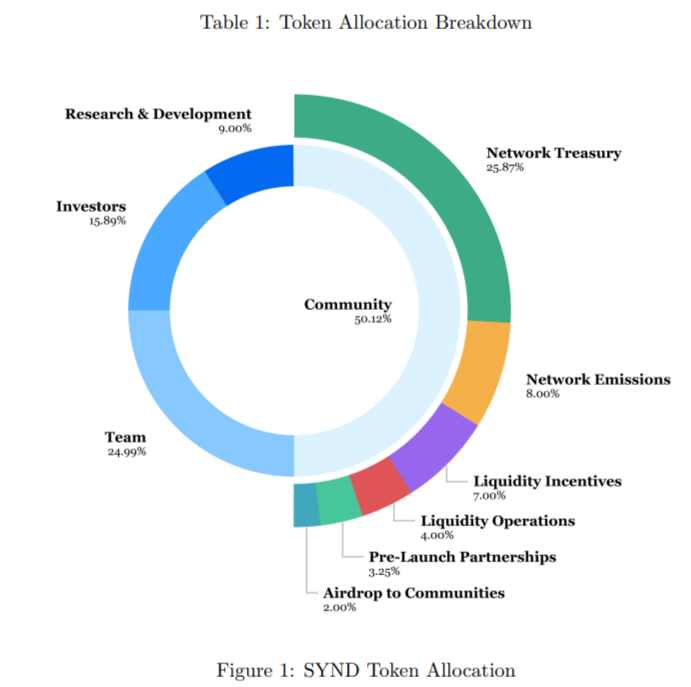
On the other hand, the community will receive 50.12% of the total token supply, not including the 2% allocated for its airdrop event. The Treasury will hold approximately 25.87% of the tokens, investors will get 15.89% of the supply, while the team behind the project will hold 24.99% of the total tokens.
All tokens allocated to team members will be subjected to a 48-month unlocking period with a year-long cliff. Investor tokens are subject to the same terms of unlocking.
You May Also Like

Cashing In On University Patents Means Giving Up On Our Innovation Future

XRP Ledger Unlocks Permissioned Domains With 91% Validator Backing