Why the Genesis Block Might be the Wrong Starting Point for Bitcoin Price Models
New analysis by trader Plan C argues that using the Genesis block as Bitcoin’s model origin point has produced two miscalibrations, and that switching to April 6, 2009 resolves both without any slope drift.
What the Model Comparison Actually Tests
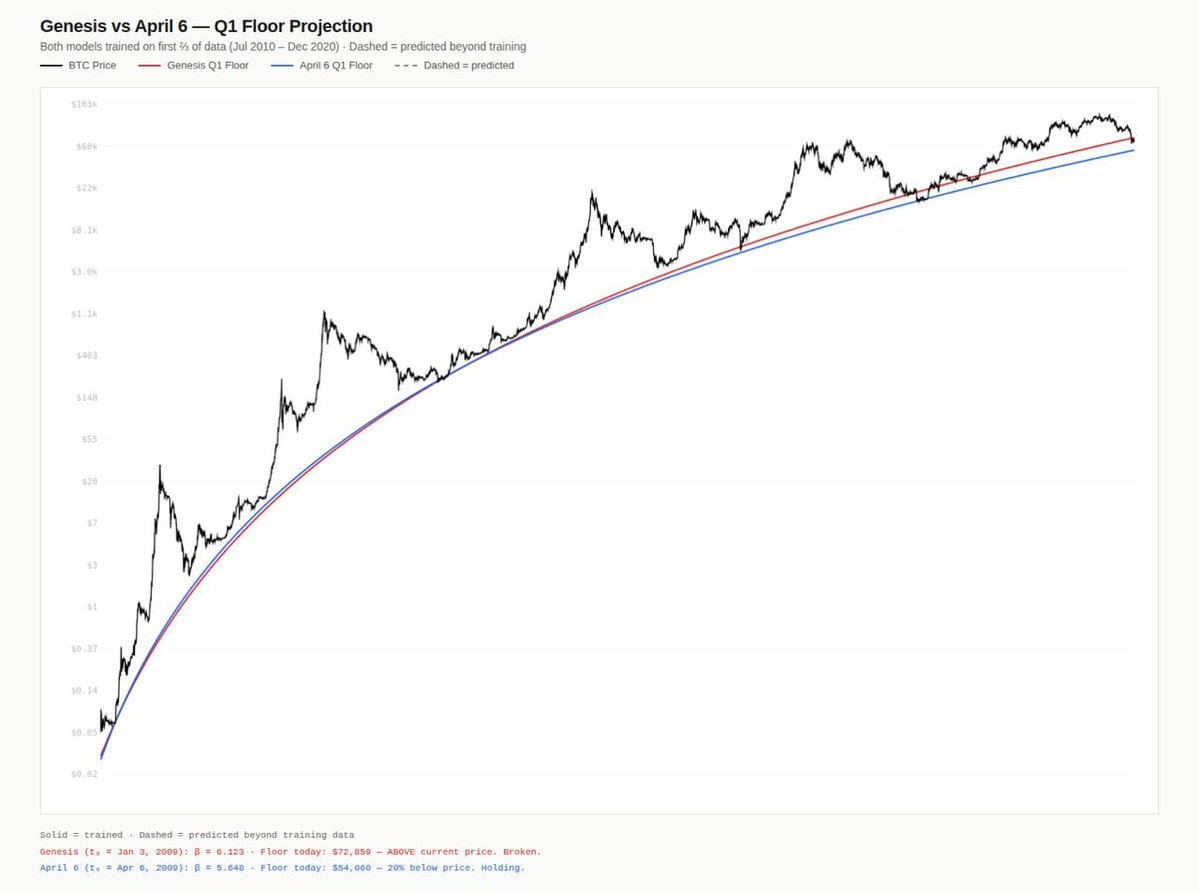
Plan C, the analyst behind this research, trained two separate quantile floor projection models on the first two-thirds of Bitcoin’s price history, from July 2010 through December 2020, then measured how accurately each model predicted the remaining one-third of the data. The only variable that differs between them is the start date. One model anchors to the Genesis block, January 3, 2009. The other anchors to April 6, 2009.
 Source: https://x.com/TheRealPlanC/status/2031241250586677287
The results are not close. The April 6 model nailed the FTX crash low, stayed completely stable throughout, and currently projects Bitcoin’s first quantile floor at approximately $55,000. The Genesis block model spent 12% of the time during the test period below its own first quantile, meaning it repeatedly predicted a floor that Bitcoin’s actual price broke through. To compensate, the model’s slope drifted down to approximately $59,000 before recalibrating.
That drift is the technical failure. A model that requires its slope to adjust after the fact is not predicting. It is following.
Why Start Dates Matter in Power Law Models
Bitcoin price models built on power law regression are highly sensitive to the anchor point because the entire curve extrapolates from it. Moving the start date by a few months on a logarithmic scale shifts every subsequent projection. The Genesis block is an intuitive starting point because it is Bitcoin’s literal beginning. But the Genesis block period includes months of zero price discovery and essentially no market activity, data points that introduce noise rather than signal into the regression.
April 6, 2009 represents a different kind of anchor, though Plan C does not specify precisely why that date produces superior results in the post. The implication is that it captures the beginning of meaningful network activity rather than the ceremonial launch, giving the model a cleaner foundation to extrapolate from.
The Two Failures and What They Mean
The Genesis block model failed during FTX. Bitcoin’s collapse to approximately $15,500 in November 2022 broke below the model’s predicted floor, which should have been a support level. A model floor that does not hold is not a floor.
The same model would have failed again during the current pullback from $100,000 toward $60,000 if the slope had not drifted downward to accommodate the breach. The drift is the model saving itself from a second public failure by quietly moving the goalposts. Plan C is pointing out that the goalpost movement is happening and that it indicates miscalibration rather than accuracy.
The April 6 model requires no such adjustment. It held during FTX, it held during the current correction, and its projected floor sits at $55,000 without any post-hoc slope correction.
What $55,000 as a Floor Actually Implies
Bitcoin currently trades around $67,000 to $69,000. A first quantile floor of $55,000 means the model considers prices below that level to represent the bottom 25% of historical Bitcoin valuations relative to its long-term growth curve. It is not a prediction that Bitcoin will fall to $55,000. It is a statement about where the model considers the lower bound of normal price behavior to sit.
Whether that boundary holds depends on whether Bitcoin’s long-term growth curve continues following the same power law trajectory it has traced since 2009. Every cycle has tested that assumption. So far it has held. The question the model raises without answering is whether the next test breaks it or confirms it again.
The post Why the Genesis Block Might be the Wrong Starting Point for Bitcoin Price Models appeared first on ETHNews.
You May Also Like

The Channel Factories We’ve Been Waiting For
Nvidia (NVDA) vs AMD: The Ultimate AI Stock Showdown for 2025