TLDR The S&P 500, Dow, and Nasdaq all fell for a third straight week, with oil above $100 a barrel driving inflation fears. Crude oil surged roughly 9% after MiddleTLDR The S&P 500, Dow, and Nasdaq all fell for a third straight week, with oil above $100 a barrel driving inflation fears. Crude oil surged roughly 9% after Middle

Weekly Recap: Oil Prices, Inflation Data, and Earnings — What Moved Markets This Week

2026/03/14 16:39
3 min read
For feedback or concerns regarding this content, please contact us at crypto.news@mexc.com

TLDR

  • The S&P 500, Dow, and Nasdaq all fell for a third straight week, with oil above $100 a barrel driving inflation fears.
  • Crude oil surged roughly 9% after Middle East tensions disrupted flows through the Strait of Hormuz.
  • Oracle beat earnings estimates with over 20% revenue growth, powered by AI and cloud demand.
  • Gold dipped about 1% despite geopolitical risk, as a stronger dollar limited safe-haven buying.
  • Energy stocks were the week’s big winner, while consumer staples and healthcare fell 4–5%.

U.S. stocks dropped for a third week in a row as oil prices climbed above $100 a barrel and fresh Middle East tensions rattled investors. All three major indexes ended lower for the week ending March 13, 2026.

The S&P 500 fell about 1.6%, the Dow lost around 2%, and the Nasdaq slipped roughly 1.3%. Small caps also declined, with the Russell 2000 down about 1.8%.
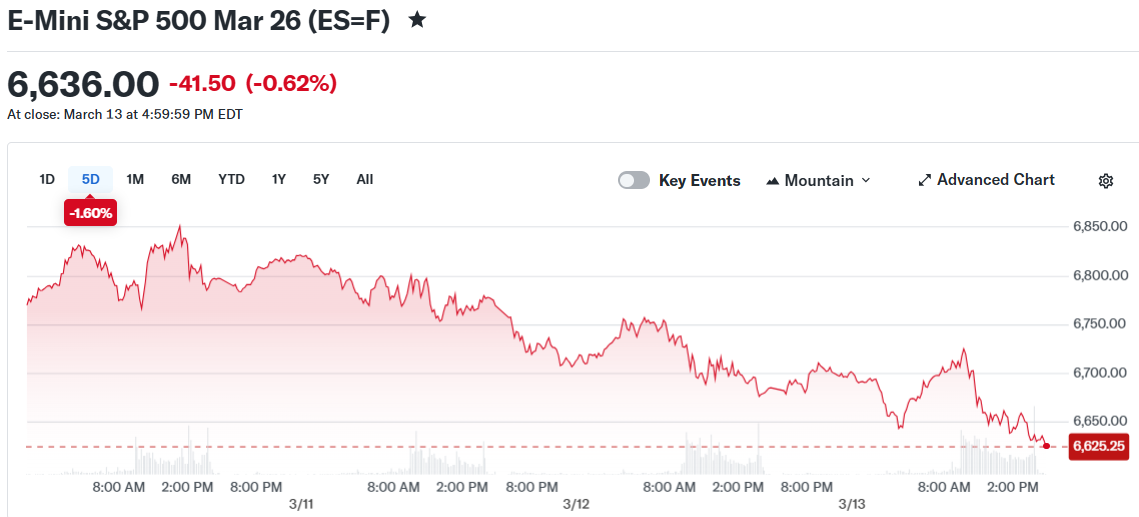
E-Mini S&P 500 Mar 26 (ES=F)E-Mini S&P 500 Mar 26 (ES=F)

The biggest story was oil. Crude surged roughly 9% after conflict involving the U.S., Israel, and Iran disrupted shipping through the Strait of Hormuz. Analysts called it one of the sharpest weekly jumps in oil futures since the 1980s.

Higher oil prices brought inflation worries back to the front. Producer price data came in slightly above expectations, raising concerns that costs could filter through to consumers in the weeks ahead.

That put the Federal Reserve in a tough spot. Markets still expect rate cuts later this year, but the timing is now less certain as energy-driven inflation complicates the picture.

Oracle Stands Out in Earnings Week

Oracle was the week’s standout earnings report. The company posted fiscal Q3 results above expectations, with total revenue growing more than 20% and AI infrastructure sales showing triple-digit growth.

Management also issued strong guidance, projecting high-teens revenue growth into fiscal 2027. The stock jumped in after-hours trading but ended the week roughly flat as investors weighed the outlook against a price already more than 50% below last year’s highs.

Campbell Soup told a different story. The company slightly beat on adjusted earnings but issued cautious 2026 guidance that fell short of expectations, sending shares lower.

Energy and industrial names bucked the broader trend, with several mid-cap companies reporting solid results tied to stronger demand and export opportunities.

Gold Falls, Energy Stocks Rise

Gold briefly climbed back above $5,100 per ounce on Friday but still finished the week down about 1%. A stronger dollar and fading rate-cut hopes offset demand for safe-haven assets.

Energy stocks were the clear winners. Major U.S. energy funds gained 2–3% for the week. Marathon Petroleum and other refiners rose in the high single digits as investors bet on stronger profit margins from higher oil prices.

Consumer staples and healthcare were among the weakest sectors, each falling 4–5%. Investors rotated away from those groups as input costs rose and earnings risk increased.

Financials also lagged, pressured by headlines around private-credit exposures at major institutions. Tech was slightly negative overall, though large-cap names held up better than smaller software stocks.

The Cboe Volatility Index rose from late February levels as investors paid more for downside protection, reflecting the more cautious mood heading into next week.

The post Weekly Recap: Oil Prices, Inflation Data, and Earnings — What Moved Markets This Week appeared first on CoinCentral.

Market Opportunity
Cloud Logo
Cloud Price(CLOUD)
$0.0374
$0.0374$0.0374
-0.08%
USD
Cloud (CLOUD) Live Price Chart
Disclaimer: The articles reposted on this site are sourced from public platforms and are provided for informational purposes only. They do not necessarily reflect the views of MEXC. All rights remain with the original authors. If you believe any content infringes on third-party rights, please contact crypto.news@mexc.com for removal. MEXC makes no guarantees regarding the accuracy, completeness, or timeliness of the content and is not responsible for any actions taken based on the information provided. The content does not constitute financial, legal, or other professional advice, nor should it be considered a recommendation or endorsement by MEXC.

You May Also Like

Aave DAO to Shut Down 50% of L2s While Doubling Down on GHO

Aave DAO to Shut Down 50% of L2s While Doubling Down on GHO

The post Aave DAO to Shut Down 50% of L2s While Doubling Down on GHO appeared on BitcoinEthereumNews.com. Aave DAO is gearing up for a significant overhaul by shutting down over 50% of underperforming L2 instances. It is also restructuring its governance framework and deploying over $100 million to boost GHO. This could be a pivotal moment that propels Aave back to the forefront of on-chain lending or sparks unprecedented controversy within the DeFi community. Sponsored Sponsored ACI Proposes Shutting Down 50% of L2s The “State of the Union” report by the Aave Chan Initiative (ACI) paints a candid picture. After a turbulent period in the DeFi market and internal challenges, Aave (AAVE) now leads in key metrics: TVL, revenue, market share, and borrowing volume. Aave’s annual revenue of $130 million surpasses the combined cash reserves of its competitors. Tokenomics improvements and the AAVE token buyback program have also contributed to the ecosystem’s growth. Aave global metrics. Source: Aave However, the ACI’s report also highlights several pain points. First, regarding the Layer-2 (L2) strategy. While Aave’s L2 strategy was once a key driver of success, it is no longer fit for purpose. Over half of Aave’s instances on L2s and alt-L1s are not economically viable. Based on year-to-date data, over 86.6% of Aave’s revenue comes from the mainnet, indicating that everything else is a side quest. On this basis, ACI proposes closing underperforming networks. The DAO should invest in key networks with significant differentiators. Second, ACI is pushing for a complete overhaul of the “friendly fork” framework, as most have been unimpressive regarding TVL and revenue. In some cases, attackers have exploited them to Aave’s detriment, as seen with Spark. Sponsored Sponsored “The friendly fork model had a good intention but bad execution where the DAO was too friendly towards these forks, allowing the DAO only little upside,” the report states. Third, the instance model, once a smart…
Share
BitcoinEthereumNews2025/09/18 02:28
Pi Network Community Leadership Program Opens Doors for New GCV Ambassadors

Pi Network Community Leadership Program Opens Doors for New GCV Ambassadors

    The Pi Network community is entering another stage of organizational development as new opportunities emerge for p

Share
Hokanews2026/03/15 22:16
U.S. Congressman Tells Senate to Pass House Crypto Bill or Step Aside – Inside the Clarity Act Standoff

U.S. Congressman Tells Senate to Pass House Crypto Bill or Step Aside – Inside the Clarity Act Standoff

Key Takeaways: Rep. French Hill is pushing the Senate to adopt the House-passed Clarity Act to break the stablecoin deadlock […] The post U.S. Congressman Tells
Share
Coindoo2026/03/15 22:15
