TLDR Solana’s SuperTrend indicator flipped bullish on March 13 for the first time since early January. SOL has dropped roughly 67% from its September 2025 peak,TLDR Solana’s SuperTrend indicator flipped bullish on March 13 for the first time since early January. SOL has dropped roughly 67% from its September 2025 peak,

Solana (SOL) Price: Grayscale Makes the Bull Case as SuperTrend Indicator Turns Bullish

2026/03/15 16:26
3 min read
For feedback or concerns regarding this content, please contact us at crypto.news@mexc.com

TLDR

  • Solana’s SuperTrend indicator flipped bullish on March 13 for the first time since early January.
  • SOL has dropped roughly 67% from its September 2025 peak, with the current price around $88–89.
  • Weekly technicals remain bearish, with 15 of 17 indicators signaling a sell.
  • Grayscale’s head of research flagged SOL as a potential buy at its current discount.
  • Solana Spot ETF cumulative inflows have reached $961–$968 million, with weekly inflows slowing sharply.

Solana (SOL) has flashed its first bullish technical signal in roughly two months, even as the broader chart picture remains firmly in bear territory. The development has drawn attention from analysts and institutional researchers alike.
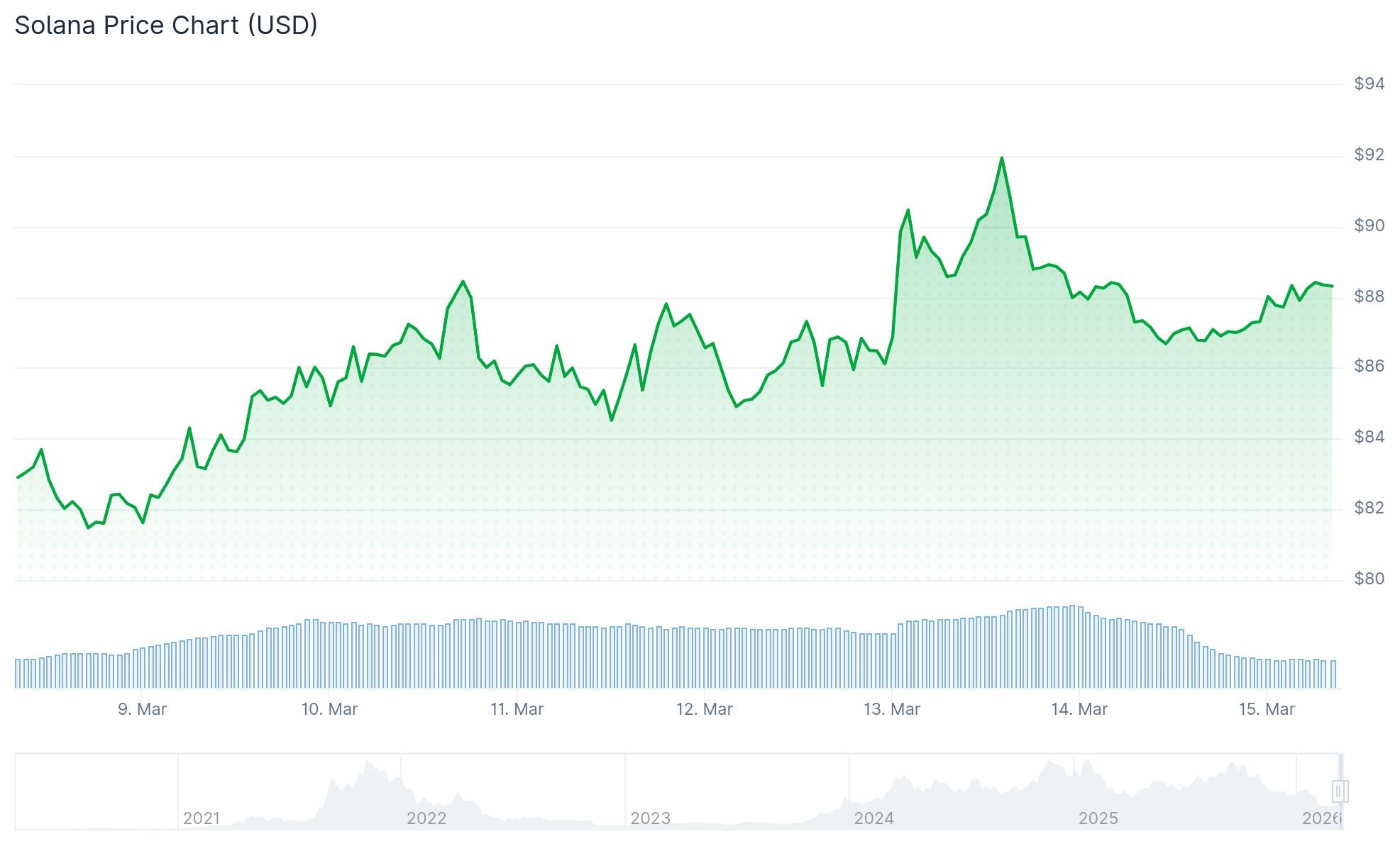
Solana (SOL) PriceSolana (SOL) Price

After peaking above $240 in late 2025, SOL entered a long, painful decline. The asset fell through major support levels one by one, eventually finding a floor in the $67–$80 range in early 2026.

Over the past four weeks, Solana has traded in a range between $76 and $90. It briefly pushed above $90 twice in March, with the latest attempt coinciding with the SuperTrend buy signal on the daily chart.

What the SuperTrend Signal Means

The SuperTrend indicator is a technical tool that tracks market trend direction using price and volatility data. Analyst Ali Martinez flagged the bullish flip on March 13 via X.

This is the first bullish reading from the indicator since early January. A sell signal appeared in early February, around the time SOL dropped to $67.

The signal points to potential short-term momentum, but it does not confirm a sustained recovery. The indicator can produce false signals, and the broader technical picture complicates the picture.

On the weekly chart, TradingView’s summary shows 15 indicators pointing to a sell and only 2 to a buy. Every major moving average sits above the current price. The EMA10 is at $98.47, the SMA200 at $103.70, and the EMA200 at $119.62 — all flagging sell.

The RSI sits at 32.34, approaching but not yet confirming oversold territory. The MACD is printing negative at -23.70.

For a structural shift, analysts say SOL would need to reclaim the SMA200 at $103.70 as a minimum.

Grayscale and Institutional Interest

On March 13, Grayscale Head of Research Zach Pandl published a six-point investment case for SOL, pointing to the roughly 67% drawdown from September 2025 highs as a potential entry point.

Pandl cited Solana’s lead in users, transactions, and fees across smart contract platforms over the past year. He also referenced regulatory progress around stablecoins and tokenized assets as a potential tailwind.

Solana Spot ETF daily inflows on March 13 came in at $7.60 million, all from Bitwise’s BSOL. Cumulative net inflows across listed products now stand between $961 and $968 million, with total net assets around $824–$855 million.

That said, weekly ETF inflows have dropped sharply. Total inflows for the current week came in at $3.10 million — down 83% from the prior week.

SOL is currently trading at around $88.95, up 2.8% in the past 24 hours and 11.15% over 30 days. The asset’s total market cap sits at approximately $54.74 billion, ranking it seventh among all cryptocurrencies.

The post Solana (SOL) Price: Grayscale Makes the Bull Case as SuperTrend Indicator Turns Bullish appeared first on CoinCentral.

Market Opportunity
Solana Logo
Solana Price(SOL)
$87.9
$87.9$87.9
+1.32%
USD
Solana (SOL) Live Price Chart
Disclaimer: The articles reposted on this site are sourced from public platforms and are provided for informational purposes only. They do not necessarily reflect the views of MEXC. All rights remain with the original authors. If you believe any content infringes on third-party rights, please contact crypto.news@mexc.com for removal. MEXC makes no guarantees regarding the accuracy, completeness, or timeliness of the content and is not responsible for any actions taken based on the information provided. The content does not constitute financial, legal, or other professional advice, nor should it be considered a recommendation or endorsement by MEXC.

You May Also Like

The Channel Factories We’ve Been Waiting For
The Channel Factories We’ve Been Waiting For

The post The Channel Factories We’ve Been Waiting For appeared on BitcoinEthereumNews.com. Visions of future technology are often prescient about the broad strokes while flubbing the details. The tablets in “2001: A Space Odyssey” do indeed look like iPads, but you never see the astronauts paying for subscriptions or wasting hours on Candy Crush.  Channel factories are one vision that arose early in the history of the Lightning Network to address some challenges that Lightning has faced from the beginning. Despite having grown to become Bitcoin’s most successful layer-2 scaling solution, with instant and low-fee payments, Lightning’s scale is limited by its reliance on payment channels. Although Lightning shifts most transactions off-chain, each payment channel still requires an on-chain transaction to open and (usually) another to close. As adoption grows, pressure on the blockchain grows with it. The need for a more scalable approach to managing channels is clear. Channel factories were supposed to meet this need, but where are they? In 2025, subnetworks are emerging that revive the impetus of channel factories with some new details that vastly increase their potential. They are natively interoperable with Lightning and achieve greater scale by allowing a group of participants to open a shared multisig UTXO and create multiple bilateral channels, which reduces the number of on-chain transactions and improves capital efficiency. Achieving greater scale by reducing complexity, Ark and Spark perform the same function as traditional channel factories with new designs and additional capabilities based on shared UTXOs.  Channel Factories 101 Channel factories have been around since the inception of Lightning. A factory is a multiparty contract where multiple users (not just two, as in a Dryja-Poon channel) cooperatively lock funds in a single multisig UTXO. They can open, close and update channels off-chain without updating the blockchain for each operation. Only when participants leave or the factory dissolves is an on-chain transaction…
Share
BitcoinEthereumNews2025/09/18 00:09
Nvidia (NVDA) vs AMD: The Ultimate AI Stock Showdown for 2025
Nvidia (NVDA) vs AMD: The Ultimate AI Stock Showdown for 2025

Nvidia (NVDA) dominates AI chips with superior margins and ecosystem. AMD challenges but trails. Compare both stocks to determine your best AI investment. The post
Share
Blockonomi2026/03/15 19:42
New Research Paper: Why Ripple Will Never Abandon XRP

New Research Paper: Why Ripple Will Never Abandon XRP

Crypto researcher SMQKE has shared excerpts from an academic publication to support the argument that XRP will remain integral to Ripple Labs’ operation. In a post
Share
Timestabloid2026/03/15 19:02