The post Bitcoin stalls: U.S. policy uncertainty clouds BTC’s path beyond $124K appeared on BitcoinEthereumNews.com. Key Takeaways Why is Bitcoin under pressure? The U.S. EPU Index surged to 939.7, nine times above average, raising risks of 2–5% contraction across investments, jobs, and consumption. How does this cycle differ for BTC? Active Addresses kept falling despite record highs and ETF inflows, signaling investors now rely more on exchanges and institutional vehicles than on-chain activity. Bitcoin [BTC] has been struggling to reach a new high after trading up to $124,000, as capital inflows remain low. U.S. economic data suggested inflows could shrink further, raising the risk of weaker prices and volumes. Even so, sentiment across broader markets pointed to a different path for the asset. Policy stress weighs on Bitcoin The U.S. Economic Policy Uncertainty (EPU) Index, according to Alphractal, hit 939.7 on the 15th of September—its highest since 2020 during the COVID-19 pandemic. The EPU tracks how the market is performing and predicts key events such as recessions. Alphractal noted that a projected risk of 2–5% still looms. Drivers included tariff shocks, persistent inflation above 3%, and heated fiscal disputes in Washington. These pressures left risk assets like Bitcoin vulnerable to at least short-term declines. Source: Alphractal Crypto analyst Joao Wedson warned that “history always repeats itself,” referencing Bitcoin’s performance in January 2024 when the EPU surged to 1,024 and Bitcoin dropped 21% from $48,969 to $38,555. “This is nothing more than a social fractal that has repeated itself over the centuries.” Wedson added that this period may present a strong accumulation opportunity, stressing that such conditions are usually short-term. Will Bitcoin break the cycle curse? New market insights suggested that the current Bitcoin market cycle may differ from past cycles. Crypto analyst Darkforst noted that in previous bull runs, Bitcoin’s on-chain activity surged, with Active Addresses (AA) rising alongside price. This time appears different. While… The post Bitcoin stalls: U.S. policy uncertainty clouds BTC’s path beyond $124K appeared on BitcoinEthereumNews.com. Key Takeaways Why is Bitcoin under pressure? The U.S. EPU Index surged to 939.7, nine times above average, raising risks of 2–5% contraction across investments, jobs, and consumption. How does this cycle differ for BTC? Active Addresses kept falling despite record highs and ETF inflows, signaling investors now rely more on exchanges and institutional vehicles than on-chain activity. Bitcoin [BTC] has been struggling to reach a new high after trading up to $124,000, as capital inflows remain low. U.S. economic data suggested inflows could shrink further, raising the risk of weaker prices and volumes. Even so, sentiment across broader markets pointed to a different path for the asset. Policy stress weighs on Bitcoin The U.S. Economic Policy Uncertainty (EPU) Index, according to Alphractal, hit 939.7 on the 15th of September—its highest since 2020 during the COVID-19 pandemic. The EPU tracks how the market is performing and predicts key events such as recessions. Alphractal noted that a projected risk of 2–5% still looms. Drivers included tariff shocks, persistent inflation above 3%, and heated fiscal disputes in Washington. These pressures left risk assets like Bitcoin vulnerable to at least short-term declines. Source: Alphractal Crypto analyst Joao Wedson warned that “history always repeats itself,” referencing Bitcoin’s performance in January 2024 when the EPU surged to 1,024 and Bitcoin dropped 21% from $48,969 to $38,555. “This is nothing more than a social fractal that has repeated itself over the centuries.” Wedson added that this period may present a strong accumulation opportunity, stressing that such conditions are usually short-term. Will Bitcoin break the cycle curse? New market insights suggested that the current Bitcoin market cycle may differ from past cycles. Crypto analyst Darkforst noted that in previous bull runs, Bitcoin’s on-chain activity surged, with Active Addresses (AA) rising alongside price. This time appears different. While…

Bitcoin stalls: U.S. policy uncertainty clouds BTC’s path beyond $124K

3 min read

Key Takeaways

Why is Bitcoin under pressure?

The U.S. EPU Index surged to 939.7, nine times above average, raising risks of 2–5% contraction across investments, jobs, and consumption.

How does this cycle differ for BTC?

Active Addresses kept falling despite record highs and ETF inflows, signaling investors now rely more on exchanges and institutional vehicles than on-chain activity.


Bitcoin [BTC] has been struggling to reach a new high after trading up to $124,000, as capital inflows remain low.

U.S. economic data suggested inflows could shrink further, raising the risk of weaker prices and volumes. Even so, sentiment across broader markets pointed to a different path for the asset.

Policy stress weighs on Bitcoin

The U.S. Economic Policy Uncertainty (EPU) Index, according to Alphractal, hit 939.7 on the 15th of September—its highest since 2020 during the COVID-19 pandemic.

The EPU tracks how the market is performing and predicts key events such as recessions. Alphractal noted that a projected risk of 2–5% still looms.

Drivers included tariff shocks, persistent inflation above 3%, and heated fiscal disputes in Washington. These pressures left risk assets like Bitcoin vulnerable to at least short-term declines.

Source: Alphractal

Crypto analyst Joao Wedson warned that “history always repeats itself,” referencing Bitcoin’s performance in January 2024 when the EPU surged to 1,024 and Bitcoin dropped 21% from $48,969 to $38,555.

Wedson added that this period may present a strong accumulation opportunity, stressing that such conditions are usually short-term.

Will Bitcoin break the cycle curse?

New market insights suggested that the current Bitcoin market cycle may differ from past cycles.

Crypto analyst Darkforst noted that in previous bull runs, Bitcoin’s on-chain activity surged, with Active Addresses (AA) rising alongside price.

This time appears different. While Bitcoin has set new highs, AA has continued to decline.

Darkforst explained,

Source: X

He attributed this evolution to centralized exchanges (CEXs), which now provide extensive services that keep investors engaged on their platforms rather than on-chain.

The entry of institutional investors has also reshaped the market.

The launch of Bitcoin spot ETFs in 2024 gave speculators access to BTC without needing to manage wallets, transact on-chain, or worry about asset security.

AMBCrypto reviewed exchange activity and found that accumulation has been underway for six consecutive weeks, according to CoinGlass.

This week alone, investors scooped up $165 million worth of Bitcoin from the market.

Next: SEI bulls target $0.50 – First, THIS support level needs to hold

Source: https://ambcrypto.com/bitcoin-stalls-u-s-policy-uncertainty-clouds-btcs-path-beyond-124k/


Market Opportunity
Union Logo
Union Price(U)
$0.001567
$0.001567$0.001567
+0.25%
USD
Union (U) Live Price Chart
Disclaimer: The articles reposted on this site are sourced from public platforms and are provided for informational purposes only. They do not necessarily reflect the views of MEXC. All rights remain with the original authors. If you believe any content infringes on third-party rights, please contact service@support.mexc.com for removal. MEXC makes no guarantees regarding the accuracy, completeness, or timeliness of the content and is not responsible for any actions taken based on the information provided. The content does not constitute financial, legal, or other professional advice, nor should it be considered a recommendation or endorsement by MEXC.

You May Also Like

Once Upon a Farm Announces Pricing of Initial Public Offering

Once Upon a Farm Announces Pricing of Initial Public Offering

BERKELEY, Calif.–(BUSINESS WIRE)–Once Upon a Farm today announced the pricing of its initial public offering of 10,997,209 shares of its common stock, 7,631,537
Share
AI Journal2026/02/06 08:15
Forward Industries Bets Big on Solana With $4B Capital Plan

Forward Industries Bets Big on Solana With $4B Capital Plan

The firm has filed with the U.S. Securities and Exchange Commission to launch a $4 billion at-the-market (ATM) equity program, […] The post Forward Industries Bets Big on Solana With $4B Capital Plan appeared first on Coindoo.
Share
Coindoo2025/09/18 04:15
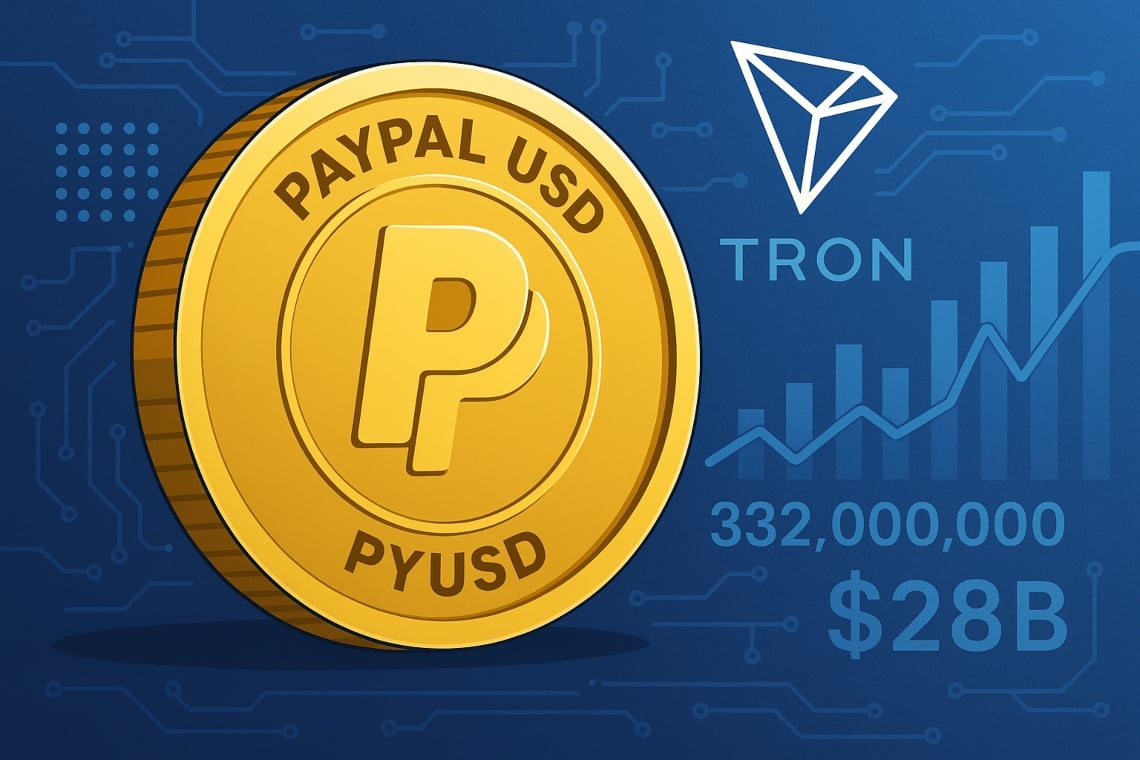
332M accounts and $28B TVL,

332M accounts and $28B TVL,

The post 332M accounts and $28B TVL, appeared on BitcoinEthereumNews.com. PayPal USD debuts on TRON as a permissionless token PYUSD0, enabled by LayerZero’s OFT standard and the Stargate Hydra extension. The announcement on September 18, 2025 (Geneva) introduces native interoperability between chains and transfers without manual steps for users; the news echoes elements already communicated by PayPal at the launch of PYUSD PayPal Newsroom. The move concerns an ecosystem that includes 332 million accounts and over $28 billion in TVL. In this context, the fungibility of a stablecoin regulated across multiple networks and the use of TRON as a settlement layer for payments and remittances is at stake. According to the data collected by TRONSCAN updated as of September 18, 2025, the network metrics confirm the cited volumes and highlighted traffic patterns. Our editorial team has verified the transaction logs and monitored the public chain metrics to corroborate the reported figures; the observations on daily flows and TVL are consistent with the network dashboards. Industry analysts observe that the entry of a regulated issuer like PayPal tends to increase institutional interest, provided there is transparency on reserves and compliance checks. What is PYUSD0 on TRON and why is it relevant PYUSD0 is the representation of PayPal USD on TRON. It is pegged one-to-one to PYUSD through the OFT standard: the two tokens remain a single stablecoin, fungible and reconciled across chains. The integration is made possible by Stargate Hydra, now operational through LayerZero. According to the founder of TRON, Justin Sun, the extension on TRON expands access and trust for users and institutions. For Bryan Pellegrino (CEO of LayerZero Labs), stablecoins represent a pillar of global payments and remittances, as the native compatibility between chains enables their operational scalability. It must be said that the alignment between issuer, cross-chain infrastructure, and settlement network is a key element. Key Numbers: TRON…
Share
BitcoinEthereumNews2025/09/19 08:18