

YORK Cooling Pod in Jeddah Signals Shift to Experiential CX
YORK Cooling Pod in Jeddah Turns Cooling into a Tangible Customer Experience
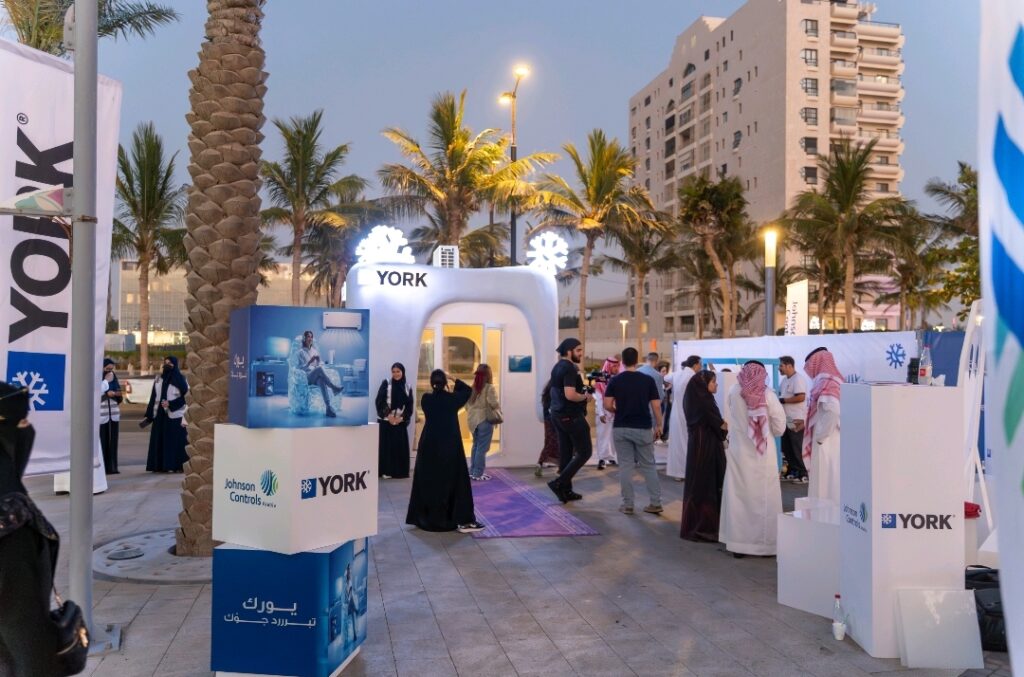
The launch of the YORK Cooling Pod in Jeddah represents a meaningful shift in how infrastructure technologies are evolving. Installed at a high-visibility public location along the Jeddah Corniche, the initiative moves beyond traditional product demonstrations by enabling people to physically experience cooling performance in real time.
In categories like HVAC, where performance is largely invisible and highly technical, this approach reframes engagement. Instead of interpreting specifications, users can directly feel the outcome. The YORK Cooling Pod in Jeddah transforms cooling from an abstract promise into a tangible, sensory experience—one that aligns with rising expectations for immediacy and proof.
This matters now because customer trust is increasingly building through validation rather than claims, especially in environments where performance has a direct impact on comfort and productivity.
Industry Context: From Technical Evaluation to Experiential Validation
Historically, cooling systems have an evaluat through engineering metrics—capacity, efficiency, and durability. While these remain important, they no longer suffice as standalone decision drivers.
Customers today—ranging from individual users to enterprise buyers—expect to understand how systems perform in real-world conditions. In regions like Saudi Arabia, where extreme temperatures make cooling mission-critical, the margin for error is minimal.
At the same time, the HVAC industry is navigating rising complexity. Sustainability regulations, energy optimization requirements, and large-scale urban development are increasing both expectations and scrutiny.
The YORK Cooling Pod in Jeddah addresses a fundamental gap in this environment: the disconnect between technical capability and customer understanding.
For CX leaders, this signals a broader evolution. Experience is becoming a key interface for translating complex systems into accessible value.
Strategic Layer: Positioning Through Experience-Led Differentiation
At a strategic level, the YORK Cooling Pod in Jeddah reflects a deliberate move toward experience-led positioning. Rather than relying solely on product features or brand legacy, the initiative focuses on how customers perceive and validate comfort.
This is not a defensive move—it is an offensive strategy aiming at differentiation. By bringing the experience into a public, accessible setting, Johnson Controls Arabia reduces the distance between product and perception.
Dr. Mohanad AlShaikh, CEO, highlights the intent to create something people can “feel,” underscoring the shift from communication to immersion.
The timing aligns with increased infrastructure investment and heightened customer scrutiny. As decision-makers demand more transparency, experience becomes a strategic tool for building credibility and trust.
Technology Layer: Translating HVAC Performance into Human Perception
The YORK Cooling Pod in Jeddah functions as a mobile, controlled micro-environment designed to simulate real-world cooling conditions. It integrates advanced HVAC systems optimized for high-temperature climates, ensuring consistent performance even under external heat stress.
Inside the pod, variables such as temperature, airflow, and humidity are precisely regulating. The result is a noticeable contrast between the interior environment and the external climate, allowing users to directly perceive system effectiveness.
Unlike traditional product demonstrations, which rely on visual displays or technical documentation, this approach uses sensory engagement as the primary interface.
The innovation lies less in the underlying technology and more in how it is presented. By making invisible systems perceptible, the YORK Cooling Pod in Jeddah redefines how value is communicated.
CX Impact: From Interpretation to Immediate Understanding
The YORK Cooling Pod in Jeddah fundamentally changes the customer journey by shifting it from interpretation to experience. Instead of analyzing data points, customers interact directly with outcomes.
This has several measurable effects on customer experience:
- Reduced cognitive load: Users no longer need to interpret technical specifications
- Faster decision-making: Direct experience accelerates understanding and evaluation
- Increased trust: Real-time validation strengthens confidence in performance claims
For enterprise buyers, the benefits extend further. The ability to demonstrate performance physically simplifies internal alignment among stakeholders who may not have technical expertise.
Additionally, the initiative reinforces perceptions of reliability. Consistent cooling in a controlled environment signals durability and effectiveness in real-world applications.
Industry Implications: Experiential Proof Becomes a Competitive Necessity
The emergence of the YORK Cooling Pod in Jeddah highlights a broader structural shift in how infrastructure solutions are marketed and evaluated.
As products become more complex and less visible, traditional communication methods lose effectiveness. Companies must find ways to make performance tangible.
This trend is likely to drive increased adoption of experiential formats across the industry, including mobile demonstration units, immersive environments, and simulation-based showcases.
Competitors will need to adapt by investing in similar approaches or risk being perceived as less transparent and less trustworthy.
The implication is clear: experiential validation is transitioning from a differentiator to a baseline expectation.
Future Outlook: Experience as a Core Component of CX Strategy
Looking ahead, the role of experience in customer journeys is expected to expand further. What begins as a standalone activation may evolve into a standard component of product engagement strategies.
Technologies such as digital twins, augmented environments, and real-time simulations could enhance how customers interact with infrastructure solutions before purchase.
The YORK Cooling Pod in Jeddah represents an early manifestation of this shift—one that aligns with broader trends toward customer-centric innovation and experiential engagement.
As expectations continue to rise, organizations that can both deliver and demonstrate value effectively will be better positioned to compete.
Key Takeaways
Experience is Becoming the Primary Validation Mechanism
Customers increasingly rely on direct interaction to assess performance. Organizations must design experiences that make complex systems understandable and credible.
Sensory Engagement Accelerates Decision Cycles
By reducing the need for interpretation, experiential validation shortens evaluation timelines and improves confidence across stakeholders.
Infrastructure Products Require Experience-Led Storytelling
Technical systems need intuitive narratives. Experience serves as a powerful medium for translating engineering into user value.
Public Activations Expand Customer Reach
Deploying experiences in accessible environments broadens engagement and enables interaction beyond traditional decision-makers.
Trust is Built Through Demonstration, Not Assertion
In high-impact categories, proof outweighs messaging. Experiential validation is becoming central to building long-term customer trust.
The post YORK Cooling Pod in Jeddah Signals Shift to Experiential CX appeared first on CX Quest.


Ayrıca Şunları da Beğenebilirsiniz

Powell’s inflation warning dampens rate cut expectations for June FOMC meeting: FT

Lawmaker Demands Polymarket Remove 219 War Bets After Airman Market Controversy – Bitcoin News




