

Delaware, New Jersey Advance Bills to Ban Crypto ATMs
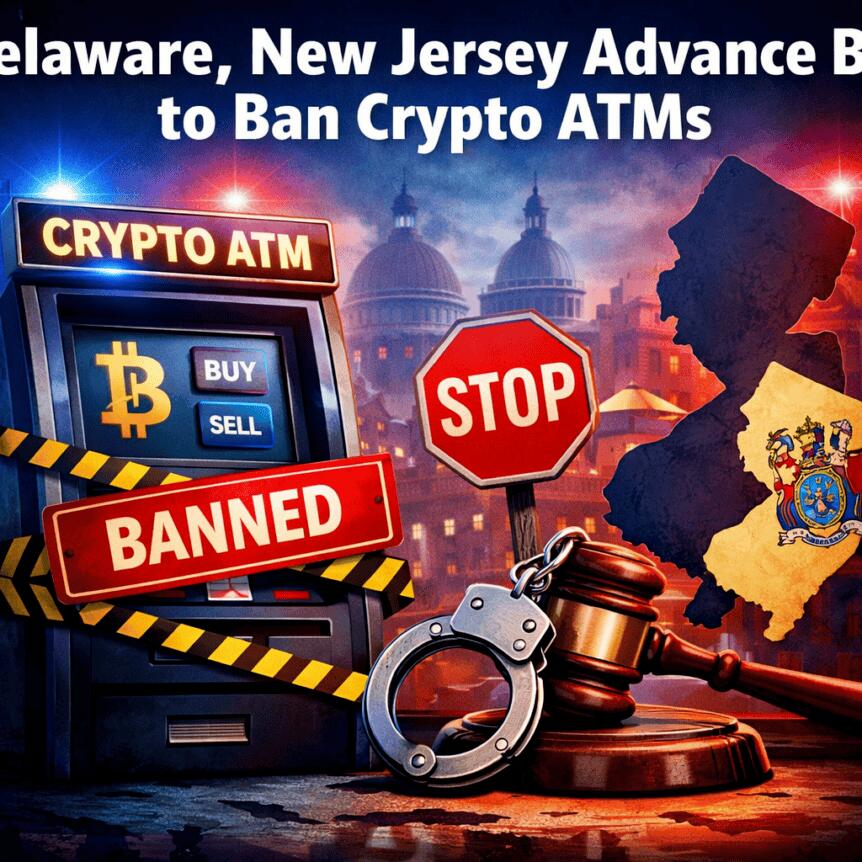
Delaware and New Jersey are moving to ban cryptocurrency ATMs, joining a widening set of U.S. states that have moved to curb kiosks amid concerns they are predominantly used for scams. The legislative pushes come as regulators increasingly scrutinize consumer protections, money-laundering risks, and the legitimacy of crypto service points beyond traditional exchanges.
The Delaware House Economic Committee on Tuesday advanced House Bill 441 to the full chamber, which would prohibit ownership, installation, or operation of a cryptocurrency kiosk within the state. In neighboring New Jersey, the Senate Commerce Committee voted unanimously to send its bill banning crypto ATMs to the full Senate floor, reflecting a bipartisan concern over the security and integrity of such devices.
Beyond Delaware and New Jersey, several states have already enacted total bans on crypto ATMs. Indiana was the first to do so in March, followed by Tennessee in April and Minnesota in May, as lawmakers cite a rising incidence of scams linked to the kiosks. The regulatory trend underscores a broader pattern of state-level risk mitigation around unregulated crypto access points.
The push to curb crypto kiosks is also supported by troubling enforcement data. The FBI’s IC3 center reported nearly 13,500 complaints related to crypto ATMs in 2025, totaling more than $388 million in losses—a 23% rise in complaints and a 58% increase in losses versus 2024. The demographic profile of victims has drawn particular concern, with more than half of the losses attributed to individuals aged over 50, underscoring protection gaps for older investors.
Delaware’s proponents frame the proposed restrictions as a consumer-protection measure. Representative Cyndie Romer, a sponsor of the bill, characterized crypto ATMs as a platform that “reduces digital currency to a predatory cash grab.” She argued that high transaction costs—regularly cited as well above typical exchange fees—create incentives for misuse and siphon funds from vulnerable populations. By design, she contends, such kiosks complicate oversight and enable predatory activity that online venues rarely justify through normal market structure.
The Delaware bill would extend beyond bans on kiosks to prohibit fiat-to-crypto sales that replicate or substitute ATM-like functionality through point-of-sale systems or similar cash-register mechanisms. It would also require the removal of any crypto ATMs from the state within 90 days after enactment. Penalties for violations could reach $10,000, and if a kiosk continues operating after an enforcement action, fee refunds to users must be issued or funds directed to a consumer-protection mechanism if users cannot be located.
New Jersey’s measure mirrors the objective of Delaware’s approach—prohibiting ownership, control, installation, management, and sale or offering to sell a crypto ATM due to a rise in related scams. The proposed penalties start at $10,000 for a first offense and escalate to $20,000 for subsequent offenses, signaling a tough regulatory stance aimed at deterrence and compliance clarity for operators.
Key takeaways
- Delaware’s HB 441 would ban owning, installing, or operating cryptocurrency kiosks and would bar fiat-to-crypto sales that function like ATMs, with a 90-day compliance window once enacted.
- New Jersey’s bill would prohibit the ownership, control, installation, management, or sale of crypto ATMs, introducing penalties of up to $10,000 for a first offense and up to $20,000 for later offenses.
- The moves reflect a broader U.S. regulatory wave, with Indiana, Tennessee, and Minnesota already enacting total bans on crypto ATMs, and discussional momentum in other cities and states.
- Federal enforcement data indicate a significant scale of crypto ATM–related scams and losses, with 2025 seeing substantial year-over-year increases in both complaints and dollar losses, highlighting consumer-protection imperatives for policymakers.
- Industry operators argue the kiosks are not inherently culpable for scams and point to on-screen warnings and safeguards, while some operators have faced financial restructurings amid regulatory pressure.
Regulatory trajectory in Delaware and New Jersey
Delaware’s proposal targets the core functions of crypto kiosks: ownership, installation, and operation. By banishing fiat-to-crypto flows that imitate ATM activity and mandating rapid removal of kiosks, the bill seeks to close what its sponsors view as a consumer-exposure gap. The 90-day removal period provides a defined transition window for businesses to unwind existing deployments, while the penalties are designed to deter noncompliance. The scope of the bill suggests a comprehensive approach to kiosk-based crypto access that regulators fear could be exploited for illicit activity or to target susceptible populations.
New Jersey’s bill adopts a parallel rationale, anchoring the ban in a stated concern over “a significant rise in scams associated with their use.” The escalating penalties reflect an intent to push operators toward discontinuation or relocation of services, with limited tolerance for repeated violations. The public policy question centers on balancing consumer protection with innovation in financial services and whether alternative, regulated channels could provide safer access to digital assets.
Both state proposals emphasize enforcement mechanisms and consumer redress: in Delaware, violations could trigger fines up to $10,000, and there is an explicit provision for refunding user fees or contributing to a consumer-protection fund if user identification is not feasible. These elements illustrate a broader regulatory pattern that prioritizes restitution and deterrence as part of crypto-related consumer protections.
Federal and state enforcement context
The FBI’s IC3 reporting underscores the regulatory urgency behind these measures. In 2025, the agency documented roughly 13,500 crypto ATM–related complaints and more than $388 million in losses, marking a notable rise in both activity and impact. The data also show a disproportionate impact on older adults, reinforcing concerns that targeted protections are warranted for vulnerable consumer groups. The FBI’s findings contribute to an evidentiary basis for state lawmakers arguing that existing oversight is insufficient to prevent scams and protect retail investors.
State-level responses vary, with Indiana, Tennessee, and Minnesota having enacted outright bans as a response to the scam prevalence. Some municipalities have explored or implemented ordinances, while others have placed caps on transaction sizes in certain jurisdictions. This mosaic of approaches highlights a regulatory divergence in the United States—one that regulators and industry participants are likely to monitor closely as KYC/AML expectations evolve and as banks and payment rails grapple with crypto-related compliance requirements.
Industry voices have framed the bans as an overreach or a misattribution of responsibility. Bitcoin Depot, previously the largest operator with more than 9,000 kiosks, cited regulatory pressure as a major factor in its bankruptcy filing last month. Operators have historically argued that they are not responsible for the actions of third-party scammers, pointing to on-screen warnings, transaction-limits, and other safeguards as part of a layered defense. The tension between consumer protection objectives and the operational viability of crypto kiosks remains a central policy question as the regulatory framework hardens.
The landscape is further shaped by cross-border considerations and broader regulatory dialogue. While U.S. states pursue prohibitions or restrictions on on-site kiosks, other jurisdictions—such as Canada—have considered bans in response to scams and money-laundering concerns. The divergent regulatory approaches reflect a global pattern where policymakers weigh access and innovation against risk mitigation and market integrity. For market participants and compliance teams, the key question is how to align product design, KYC/AML controls, consumer disclosures, and incident response with a shifting patchwork of state and national rules.
An additional facet of the debate concerns the responsibility of kiosk operators in a digital-asset economy that increasingly relies on regulated, banked rails. Proponents of bans argue that unregulated access points complicate enforcement and increase consumer exposure to loss. Opponents contend that effective regulation—rather than outright bans—could preserve consumer access while imposing robust anti-fraud controls. The ongoing policy debate will influence licensing requirements, oversight mechanisms, and the integration of stablecoins and other crypto products within mainstream financial systems.
As regulators weigh the next steps, the Delaware and New Jersey measures illustrate a disciplined approach to consumer protection and market integrity. The focus on clear prohibitions, defined timelines for compliance, and structured penalties signals a trend toward more predictable regulatory norms for crypto kiosks and similar access points across the United States.
Bitcoin and digital-asset firms, exchanges, and financial institutions will closely monitor the legislative developments, enforcement data, and operator responses to gauge risk, compliance costs, and potential shifts in consumer behavior. The evolving policy framework will likely influence future licensing regimes, AML/KYC standards, and cross-border coordination as policymakers seek to balance innovation with robust guardrails.
Looking ahead, observers should watch how these bills fare in their respective chambers, how regulators assess the effectiveness of existing safeguards, and whether alternative regulatory models—such as licensing, disclosure requirements, or transaction-limits—emerge as viable middle-ground options. The interplay between state-level bans and federal enforcement priorities will shape the regulatory trajectory for crypto access points in the United States over the coming years.
Closing perspective: As states refine their approaches to crypto kiosks, the core questions revolve around protection, accountability, and the operational viability of compliant access to digital assets. Regulatory clarity in the near term will be critical for assessing the future role of crypto ATMs within a governed financial ecosystem.
This article was originally published as Delaware, New Jersey Advance Bills to Ban Crypto ATMs on Crypto Breaking News – your trusted source for crypto news, Bitcoin news, and blockchain updates.


Ayrıca Şunları da Beğenebilirsiniz

RunRio supports GenSan earthquake relief with P1M donation

Egyptian foreign minister to meet Putin over Iran conflict

SpaceX IPO: How to Confirm Share Allocation


Popüler Haberler
Daha fazla
