

Constellation Energy Stock’s 431% Operating Income Jump Puts Operating Margins at a 2-Year High
Key Takeaways for Constellation Energy Stock
- Constellation Energy reported Q1 2026 revenue of $11.12 billion, up 64% year-over-year following its January acquisition of Calpine Corporation.
- Operating income reached $2.44 billion in Q1 2026, a 431% increase from the same quarter a year earlier.
- Operating margins expanded to 22% in Q1 2026, compared to 7% in Q1 2025, marking the sharpest quarterly margin recovery in the company’s post-spinoff history.
- TIKR’s model values Constellation Energy stock at approximately $508 by December 2030, implying around 90% total return from the current price.
Most investors never know if a stock is truly undervalued or overpriced. TIKR’s professional-grade valuation tools give you a clear, data-backed answer across 60,000+ stocks for free →
Constellation Energy Posts a 431% Operating Income Jump: Is the Market Still Underpricing the New Business?
 CEG Stock Q1 2026 Earnings in USD (TIKR)
Constellation Energy (CEG), the largest nuclear power operator in the United States, reported Q1 2026 adjusted operating earnings of $2.74 per share following its close of the $16 billion Calpine acquisition in January 2026.
The Calpine deal, which combined CEG’s zero-emission nuclear fleet with Calpine’s natural gas and geothermal assets transformed Constellation from a pure nuclear operator into the nation’s largest private-sector power producer with 55 gigawatts of capacity.
Revenue came in at $11.12 billion for the quarter.
That figure beat the Street estimate of $8.69 billion by a wide margin, with the growth driven almost entirely by the addition of Calpine assets to the consolidated income statement.
The company’s nuclear fleet generated 40 million megawatt-hours of zero-carbon electricity in the quarter, running at a capacity factor of 92%.
The combined cycle and cogeneration fleet contributed an additional 23 million megawatt-hours.
CEO Joe Dominguez stated on the Q1 earnings call: “Our long-term outlook is compelling. With a base earnings growth rate that exceeds 20% through 2029, anchored by highly visible drivers that include the nuclear production tax credit, which grows with inflation, long-term contracts with high-quality counterparties and durable customer margins.”
Constellation also repurchased approximately 1.2 million shares at an average price of roughly $285 per share during the quarter.
The company reaffirmed full-year 2026 adjusted operating earnings guidance of $11 to $12 per share and cited a hyperscaler demand pipeline growing nearly 75% year-over-year in projected capital spending by data center customers.
The Calpine integration is already showing up in the numbers — and the contracting pipeline with hyperscalers makes it structural. Dig into CEG’s capacity utilization and forward estimates on TIKR for free →
CEG’s Operating Margins Hit 22%: What Drove the Inflection and Whether It Holds
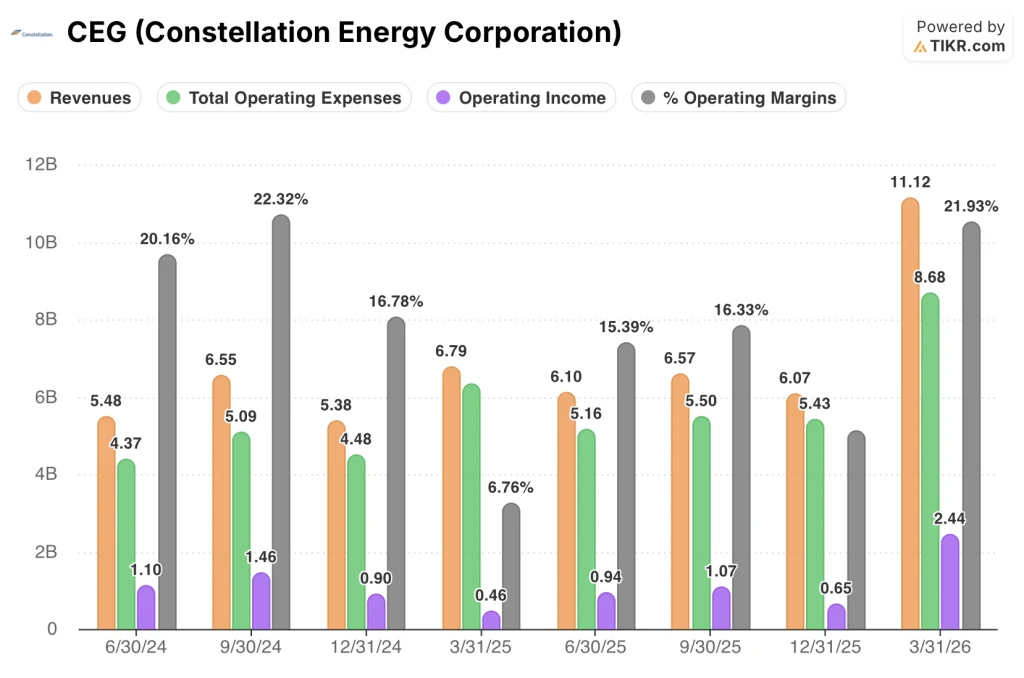 CEG Stock Quarterly Financials (TIKR)
Revenue reached $11.12 billion in Q1 2026, a 64% increase over the prior-year quarter.
Total operating expenses rose to $8.68 billion, absorbing the full cost structure of the newly acquired Calpine assets for the first time.
Operating income came in at $2.44 billion for the quarter.
That represents a 431% increase over the $0.46 billion posted in Q1 2025, when the business was still a standalone nuclear operator carrying a much lighter but less scalable cost base.
Operating margins reached 22% in Q1 2026.
That compares to a margin of just 7% in Q1 2025, a 15-point expansion driven by Calpine’s higher-revenue contribution landing on an operating cost structure that had not yet fully scaled to match it.
The Q1 2026 margin of 22% is the highest quarterly operating margin CEG has posted in this data series, matching the 22% printed in Q3 2024 before Calpine’s costs entered the income statement.
The question the income statement raises now is whether the new cost base, anchored by Calpine’s fuel and purchased power expenses of $6.35 billion in Q1, will sustain the 22% margin level or compress it as seasonal revenue normalizes.
CEG Sits Third on Operating Margins Behind NEE and VST, With NRG Trailing the Group at 4%
 CEG Stock Operating Margins vs NEE Stock, NRG Stock, and VST Stock (TIKR)
Constellation Energy posted a 22% operating margin in Q1 2026, outpacing NRG Energy (NRG) at 4% and Vistra at 27% in the same quarter.
Meanwhile, NextEra Energy (NEE) held a 30% operating margin in Q1 2026, maintaining its lead over the peer group across every quarter in this data series.
CEG’s Q1 2026 margin of 22% marks a recovery from the 7% trough posted in Q1 2025, when the pre-Calpine cost structure carried nuclear overhead without the revenue scale to absorb it.
NRG has traded between 1% and 21% over the trailing eight quarters, the most volatile margin profile in the group, reflecting its retail-heavy business model and exposure to commodity cost timing.
Vistra (VST) reached 27% in Q1 2026 after printing 41% in Q3 2024, a compression that reflects the same post-peak normalization dynamic CEG is now navigating from the opposite direction.
Is Constellation Energy Stock Undervalued at $267? TIKR’s $508 Target Says the Gap Is Real
TIKR’s model values Constellation Energy at approximately $508 by December 2030, implying around 90% total return from the current price of $267, or roughly 15% per year.
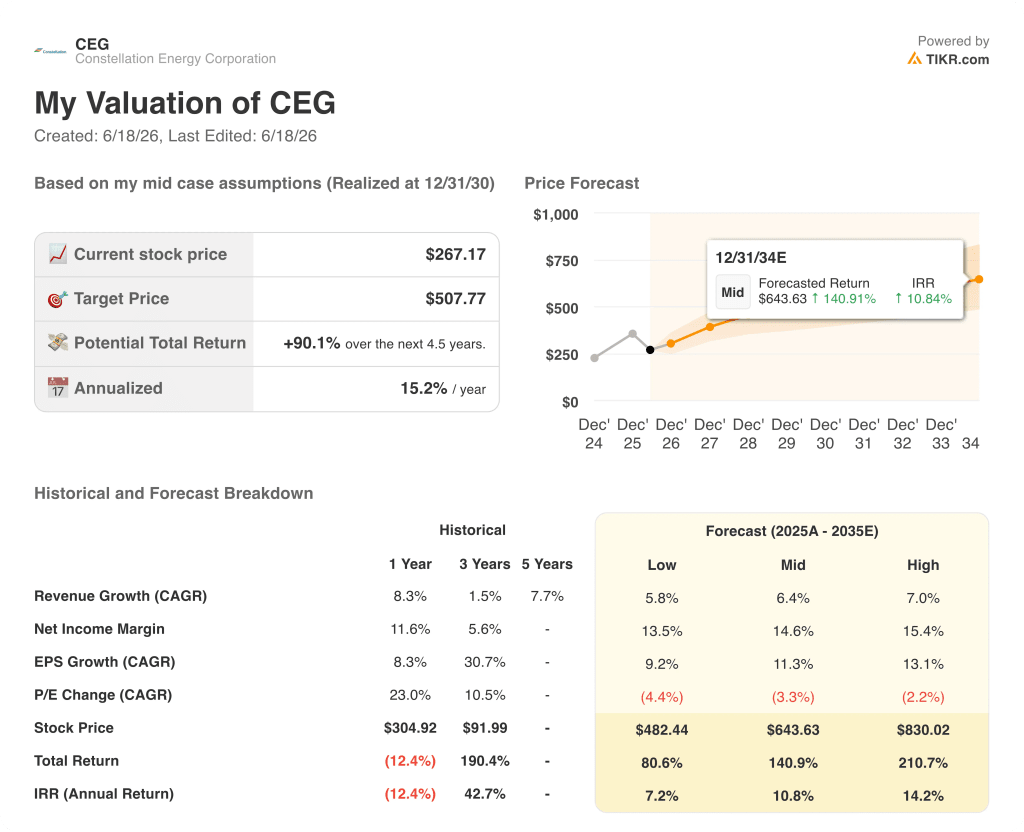 CEG Stock Valuation Model Results (TIKR)
The operating margin inflection already visible in Q1 2026 is the income statement mechanism that makes a target at that level reachable.
Constellation’s long-term guidance calls for base earnings growth exceeding 20% annually through 2029, anchored by the nuclear production tax credit, Calpine’s integrated cost structure, and a growing book of long-term data center contracts — exactly the operating leverage dynamic that Q1’s margin expansion began to demonstrate.
The condition the target depends on is that the 22% operating margin reached in Q1 2026 proves durable across seasonal and regulatory variation, not a peak driven by favorable revenue timing in the first post-Calpine quarter.
The TIKR model lays out exactly what Constellation needs to earn at each horizon to justify a $508 target. Run the numbers yourself on TIKR for free →
Should You Invest in Constellation Energy Corporation?
The only way to really know is to look at the numbers yourself. TIKR gives you free access to the same institutional-quality financial data that professional analysts use to answer exactly that question.
Pull up Constellation Energy Corporation stock and you’ll see years of historical financials, what Wall Street analysts expect for revenue and earnings in the quarters ahead, how valuation multiples have moved over time, and whether price targets are trending up or down.
You can build a free watchlist to track Constellation Energy Corporation alongside every other stock on your radar. No credit card required. Just the data you need to decide for yourself.
Access Professional Tools to Analyze CEG stock on TIKR for Free →
What Did Constellation Energy Say About Data Center Demand?
Dominguez said on the Q1 call that projected hyperscaler capital spending for 2026 is nearly 75% higher than the prior year, and Constellation has submitted approximately 5,000 megawatts of new capacity resources into PJM’s interconnection queue to capture that demand.


Ayrıca Şunları da Beğenebilirsiniz

Top Analyst Presents 3 Major Historical References for XRP Price Rally

Unleashing A New Era Of Seller Empowerment

Moody’s Assigns First-Ever Rating to Bitcoin-Backed Municipal Bond in Historic Crypto Finance Move


Popüler Haberler
Daha fazla
