👨🏿🚀TechCabal Daily – LemFi comes into Wealth
TGIFLM. 
As the Gregorian calendar will have it, it’s Friday—the best day of the week(end). I have no plans except to catch up on The Legend of Vox Machina season 4 and think about how to bring value to my shareholders and investors in the coming week and the coming half of the year.
—Zia
Get smarter about Francophone Africa with our newsletter, Francophone Weekly—the startups, tech policies, and institutions building the pipelines for ecosystem growth.
- Quick Fire
 with Sheriff Adedokun
 - LemFi acquires Wealth8
- South Africa proposes crypto tax rules
- Who secured the bag?

- World Wide Web 3
- Job Openings
features
Quick Fire with Sheriff Adedokun
 Image: Sheriff Adedokun, CEO, Clea
Sheriff Adedokun is an entrepreneur and software builder with over a decade of experience building and scaling technology businesses across Africa and international markets. He started in 2013 with Hostmeng, a software development and web services company that grew to a six-figure annual revenue in USD.
- Explain your job to a five-year-old.
I help people send money safely to other countries. Sometimes, people in Africa want to buy cars, machines, or other goods from abroad, but paying the seller can be hard, slow, and stressful.
Clea helps make that payment easier. It lets users put in their money, convert it to the right foreign currency, and send it safely to the person they are buying from.
My job is to make sure the payment goes through correctly, that customers know what is happening, and that the money reaches the right place.
- Most founders spend years focused on one company. You’ve built several. What keeps pulling you back into starting things?
I would say curiosity, frustration, and belief.
Curiosity, because I am always asking why things work the way they do. Why is this process so slow? Why is this market underserved? Why are people still doing this manually? Why has nobody made this easier? Once I start asking those questions, I naturally begin to imagine a better version of that experience.
Frustration is another big driver. Many of the companies I have built started because I personally experienced a problem or saw people around me struggling with it.
Then there is belief. I believe technology can unlock opportunities for people who are often overlooked. I have built for creators, small businesses, agencies, marketers, car importers, and African businesses trying to transact globally.
- How do you decide whether an idea deserves its own company or should simply become a feature inside an existing business?
For me, the first question is whether the problem has its own customer, urgency, and market.
A feature improves an existing product. It makes customers more successful or more likely to stay. A company is different. It solves a painful problem that people actively seek a solution for, are willing to pay for, and will change their behaviour around.
I ask: Who is the customer? How often do they feel the pain? Are they already paying for a poor workaround? Can this become a standalone workflow with its own brand, pricing, and distribution?
In Clea, adding a new payout currency or supplier category is a feature because it strengthens the core mission of helping African importers pay global suppliers faster and more reliably.
Modern Rails for Africa’s Economy: How Fincra is helping businesses collect, pay out, convert, and settle across African markets. Read more here.
companies
LemFi started by helping people send money home. Now it wants to help them invest it
 Image: Zikoko Memes
There’s a familiar arc for African immigrants in the United Kingdom. You arrive. You find your footing. You send money home every month. And then, eventually, you wonder: Is there a smarter thing I could be doing with what’s left over?
LemFi, a fintech that lets users receive, send, and manage money, has spent four years building a platform around the first three steps. It has now acquiredWealth8, a wealth and investment platform, to help with the last one.
The UK’s Financial Conduct Authority (FCA) has approved LemFi’s acquisition of Wealth8, a platform built for communities that mainstream wealth managers have largely overlooked. Wealth8 offers diversified investment portfolios with minimums as low as £8 ($10). Those products will now become available to LemFi’s more than two million customers across the UK, Europe, North America, and Australia.
Explain like I’m new here: Sending money is a useful service, but it’s also a difficult business to build a lasting moat around. Fees keep falling, competition keeps growing, and customers only remit when they have money to send. Investments solve a different problem. They keep customers engaged long after the transfer is complete and open the door to products with higher margins and longer relationships. If remittances help customers support their families today, investing helps them build wealth for tomorrow.
Why this matters: TheRunnymede Trust’s Colour of Money report found that for every £1 ($1.3) of wealth held by white British households, Black African and Bangladeshi households hold just 10p ($0.13), Black Caribbean households 20p ($0.27), and Pakistani households 50p ($0.67). Much of that gap reflects differences in asset ownership rather than income alone. For immigrant families balancing finances across two countries, building wealth often takes a back seat to moving money.
LemFi has been seeking to do more than remittances for a while now. In June 2025, LemFi acquired Pillar, a UK-based credit card company. In October, it launched a “send now, pay later” product that enabled African immigrants to access loans to send money back home, using alternative data to underwrite those loans. It showed its ambition for scale beyond remittances.
Zoom out: Send money home, build a credit history, build wealth. LemFi is assembling the full financial stack for the immigrant experience. There are an estimated 281 million international migrants globally, the majority of whom are undeserved by mainstream financial institutions. LemFi wants to corner this market by building an ecosystem where money not only leaves wallets but creates value for itself.
Naira Life 2026 is here!

The theme for this year’s Naira Life Conference by Zikoko is “All About Wealth.”
Join 2,000+ in Lagos on August 22 for a day of practical money conversations and workshops designed to move you from simply earning an income to building lasting wealth. Get 15% off early bird tickets.
tax
South Africa proposes new crypto tax rules
 Image Source: Tenor
Imagine this is 2010. Two people have decided to buy exactly one Bitcoin. One dreams of becoming the next Winklevoss twin and vows not to touch it for ten years. The other is already checking the price updates to sell next Tuesday.
While they’ve made the same decision to buy Bitcoin, the tax consequences of those decisions, under South Africa’s newly proposed rules, will be very different.
Why? The South African Revenue Service (SARS), the country’s taxman, has released draft guidance explaining how it wants to tax cryptocurrency. Instead of putting every crypto holder into the same basket, the tax authority wants to distinguish between people investing in crypto for the long haul and those actively trading it for profit.
Explain like I’m new here: If you’re buying crypto mainly as a long-term investment, any profit you eventually make is likely to be treated as a capital gain, which will be taxed at 18%–36%. But if you’re constantly buying, selling, and swapping coins to make money from price movements, SARS may see you as a trader; your tax bill racks up to 45%.
There’s more: Swapping one cryptocurrency for another can also trigger a tax bill. If you exchange Bitcoin for Solana or any other crypto for another, the regulator said it will treat that as a taxable event, even if no cash ever lands in your bank account.
Your tax position doesn’t have to stay fixed either. If you bought crypto as a long-term investment but later started trading it actively, or vice versa, that change in intention could change how your gains are taxed.
You should care: Crypto has spent years operating in regulatory grey areas. First came debates over whether governments should regulate it. Now the conversation has shifted to how it should be taxed. Across Africa, governments are bringing digital assets further into the financial rulebook. Nigeria, for example, now requires crypto exchanges to submit customer transactions daily through a government reporting portal as part of its new oversight framework.
South Africa’s latest guidance is part of the same shift. Crypto is no longer being treated as something that exists outside the financial system. Whether you’re an active trader or someone who forgot about the Bitcoin you bought years ago, the rules are catching up.
Showcase Your Brand at Moonshot by TechCabal

Founders. Investors. Policymakers. Enterprise leaders. Moonshot 2026 brings together the people shaping Africa’s technology ecosystem across AI, commerce, climate, enterprise, and culture. Spotlight your brand today.
insights
funding tracker
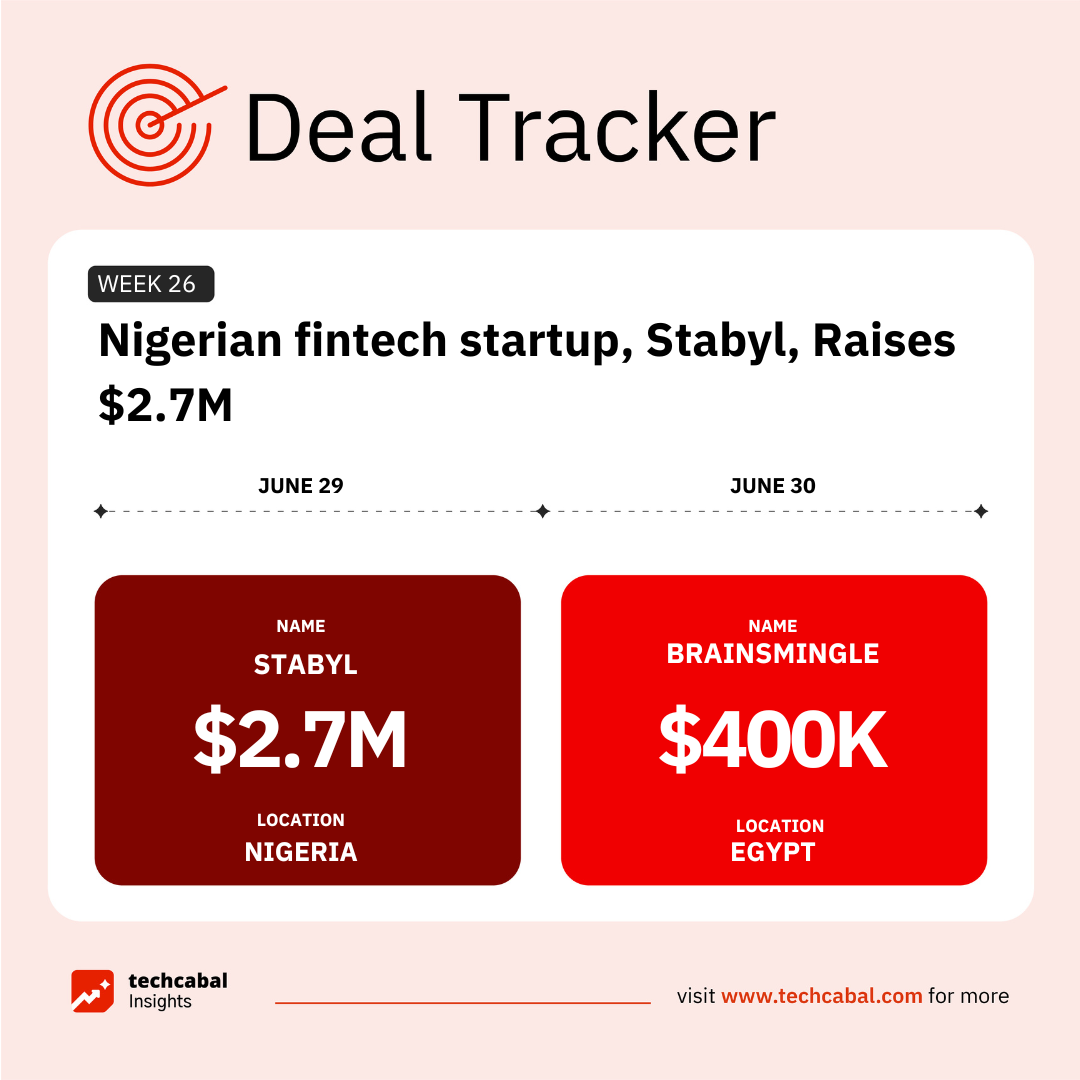 Image Source: TechCabal Insights
Stabyl, a Nigerian fintech startup, raised $2.7 million in a preseed round led by KongaPay. (June 29)
Here are the other deals for the week:
- BrainsMingle, an Egyptian HRtech startup, raised $400,000 in a seed funding round from BasharSoft Group. (June 30)
Follow us on Twitter, Instagram, and LinkedIn for more funding announcements. Before you go, find out what the data says about Africa’s tech layoffs.
CRYPTO TRACKER
The World Wide Web3
Source:

|
Coin Name |
Current Value |
Day |
Month |
|---|---|---|---|
| Bitcoin | $61,660 |
+ 1.60% |
– 7.68% |
| Ether | $1,714 |
+ 5.22% |
– 7.86% |
| XRP | $1.09 |
+ 3.24% |
– 10.52% |
| Solana | $80.88 |
+ 3.72% |
+ 8.88% |
* Data as of 06.34 AM WAT, July 3, 2026.
JOB OPENINGS
- Kredete —Blockchain Engineer — Lagos, Nigeria
- BBC — Video Journalist, BBC News Igbo — Lagos, Nigeria
- Bank of Taiwan, South Africa —Chief Risk Officer — Gauteng, South Africa
- M-KOPA — Group Tax Manager, Finance Business Partnering Manager — Nairobi, Kenya
Looking for more opportunities? There are additional openings on TechCabal’s job board. We’ve also cleared out outdated listings to keep opportunities fresh for job seekers. If you’re hiring and would like to feature an open role, please submit it via this form.
- Kenya court says restructuring alone cannot justify layoffs, raising startup risks
- Nigeria’s new identity law turns NIMC into the country’s digital trust authority
- Nigeria heads into 2027 election worried about AI, report warns it’s unprepared
Written by: Opeyemi Kareem and Zia Yusuf
Edited by: Emmanuel Nwosu & Ganiu Oloruntade
Want more of TechCabal?
Sign up for our insightful newsletters on the business and economy of tech in Africa.
- The Next Wave: futuristic analysis of the business of tech in Africa.
- Francophone Weekly by TechCabal: insider insights and analysis of Francophone’s tech ecosystem
P:S If you’re often missing TC Daily in your inbox, check your Promotions folder and move any edition of TC Daily from “Promotions” to your “Main” or “Primary” folder and TC Daily will always come to you.



Ayrıca Şunları da Beğenebilirsiniz

Argentina vs Cabo Verde Time and Where to Watch: World Cup 2026 TV Channel, Live Stream and Kick-off Guide

Critical USDT0 Response to Drift Hack Exposes Stark Contrast in Stablecoin Security Protocols