Macro investor Michael Green, who is known as the Cassandra of Passive Investing, has sharpened his critique of Bitcoin, arguing that its design makes it economically brittle and socially corrosive, setting up a winner-takes-all outcome “like a Monopoly game.” In an interview with journalist Phil Rosen, Green said “the most important thing to understand is […]Macro investor Michael Green, who is known as the Cassandra of Passive Investing, has sharpened his critique of Bitcoin, arguing that its design makes it economically brittle and socially corrosive, setting up a winner-takes-all outcome “like a Monopoly game.” In an interview with journalist Phil Rosen, Green said “the most important thing to understand is […]

Bitcoin Could End ‘Like A Monopoly Game,’ Claims Wall Street Cassandra Michael Green

2025/11/26 11:00

Macro investor Michael Green, who is known as the Cassandra of Passive Investing, has sharpened his critique of Bitcoin, arguing that its design makes it economically brittle and socially corrosive, setting up a winner-takes-all outcome “like a Monopoly game.”

In an interview with journalist Phil Rosen, Green said “the most important thing to understand is that Bitcoin has marketed itself as multiple different things to try to appeal to investors at various points in time,” but has failed on its original brief. Under the Satoshi white paper, he noted, BTC was meant to be “a peer-to-peer payment system” that removed the dependence of payment rails on banks. “By moving to a distributed ledger and a peer-to-peer system, we’d be able to get banks out of the system.”

“That’s been a total failure,” he argued. “There are almost no real transactions that are occurring in Bitcoin. We have tons of transaction activity in speculative markets trading Bitcoin, but the actual quantity of retail transactions or peer-to-peer payments that occur over the Bitcoin network are remarkably small.”

Green distinguished between emergency government “money printing” and day-to-day bank credit. “There’s money printing that comes from the government, in which they largely are trying to smooth over mistakes that have been made,” he said, describing stimulus as a way to “basically create a do-over by printing money.”

More frequent, he added, is the expansion of money when banks lend: when a bank grants a $1,000 loan, “they simply created a new account for you called your checking account that has $1,000 in it… That expansion is totally normal and it has a credit function associated with it.”

“Bitcoin destroys the ability to do that because it was intentionally designed to skip the banking system,” Green contended. Rather than a full credit system, “it is effectively just a monetary system where what you’re really seeing is Bitcoin is effectively the tokens that are paid to the accounting firms that keep the blockchain in order… every Bitcoin that’s out there is basically a payment to Deloitte & Touche.”

Why Bitcoin Is Supposedly A ‘Monopoly Game’

Because its supply is capped and banks cannot create new BTC via lending, “no new money can be created. There is no capacity for mistake forgiveness in that type of framework,” he said. That makes the system “very limiting. Interest rates and credit spreads are just too high for a real economy framework.” Despite dramatic price gains, he concluded, Bitcoin “hasn’t emerged as a payment system” or “in any meaningful economic context.”

Green’s harshest criticism was distributional. “Because we have a finite quantity of it, ultimately, that means everybody who is born after the Bitcoin has been released finds themselves in deficit,” he said. He compared this to “a serf living off land in the 14th century that didn’t belong to you,” where “there was no other land that would ever become available to you.” That, he argued, “creates a deeply unequal society.”

Although he said he “was an early adopter of Bitcoin” and initially thought it was “a really interesting idea” of private money, he now believes “if you run through the simulation, Bitcoin, because there is a finite quantity of tokens, means that it basically plays like a Monopoly game.”

In that game, “you can’t add additional players as the game is being played… because they’re just going to lose very quickly. They don’t have any other properties. They don’t have any other money.” “How does every game of Monopoly end?” he asked. “Someone wins. With a single winner.”

“That’s exactly what we’ve seen within Bitcoin,” Green maintained, citing “increased concentration” and a Gini coefficient “beyond anything we’ve ever seen in the real world.” Instead of democratizing access, he argued, Bitcoin builds “a system that ultimately collapses upon itself and locks people out. Far from democratizing access, it does the exact opposite.”

At press time, BTC traded at $87,589.
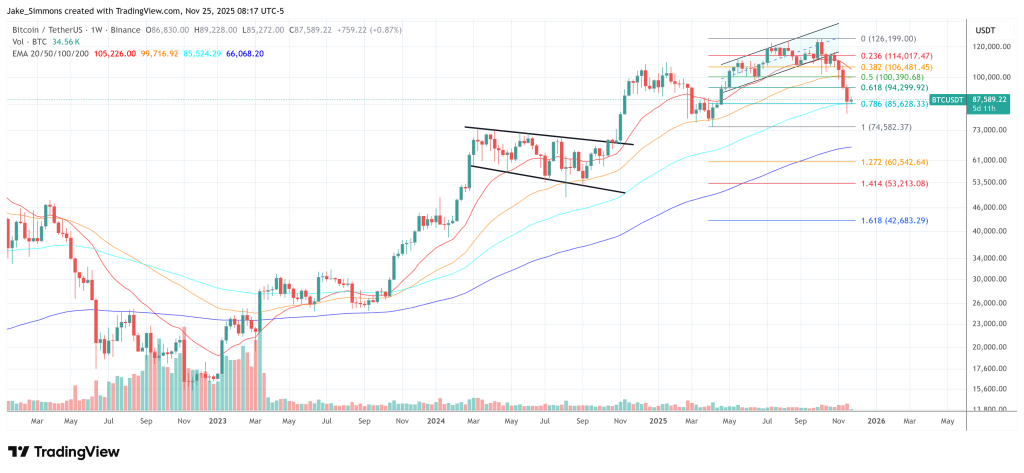
Bitcoin price
Piyasa Fırsatı
Wink Logosu
Wink Fiyatı(LIKE)
$0,003892
$0,003892$0,003892
+3,51%
USD
Wink (LIKE) Canlı Fiyat Grafiği
Sorumluluk Reddi: Bu sitede yeniden yayınlanan makaleler, halka açık platformlardan alınmıştır ve yalnızca bilgilendirme amaçlıdır. MEXC'nin görüşlerini yansıtmayabilir. Tüm hakları telif sahiplerine aittir. Herhangi bir içeriğin üçüncü taraf haklarını ihlal ettiğini düşünüyorsanız, kaldırılması için lütfen service@support.mexc.com ile iletişime geçin. MEXC, içeriğin doğruluğu, eksiksizliği veya güncelliği konusunda hiçbir garanti vermez ve sağlanan bilgilere dayalı olarak alınan herhangi bir eylemden sorumlu değildir. İçerik, finansal, yasal veya diğer profesyonel tavsiye niteliğinde değildir ve MEXC tarafından bir tavsiye veya onay olarak değerlendirilmemelidir.

Ayrıca Şunları da Beğenebilirsiniz

The Channel Factories We’ve Been Waiting For

The Channel Factories We’ve Been Waiting For

The post The Channel Factories We’ve Been Waiting For appeared on BitcoinEthereumNews.com. Visions of future technology are often prescient about the broad strokes while flubbing the details. The tablets in “2001: A Space Odyssey” do indeed look like iPads, but you never see the astronauts paying for subscriptions or wasting hours on Candy Crush.  Channel factories are one vision that arose early in the history of the Lightning Network to address some challenges that Lightning has faced from the beginning. Despite having grown to become Bitcoin’s most successful layer-2 scaling solution, with instant and low-fee payments, Lightning’s scale is limited by its reliance on payment channels. Although Lightning shifts most transactions off-chain, each payment channel still requires an on-chain transaction to open and (usually) another to close. As adoption grows, pressure on the blockchain grows with it. The need for a more scalable approach to managing channels is clear. Channel factories were supposed to meet this need, but where are they? In 2025, subnetworks are emerging that revive the impetus of channel factories with some new details that vastly increase their potential. They are natively interoperable with Lightning and achieve greater scale by allowing a group of participants to open a shared multisig UTXO and create multiple bilateral channels, which reduces the number of on-chain transactions and improves capital efficiency. Achieving greater scale by reducing complexity, Ark and Spark perform the same function as traditional channel factories with new designs and additional capabilities based on shared UTXOs.  Channel Factories 101 Channel factories have been around since the inception of Lightning. A factory is a multiparty contract where multiple users (not just two, as in a Dryja-Poon channel) cooperatively lock funds in a single multisig UTXO. They can open, close and update channels off-chain without updating the blockchain for each operation. Only when participants leave or the factory dissolves is an on-chain transaction…
Paylaş
BitcoinEthereumNews2025/09/18 00:09
SOLANA NETWORK Withstands 6 Tbps DDoS Without Downtime

SOLANA NETWORK Withstands 6 Tbps DDoS Without Downtime

The post SOLANA NETWORK Withstands 6 Tbps DDoS Without Downtime appeared on BitcoinEthereumNews.com. In a pivotal week for crypto infrastructure, the Solana network
Paylaş
BitcoinEthereumNews2025/12/16 20:44
Why The Green Bay Packers Must Take The Cleveland Browns Seriously — As Hard As That Might Be

Why The Green Bay Packers Must Take The Cleveland Browns Seriously — As Hard As That Might Be

The post Why The Green Bay Packers Must Take The Cleveland Browns Seriously — As Hard As That Might Be appeared on BitcoinEthereumNews.com. Jordan Love and the Green Bay Packers are off to a 2-0 start. Getty Images The Green Bay Packers are, once again, one of the NFL’s better teams. The Cleveland Browns are, once again, one of the league’s doormats. It’s why unbeaten Green Bay (2-0) is a 8-point favorite at winless Cleveland (0-2) Sunday according to betmgm.com. The money line is also Green Bay -500. Most expect this to be a Packers’ rout, and it very well could be. But Green Bay knows taking anyone in this league for granted can prove costly. “I think if you look at their roster, the paper, who they have on that team, what they can do, they got a lot of talent and things can turn around quickly for them,” Packers safety Xavier McKinney said. “We just got to kind of keep that in mind and know we not just walking into something and they just going to lay down. That’s not what they going to do.” The Browns certainly haven’t laid down on defense. Far from. Cleveland is allowing an NFL-best 191.5 yards per game. The Browns gave up 141 yards to Cincinnati in Week 1, including just seven in the second half, but still lost, 17-16. Cleveland has given up an NFL-best 45.5 rushing yards per game and just 2.1 rushing yards per attempt. “The biggest thing is our defensive line is much, much improved over last year and I think we’ve got back to our personality,” defensive coordinator Jim Schwartz said recently. “When we play our best, our D-line leads us there as our engine.” The Browns rank third in the league in passing defense, allowing just 146.0 yards per game. Cleveland has also gone 30 straight games without allowing a 300-yard passer, the longest active streak in the NFL.…
Paylaş
BitcoinEthereumNews2025/09/18 00:41