Markets Share Share this article Copy linkX (Twitter)LinkedInFacebookEmail Wall Street bank JPMorgan says stablecoin ma Markets Share Share this article Copy linkX (Twitter)LinkedInFacebookEmail Wall Street bank JPMorgan says stablecoin ma

Wall Street bank JPMorgan says stablecoin market could grow to $600 billion by 2028

2025/12/19 22:54
Share
Share this article
Copy linkX (Twitter)LinkedInFacebookEmail

Wall Street bank JPMorgan says stablecoin market could grow to $600 billion by 2028

The bank said stablecoin growth is still mostly driven by crypto trading, and rising payments use may boost velocity more than supply.

By Will Canny, AI Boost|Edited by Jesse Hamilton
Dec 19, 2025, 2:54 p.m.
JPMorgan research shares a modest view on stablecoin growth. (Ikechukwu Julius Ugwu/Unsplash)

What to know:

  • JPMorgan said stablecoin supply is up about $100 billion this year to roughly $308 billion, led by USDT and USDC.
  • The bank's analysts expect steady growth into 2028, but well below the most bullish projections.
  • Trading demand still dominates, and payments adoption may lift stablecoin velocity more than supply, the report said.

Wall Street bank JPMorgan Chase & Co. (JPM) said the stablecoin supply could reach $500 billion to $600 billion by 2028, far short of the most bullish $2 trillion to $4 trillion calls.

Stablecoin demand is still primarily a crypto-market story, not a payments story, according to the largest U.S. bank by assets.

STORY CONTINUES BELOW
Don't miss another story.Subscribe to the Crypto Daybook Americas Newsletter today. See all newsletters
Sign me up

JPMorgan noted that the stablecoin market has grown about $100 billion this year to roughly $308 billion, led by Tether’s USDT and Circle’s (CRCL) USDC.

Demand is still driven mainly by crypto trading and collateral needs across derivatives and decentralized finance (DeFi), with derivatives venues adding about $20 billion in stablecoin holdings alongside a surge in perpetual futures activity, the report said.

"The vast majority of stablecoin demand stems from their use as cash or collateral in the crypto ecosystem to facilitate crypto trading including derivatives trading, DeFi lending and borrowing," wrote analysts led by Nikolaos Panigirtzoglou, in the Wednesday report.

Stablecoins are cryptocurrencies pegged to assets such as fiat currencies or gold, but most often the U.S. dollar. They underpin much of the crypto economy, serving as payment rails and a tool for moving money across borders.

The analysts said payments are a smaller driver today but could grow as more providers test stablecoin-based rails for cross-border transfers.

Still, the report said wider payment use doesn’t automatically require a much larger stablecoin float because velocity, how quickly tokens circulate, can rise as integration deepens.

Banks and payment networks are also moving to protect their role in institutional flows through tokenized deposits and other blockchain initiatives, while Central Bank Digital Currency (CBDC) efforts could offer regulated alternatives that compete with private stablecoins, the report added.

Read more: Stablecoin Adoption Is ‘Exploding' — Here's Why Wall Street Is Going All-In

StablecoinsJPMorganAnalysts
AI Disclaimer: Parts of this article were generated with the assistance from AI tools and reviewed by our editorial team to ensure accuracy and adherence to our standards. For more information, see CoinDesk's full AI Policy.

More For You

Protocol Research: GoPlus Security

Commissioned byGoPlus

What to know:

  • As of October 2025, GoPlus has generated $4.7M in total revenue across its product lines. The GoPlus App is the primary revenue driver, contributing $2.5M (approx. 53%), followed by the SafeToken Protocol at $1.7M.
  • GoPlus Intelligence's Token Security API averaged 717 million monthly calls year-to-date in 2025 , with a peak of nearly 1 billion calls in February 2025. Total blockchain-level requests, including transaction simulations, averaged an additional 350 million per month.
  • Since its January 2025 launch , the $GPS token has registered over $5B in total spot volume and $10B in derivatives volume in 2025. Monthly spot volume peaked in March 2025 at over $1.1B , while derivatives volume peaked the same month at over $4B.
View Full Report

More For You

DraftKings enters prediction markets with CFTC-approved app for real-world events

The sports-betting giant enters the growing world of event contracts with CFTC-registered DraftKings Predictions in 38 states.

What to know:
  • DraftKings has unveiled a CFTC-regulated app letting users trade on real-world outcomes like sports and finance in 38 U.S. states.
  • The move puts it in direct competition with crypto-native prediction markets like Polymarket or other competitors like Kalshi and Robinhood.
  • Prediction markets have emerged as one of the biggest financial trends of the year, fueled by regulatory clarity and rising demand for real-time speculation.
Read full story
Latest Crypto News

Most Influential 2025's Honorable Mentions

Most Influential: Hsiao-Wei Wang and Tomasz K. Stańczak

Most Influential: Luke Dashjr

Most Influential: Jeff Yan

Most Influential: The Solana Developers

Most Influential: Stani Kulechov

Top Stories

DraftKings enters prediction markets with CFTC-approved app for real-world events

Bitcoin gains as yen surprisingly tumbles after BOJ rate hike: Crypto Daybook Americas

Jump Trading sued for $4 billion in connection to Do Kwon’s Terra Labs collapse: WSJ

Coinbase files lawsuits in 3 states over attempts to regulate prediction markets

Re-litigating the GENIUS Act Brings Risk and No Rewards

What if crypto's U.S. market structure effort just never gets there?

Piyasa Fırsatı
Lorenzo Protocol Logosu
Lorenzo Protocol Fiyatı(BANK)
$0,03674
$0,03674$0,03674
+2,11%
USD
Lorenzo Protocol (BANK) Canlı Fiyat Grafiği
Sorumluluk Reddi: Bu sitede yeniden yayınlanan makaleler, halka açık platformlardan alınmıştır ve yalnızca bilgilendirme amaçlıdır. MEXC'nin görüşlerini yansıtmayabilir. Tüm hakları telif sahiplerine aittir. Herhangi bir içeriğin üçüncü taraf haklarını ihlal ettiğini düşünüyorsanız, kaldırılması için lütfen service@support.mexc.com ile iletişime geçin. MEXC, içeriğin doğruluğu, eksiksizliği veya güncelliği konusunda hiçbir garanti vermez ve sağlanan bilgilere dayalı olarak alınan herhangi bir eylemden sorumlu değildir. İçerik, finansal, yasal veya diğer profesyonel tavsiye niteliğinde değildir ve MEXC tarafından bir tavsiye veya onay olarak değerlendirilmemelidir.

Ayrıca Şunları da Beğenebilirsiniz

Building a DEXScreener Clone: A Step-by-Step Guide

Building a DEXScreener Clone: A Step-by-Step Guide

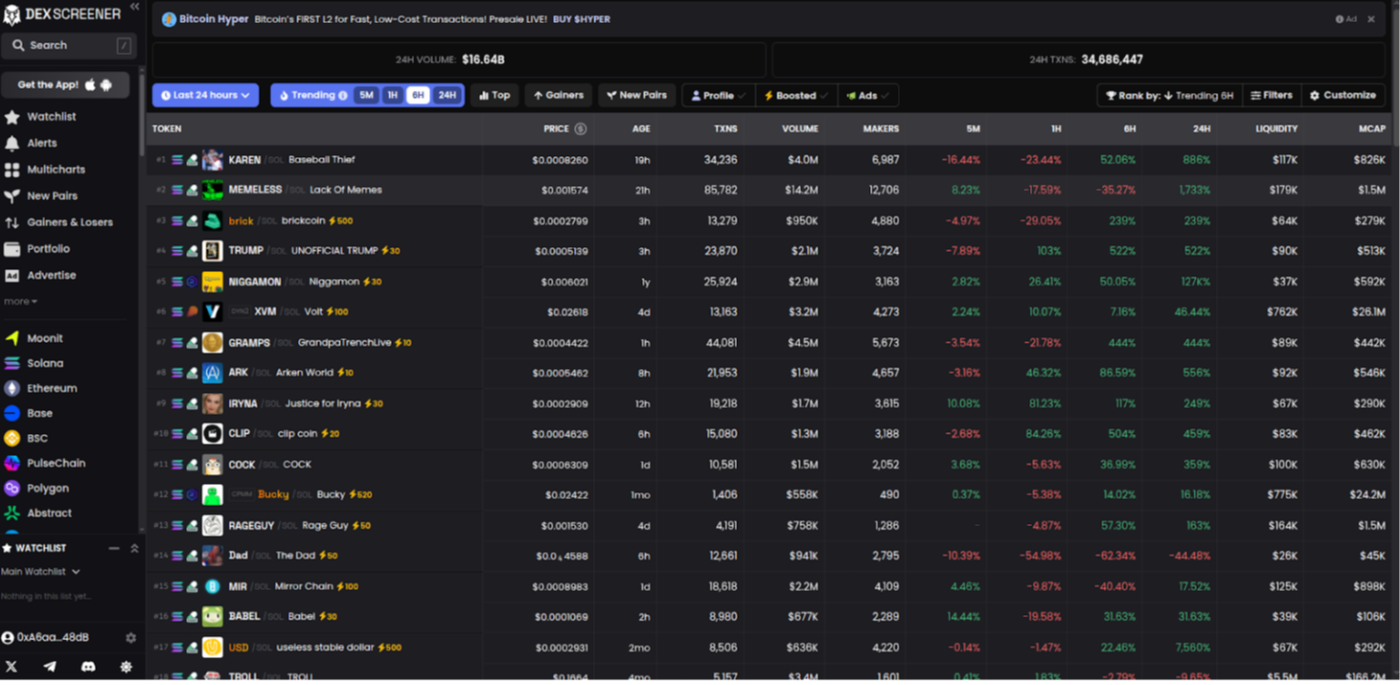
DEX Screener is used by crypto traders who need access to on-chain data like trading volumes, liquidity, and token prices. This information allows them to analyze trends, monitor new listings, and make informed investment decisions. In this tutorial, I will build a DEXScreener clone from scratch, covering everything from the initial design to a functional app. We will use Streamlit, a Python framework for building full-stack apps.
Paylaş
Hackernoon2025/09/18 15:05
Which DOGE? Musk's Cryptic Post Explodes Confusion

Which DOGE? Musk's Cryptic Post Explodes Confusion

A viral chart documenting a sharp decline in U.S. federal employment during President Trump's second term has sparked unexpected confusion in cryptocurrency markets
Paylaş
Coinstats2025/12/20 01:13
Google's AP2 protocol has been released. Does encrypted AI still have a chance?

Google's AP2 protocol has been released. Does encrypted AI still have a chance?

Following the MCP and A2A protocols, the AI Agent market has seen another blockbuster arrival: the Agent Payments Protocol (AP2), developed by Google. This will clearly further enhance AI Agents' autonomous multi-tasking capabilities, but the unfortunate reality is that it has little to do with web3AI. Let's take a closer look: What problem does AP2 solve? Simply put, the MCP protocol is like a universal hook, enabling AI agents to connect to various external tools and data sources; A2A is a team collaboration communication protocol that allows multiple AI agents to cooperate with each other to complete complex tasks; AP2 completes the last piece of the puzzle - payment capability. In other words, MCP opens up connectivity, A2A promotes collaboration efficiency, and AP2 achieves value exchange. The arrival of AP2 truly injects "soul" into the autonomous collaboration and task execution of Multi-Agents. Imagine AI Agents connecting Qunar, Meituan, and Didi to complete the booking of flights, hotels, and car rentals, but then getting stuck at the point of "self-payment." What's the point of all that multitasking? So, remember this: AP2 is an extension of MCP+A2A, solving the last mile problem of AI Agent automated execution. What are the technical highlights of AP2? The core innovation of AP2 is the Mandates mechanism, which is divided into real-time authorization mode and delegated authorization mode. Real-time authorization is easy to understand. The AI Agent finds the product and shows it to you. The operation can only be performed after the user signs. Delegated authorization requires the user to set rules in advance, such as only buying the iPhone 17 when the price drops to 5,000. The AI Agent monitors the trigger conditions and executes automatically. The implementation logic is cryptographically signed using Verifiable Credentials (VCs). Users can set complex commission conditions, including price ranges, time limits, and payment method priorities, forming a tamper-proof digital contract. Once signed, the AI Agent executes according to the conditions, with VCs ensuring auditability and security at every step. Of particular note is the "A2A x402" extension, a technical component developed by Google specifically for crypto payments, developed in collaboration with Coinbase and the Ethereum Foundation. This extension enables AI Agents to seamlessly process stablecoins, ETH, and other blockchain assets, supporting native payment scenarios within the Web3 ecosystem. What kind of imagination space can AP2 bring? After analyzing the technical principles, do you think that's it? Yes, in fact, the AP2 is boring when it is disassembled alone. Its real charm lies in connecting and opening up the "MCP+A2A+AP2" technology stack, completely opening up the complete link of AI Agent's autonomous analysis+execution+payment. From now on, AI Agents can open up many application scenarios. For example, AI Agents for stock investment and financial management can help us monitor the market 24/7 and conduct independent transactions. Enterprise procurement AI Agents can automatically replenish and renew without human intervention. AP2's complementary payment capabilities will further expand the penetration of the Agent-to-Agent economy into more scenarios. Google obviously understands that after the technical framework is established, the ecological implementation must be relied upon, so it has brought in more than 60 partners to develop it, almost covering the entire payment and business ecosystem. Interestingly, it also involves major Crypto players such as Ethereum, Coinbase, MetaMask, and Sui. Combined with the current trend of currency and stock integration, the imagination space has been doubled. Is web3 AI really dead? Not entirely. Google's AP2 looks complete, but it only achieves technical compatibility with Crypto payments. It can only be regarded as an extension of the traditional authorization framework and belongs to the category of automated execution. There is a "paradigm" difference between it and the autonomous asset management pursued by pure Crypto native solutions. The Crypto-native solutions under exploration are taking the "decentralized custody + on-chain verification" route, including AI Agent autonomous asset management, AI Agent autonomous transactions (DeFAI), AI Agent digital identity and on-chain reputation system (ERC-8004...), AI Agent on-chain governance DAO framework, AI Agent NPC and digital avatars, and many other interesting and fun directions. Ultimately, once users get used to AI Agent payments in traditional fields, their acceptance of AI Agents autonomously owning digital assets will also increase. And for those scenarios that AP2 cannot reach, such as anonymous transactions, censorship-resistant payments, and decentralized asset management, there will always be a time for crypto-native solutions to show their strength? The two are more likely to be complementary rather than competitive, but to be honest, the key technological advancements behind AI Agents currently all come from web2AI, and web3AI still needs to keep up the good work!
Paylaş
PANews2025/09/18 07:00