Meme coins, such as Dogecoin (DOGE), Shiba Inu (SHIB), and Pepe (PEPE), are at an increased risk of losses due to the current volatile market conditions. On-chain and derivatives data indicate a decline in interest in DOGE, SHIB, and PEPE, with technicals leaning bearish.Meme coins, such as Dogecoin (DOGE), Shiba Inu (SHIB), and Pepe (PEPE), are at an increased risk of losses due to the current volatile market conditions. On-chain and derivatives data indicate a decline in interest in DOGE, SHIB, and PEPE, with technicals leaning bearish.

Meme Coins Price Prediction: Dogecoin, Shiba Inu, Pepe at risk as whales exit

2025/08/22 18:17
  • Dogecoin holds above a crucial moving average as the MACD triggers a sell signal. 
  • Shiba Inu risks further losses with a breakdown from a triangle pattern.
  • Pepe fluctuates at the $0.00001000 psychological level amid an impending Death Cross.

Meme coins, such as Dogecoin (DOGE), Shiba Inu (SHIB), and Pepe (PEPE), are at an increased risk of losses due to the current volatile market conditions. On-chain and derivatives data indicate a decline in interest in DOGE, SHIB, and PEPE, with technicals leaning bearish. 

Meme coins at risk as whales count, Open Interest declines

The number of large-wallet investors, commonly referred to as whales, in a meme coin project reflects the underlying strength of its community. A decline in this count indicates a decrease in confidence among large investors. 

Santiment data shows a decline in DOGE whales, with investors owning more than 10 million tokens dropping to 882 from 887 on Monday. The decrease in SHIB whales reaches 377K, down from the monthly high of 380.48K. 
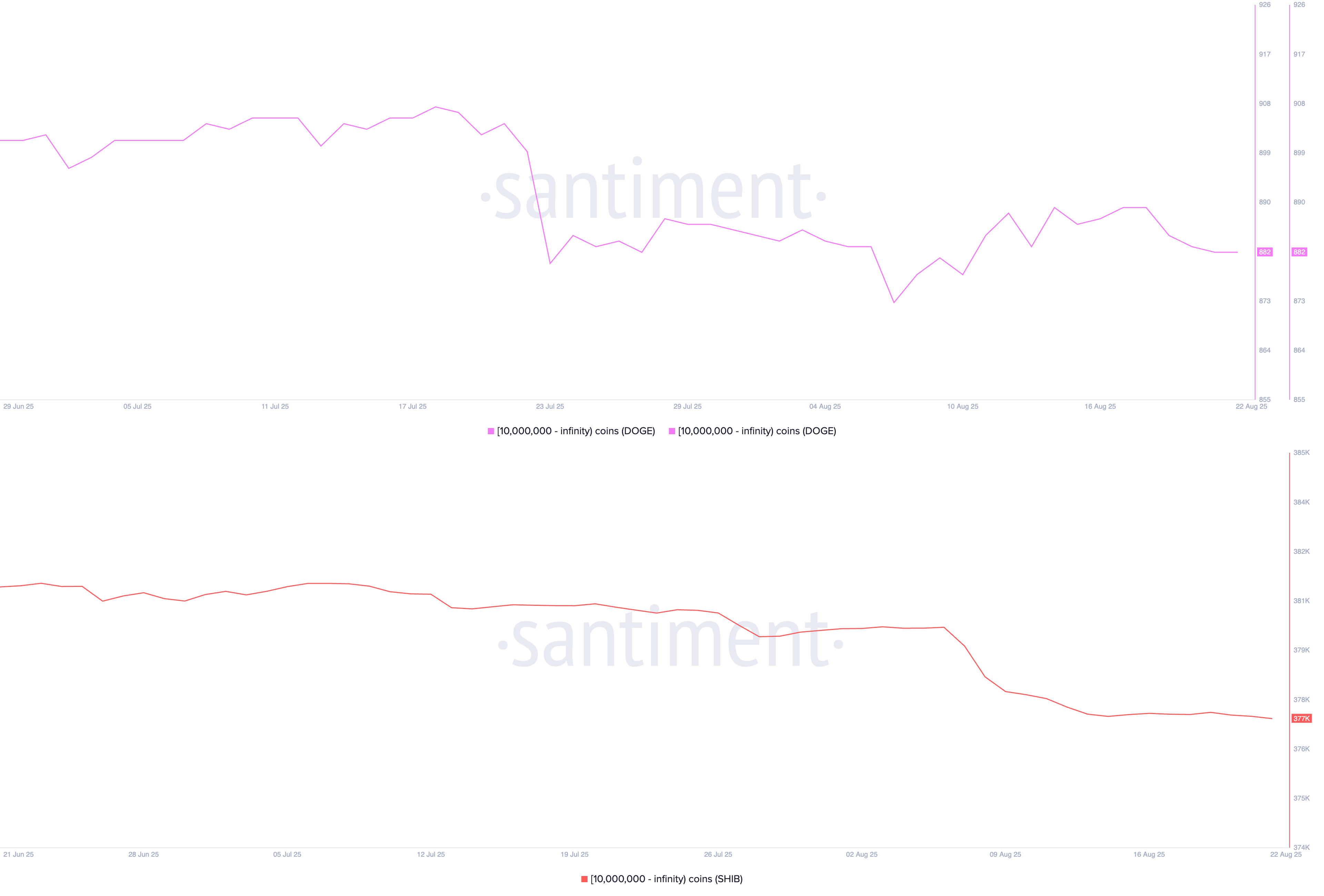
DOGE, SHIB Supply Distribution. Source: Santiment

Similarly, the count of PEPE whales is at 173K, down from the 30-day high of 173.57K.
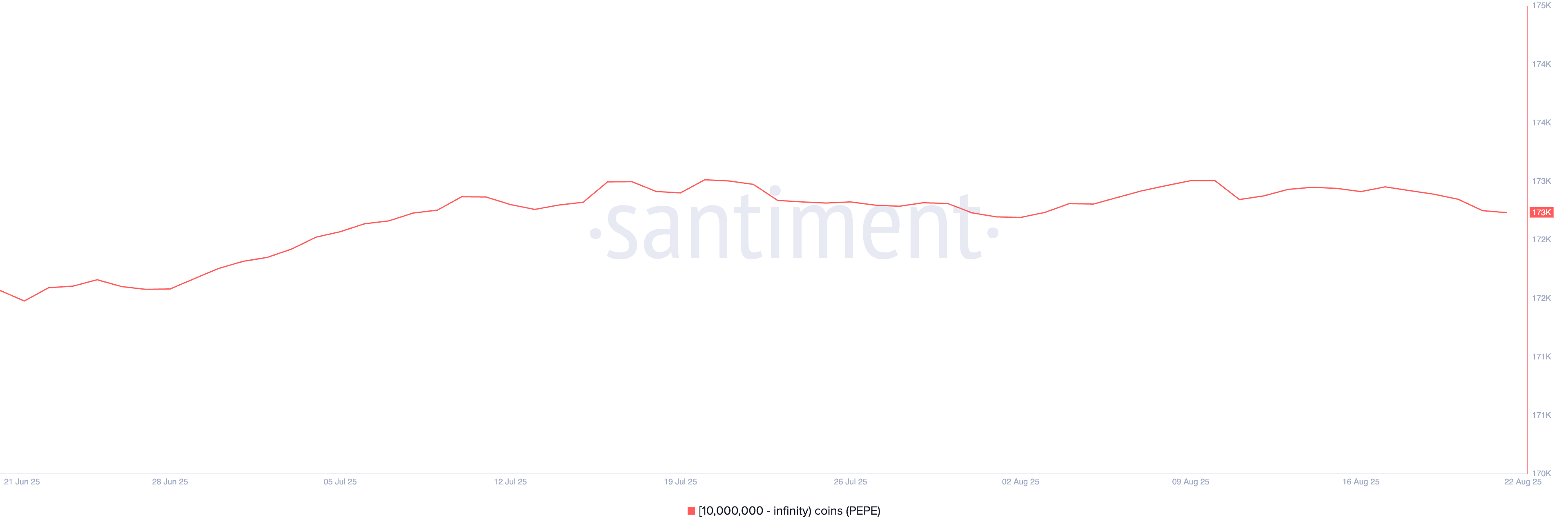
PEPE Supply Distribution. Source: Santiment

The soft conviction among whales aligns with a decline in Open Interest (OI) for meme coins in the derivatives market. CoinGlass data shows that the OI of DOGE, SHIB, and PEPE has decreased by over 2% in the last 24 hours. A decline in OI refers to heightened capital outflows as risk-off sentiment intensifies. 
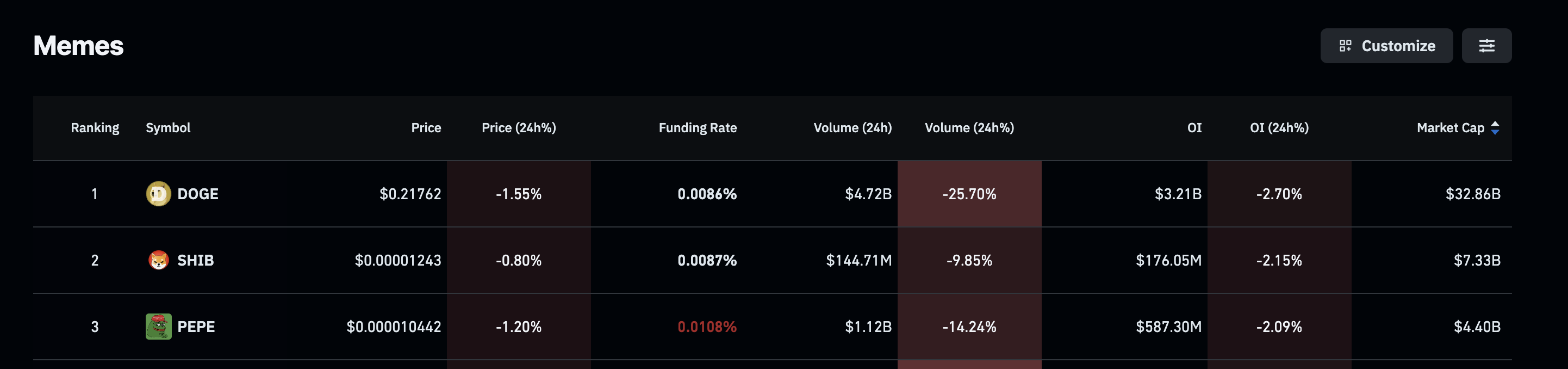
Meme coins Open Interest. Source: Coinglass

Dogecoin risks losing the 200-day EMA

Dogecoin trades at $0.2180 at press time on Friday, holding above the 50-day Exponential Moving Average (EMA) at $0.2156. The largest meme coin by market capitalization, at $32.80 billion, is at risk of losing its support from the 50-day EMA, followed by the 100-day and 200-day EMAs, as it prepares for a Golden Cross if whales count and Open Interest continues to decline. 

A drop below the 100-day EMA at $0.2092 could send DOGE to the $0.1884 low from August 3. 

The Relative Strength Index (RSI) on the daily chart reads 48 as it hovers below the halfway line, with further room for correction.

The Moving Average Convergence Divergence (MACD) and its signal line are on a downward slope, edging closer to the zero line. A slip into the negative territory would flash a bearish shift in trend momentum, indicating a sell opportunity for sidelined investors. 
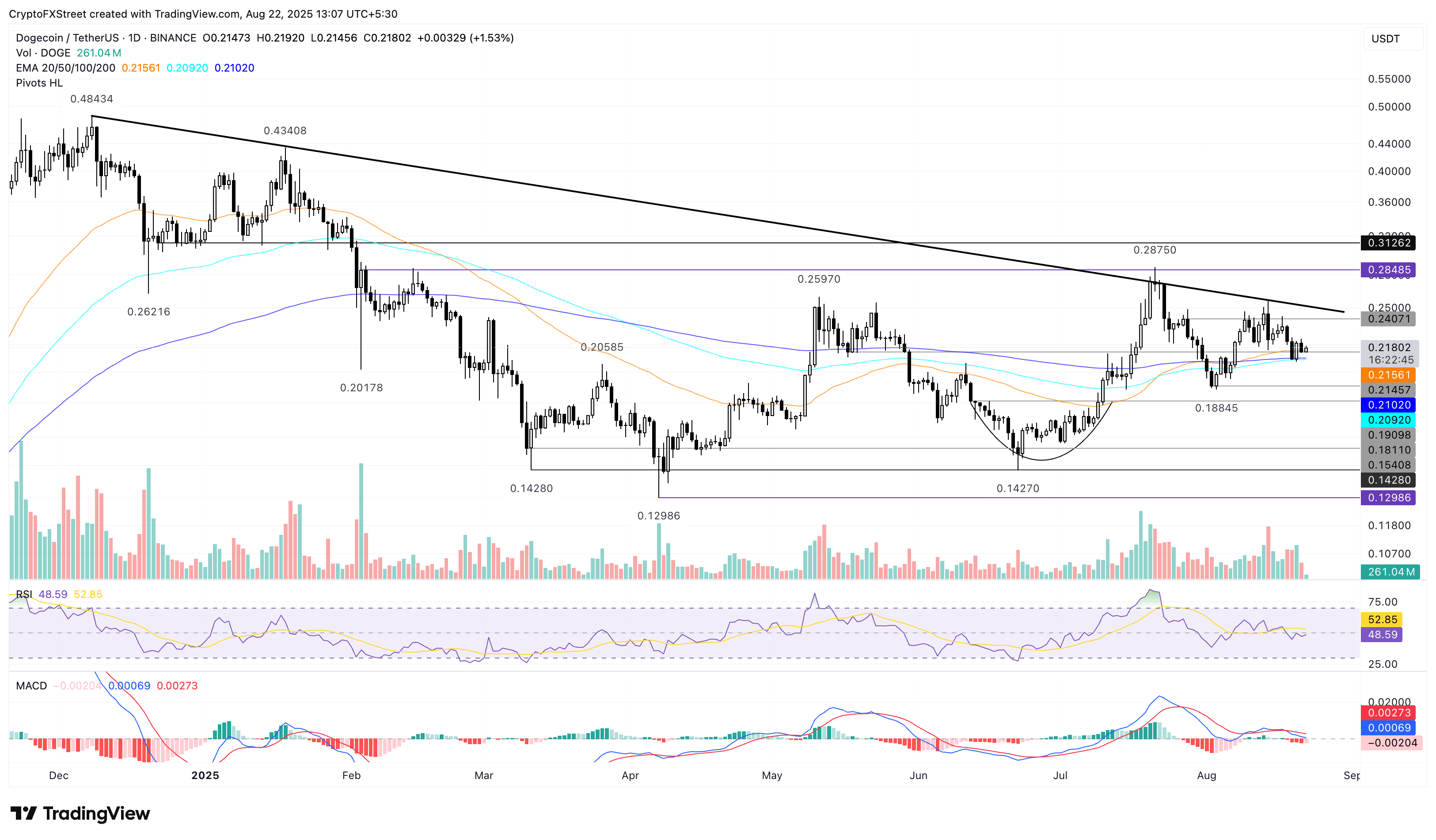
DOGE/USDT daily price chart.

On the upside, a potential bounce-back in DOGE could test an overhead resistance trendline at $0.2500, formed by connecting the peaks of December 8 and January 18. 

Shiba Inu risks further losses 

Shiba Inu holds above $0.00001244 at press time on Friday, following the 1.59% drop from Thursday. The meme coin risks further losses to the $0.00001160 low from August 2 if the support levels are breached. 

The momentum indicators suggest a bearish outlook on the daily chart as the MACD and signal lines cross into the negative territory, and the RSI at 44 slopes downwards.
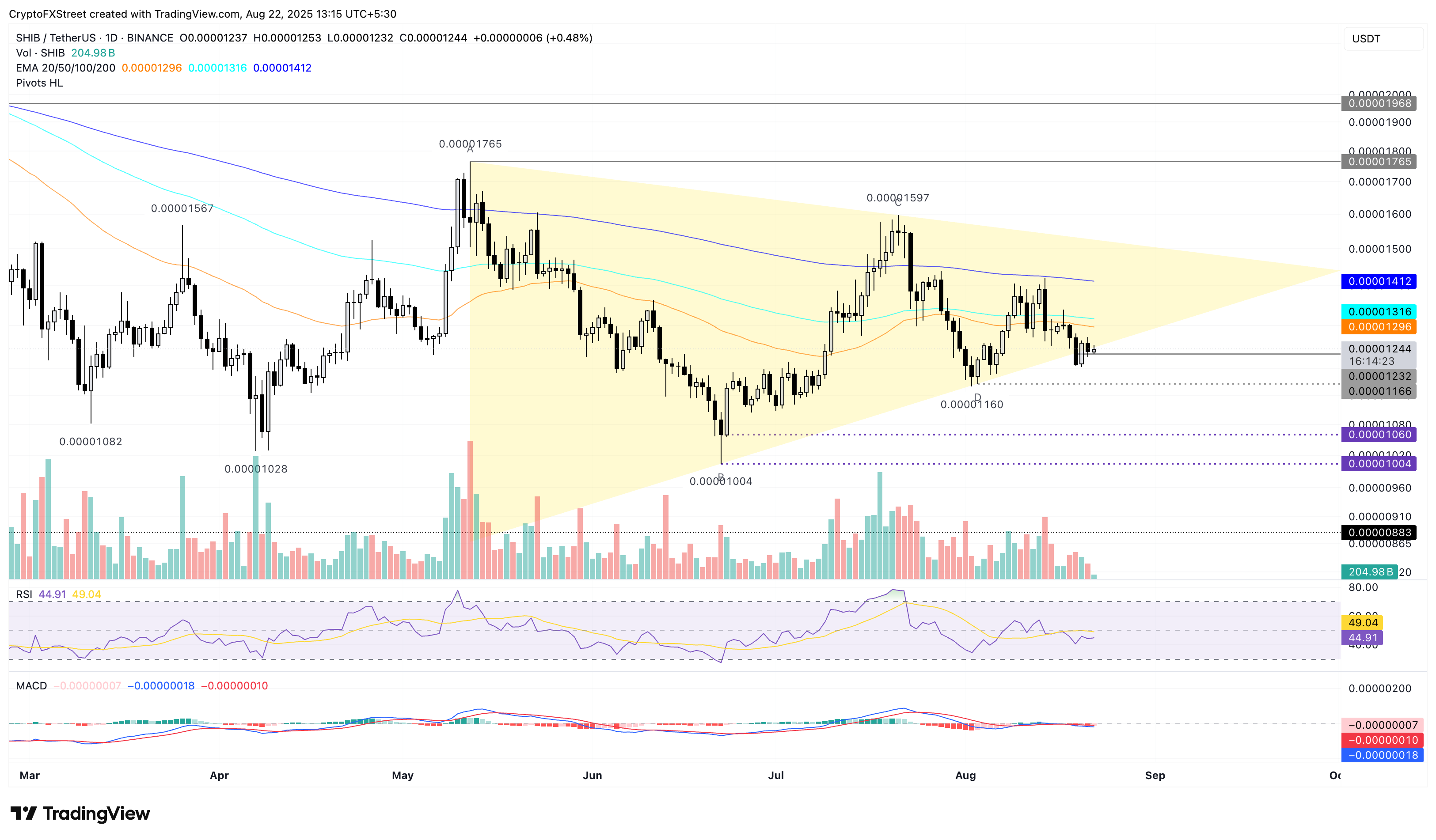
SHIB/USDT daily price chart.

On the flip side, a potential bounce back from the $0.00001244 support level could test the 50-day EMA at $0.00001296. 

Pepe’s last hold at a crucial psychological level 

Pepe extends the declining trend following the breakdown of a symmetrical triangle on the daily chart. At the time of writing, the frog-themed meme coin trades at $0.00001044, holding above the $0.00001000 psychological level. 

The downside risk escalates as the declining 50-day EMA risks a Death Cross pattern, with the close moving 100-day and 200-day EMAs. A potential crossover would signal a sell signal as bearish influence grows over the short-term trend. 

The MACD and its signal line maintain a steep trend with the RSI at 43 below the midpoint line, indicating a bearish tilt. 
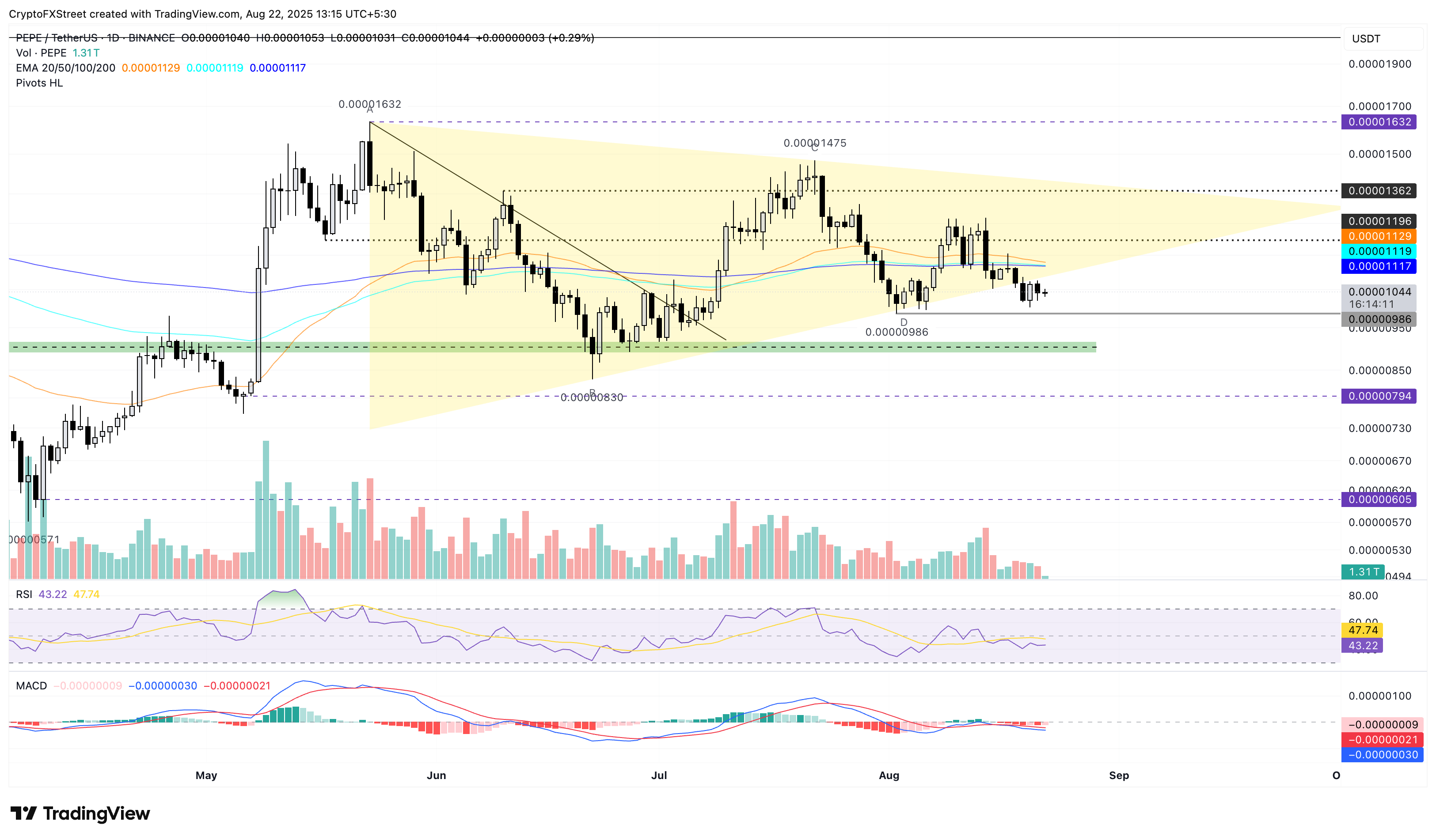
PEPE/USDT daily price chart.

On the contrary, a potential reversal in PEPE could test the 200-day EMA at $0.00001117.


Piyasa Fırsatı
SHIBAINU Logosu
SHIBAINU Fiyatı(SHIB)
$0.000007526
$0.000007526$0.000007526
+0.46%
USD
SHIBAINU (SHIB) Canlı Fiyat Grafiği
Sorumluluk Reddi: Bu sitede yeniden yayınlanan makaleler, halka açık platformlardan alınmıştır ve yalnızca bilgilendirme amaçlıdır. MEXC'nin görüşlerini yansıtmayabilir. Tüm hakları telif sahiplerine aittir. Herhangi bir içeriğin üçüncü taraf haklarını ihlal ettiğini düşünüyorsanız, kaldırılması için lütfen service@support.mexc.com ile iletişime geçin. MEXC, içeriğin doğruluğu, eksiksizliği veya güncelliği konusunda hiçbir garanti vermez ve sağlanan bilgilere dayalı olarak alınan herhangi bir eylemden sorumlu değildir. İçerik, finansal, yasal veya diğer profesyonel tavsiye niteliğinde değildir ve MEXC tarafından bir tavsiye veya onay olarak değerlendirilmemelidir.

Ayrıca Şunları da Beğenebilirsiniz

Building a DEXScreener Clone: A Step-by-Step Guide

Building a DEXScreener Clone: A Step-by-Step Guide

DEX Screener is used by crypto traders who need access to on-chain data like trading volumes, liquidity, and token prices. This information allows them to analyze trends, monitor new listings, and make informed investment decisions. In this tutorial, I will build a DEXScreener clone from scratch, covering everything from the initial design to a functional app. We will use Streamlit, a Python framework for building full-stack apps.
Paylaş
Hackernoon2025/09/18 15:05
Which DOGE? Musk's Cryptic Post Explodes Confusion

Which DOGE? Musk's Cryptic Post Explodes Confusion

A viral chart documenting a sharp decline in U.S. federal employment during President Trump's second term has sparked unexpected confusion in cryptocurrency markets
Paylaş
Coinstats2025/12/20 01:13
Google's AP2 protocol has been released. Does encrypted AI still have a chance?

Google's AP2 protocol has been released. Does encrypted AI still have a chance?

Following the MCP and A2A protocols, the AI Agent market has seen another blockbuster arrival: the Agent Payments Protocol (AP2), developed by Google. This will clearly further enhance AI Agents' autonomous multi-tasking capabilities, but the unfortunate reality is that it has little to do with web3AI. Let's take a closer look: What problem does AP2 solve? Simply put, the MCP protocol is like a universal hook, enabling AI agents to connect to various external tools and data sources; A2A is a team collaboration communication protocol that allows multiple AI agents to cooperate with each other to complete complex tasks; AP2 completes the last piece of the puzzle - payment capability. In other words, MCP opens up connectivity, A2A promotes collaboration efficiency, and AP2 achieves value exchange. The arrival of AP2 truly injects "soul" into the autonomous collaboration and task execution of Multi-Agents. Imagine AI Agents connecting Qunar, Meituan, and Didi to complete the booking of flights, hotels, and car rentals, but then getting stuck at the point of "self-payment." What's the point of all that multitasking? So, remember this: AP2 is an extension of MCP+A2A, solving the last mile problem of AI Agent automated execution. What are the technical highlights of AP2? The core innovation of AP2 is the Mandates mechanism, which is divided into real-time authorization mode and delegated authorization mode. Real-time authorization is easy to understand. The AI Agent finds the product and shows it to you. The operation can only be performed after the user signs. Delegated authorization requires the user to set rules in advance, such as only buying the iPhone 17 when the price drops to 5,000. The AI Agent monitors the trigger conditions and executes automatically. The implementation logic is cryptographically signed using Verifiable Credentials (VCs). Users can set complex commission conditions, including price ranges, time limits, and payment method priorities, forming a tamper-proof digital contract. Once signed, the AI Agent executes according to the conditions, with VCs ensuring auditability and security at every step. Of particular note is the "A2A x402" extension, a technical component developed by Google specifically for crypto payments, developed in collaboration with Coinbase and the Ethereum Foundation. This extension enables AI Agents to seamlessly process stablecoins, ETH, and other blockchain assets, supporting native payment scenarios within the Web3 ecosystem. What kind of imagination space can AP2 bring? After analyzing the technical principles, do you think that's it? Yes, in fact, the AP2 is boring when it is disassembled alone. Its real charm lies in connecting and opening up the "MCP+A2A+AP2" technology stack, completely opening up the complete link of AI Agent's autonomous analysis+execution+payment. From now on, AI Agents can open up many application scenarios. For example, AI Agents for stock investment and financial management can help us monitor the market 24/7 and conduct independent transactions. Enterprise procurement AI Agents can automatically replenish and renew without human intervention. AP2's complementary payment capabilities will further expand the penetration of the Agent-to-Agent economy into more scenarios. Google obviously understands that after the technical framework is established, the ecological implementation must be relied upon, so it has brought in more than 60 partners to develop it, almost covering the entire payment and business ecosystem. Interestingly, it also involves major Crypto players such as Ethereum, Coinbase, MetaMask, and Sui. Combined with the current trend of currency and stock integration, the imagination space has been doubled. Is web3 AI really dead? Not entirely. Google's AP2 looks complete, but it only achieves technical compatibility with Crypto payments. It can only be regarded as an extension of the traditional authorization framework and belongs to the category of automated execution. There is a "paradigm" difference between it and the autonomous asset management pursued by pure Crypto native solutions. The Crypto-native solutions under exploration are taking the "decentralized custody + on-chain verification" route, including AI Agent autonomous asset management, AI Agent autonomous transactions (DeFAI), AI Agent digital identity and on-chain reputation system (ERC-8004...), AI Agent on-chain governance DAO framework, AI Agent NPC and digital avatars, and many other interesting and fun directions. Ultimately, once users get used to AI Agent payments in traditional fields, their acceptance of AI Agents autonomously owning digital assets will also increase. And for those scenarios that AP2 cannot reach, such as anonymous transactions, censorship-resistant payments, and decentralized asset management, there will always be a time for crypto-native solutions to show their strength? The two are more likely to be complementary rather than competitive, but to be honest, the key technological advancements behind AI Agents currently all come from web2AI, and web3AI still needs to keep up the good work!
Paylaş
PANews2025/09/18 07:00