On August 28, new Fed Chair Kevin Warsh gave a speech that sounded nothing like his predecessor. No forward commitments, no soft guidance, just a hard inflation benchmark the current data hasn't met yet.
Markets didn't take it well. Stocks, gold, silver and crypto all sold off together, wiping out roughly $2 trillion in market cap in 48 hours. Bitcoin dropped from a weekly high near $81,000 down to $76,877, and by the morning of September 1 was sitting around $78,000-$78,800.
Key Takeaways
- A different Fed chair: Warsh has dropped forward guidance, brought money supply back into the conversation, and openly admitted the Fed is responsible for 65 months of high inflation.
- Inflation still hasn't cooled off: Core PCE at 3.3%, headline at 3.7%, both well above the 2% target.
- Everything sold off at once: about $2T in market cap gone in two days; BTC fell from $81,000 to $76,877.
- September is genuinely a toss-up: sticky inflation against a weakening job market (-23,000 jobs in July) has hike odds bouncing between 50% and 66% depending who you ask.
1. Kevin Warsh Isn't Playing By Powell's Rules
Warsh took over as Fed Chair in May 2026, replacing Jerome Powell. He came up through Morgan Stanley, advised the White House under Bush, sat on the Fed board from 2006 to 2011, then moved to the Hoover Institution. His whole approach to monetary policy is a departure from Powell's.
A few things stand out:
- He's deliberately vague on purpose. Warsh has said outright that forward guidance has "overstayed its welcome." He doesn't want his speeches read like a rate-path roadmap, which is exactly the opposite of how Powell operated.
- Money supply is back on the table. Warsh actually believes the money supply matters for inflation, an idea most people wrote off after 2008 but that's clearly back in fashion with him.
- He blames spending, not growth. In a WSJ op-ed late last year, he laid inflation at the feet of government overspending and rapid money-supply growth, not an economy running too hot.
At Jackson Hole he went a step further and basically threw the Fed under the bus, saying the institution itself bears responsibility for 65 straight months of elevated inflation, and that it should. That's not the kind of thing you say if you're planning to go easy just because you're new to the job, or because the White House wants you to.
2. Three Things He Actually Said
Inflation isn't fixed yet. Even with decent summer prints, Warsh argued the underlying trend hasn't really improved.
He called the 2% target "rigid" and "fixed," not something up for negotiation.
Forward guidance gets in the way. He wants markets to stop treating his remarks as a mechanical formula for the next rate move. That uncertainty is exactly why volatility spiked. Investors lost the "Fed put," the old assumption that the Fed always shows up to save the market.
"We still have work to do." His most-quoted line: "We need to be confident that underlying inflation is moving toward target, clearly and at a sufficient pace. If not, we still have a lot of work to do." No timeline attached, but the door to a hike is wider open now than at any point since he took over.
3. How Finance Markets Actually Reacted?
What made this selloff unusual is that almost everything fell together, risk assets and the so-called safe havens alike. It didn't help that a geopolitical shock hit at the same time: over the August 30-31 weekend, the US struck Iranian missile sites on Larak Island, and Iran hit back at US forces in Jordan. Brent crude jumped about 3.3% to $91.01 a barrel, adding fuel to the inflation worries right as markets were repricing hike odds.
Here's the mechanism: when 2-year yields climb faster than 10-year yields, the curve flattens, which means the market is pricing in earlier Fed action. That's bad news for anything with a long duration, big-cap tech and Bitcoin included, because their future cash flows get discounted at a higher rate.
4. Two Sets of Data, Two Different Stories
This is where it gets messy, because the data genuinely doesn't agree with itself.
Arguing for a hike:
- Core PCE stuck at 3.3% with no real multi-month decline
- Services inflation (insurance, financial, housing) still climbing about 0.3% a month
- The July FOMC vote split 9-3, with three regional presidents, reportedly Hammack, Kashkari and Logan, wanting an immediate 25bp hike
- July minutes show a lot of members think more tightening will be needed if inflation doesn't budge
- Warsh himself said he'd struggle to call financial conditions "restrictive," which reads as there being room to tighten further without breaking anything
Arguing against one:
- Nonfarm payrolls fell 23,000 in July, plus a combined 103,000-job downward revision for May and June
- Labor force participation dropped to 61.4%, the lowest since February 2021
- Unemployment fell for the wrong reason: about 264,000 people left the workforce instead of finding jobs
- Real consumer spending barely moved in July
- Some describe the job market as "low-hire, low-fire" but slowly getting worse
There's also a more cynical read on all this: Warsh's tough talk might be more about managing expectations than an actual plan to act. He was appointed under politically sensitive circumstances, so sounding hawkish protects the Fed's independence from accusations of political interference, while an actual hike would really just be a blunt reaction to supply shocks (Iran-related energy costs, tariffs) rather than genuine overheating demand. Tightening right before the midterms isn't exactly a politically convenient move either. Take that for what it's worth, it's a theory, not a prediction.
Hike-odds pricing has also been all over the place in just the last few days. CME FedWatch jumped from about 39.9% on August 21 to 57% on August 30 to 66% on the morning of August 31, before settling back to 57-60% by the end of the week, while Polymarket and Kalshi have leaned the other way, around 52-53% for no hike. That gap between sources tells you this is genuinely unresolved, so it's worth tracking day to day rather than fixating on one number. On the bank side, Deutsche Bank still expects 50bps of hikes this year split across September and December, while Barclays flipped completely after the speech, going from "Fed holds through year-end" to "back-to-back 25bp hikes in September and December."
5. What This Means for Bitcoin?
Bitcoin had a monster August, running from around $55,000 up to nearly $81,000, its best August in close to a decade. That was the "debasement trade" at work: the bet that the Fed eventually gets forced into easing to keep the economy afloat, which pushes money into "hard" assets like Bitcoin as a hedge against currency debasement.
Warsh's speech put that whole thesis to the test. As hike odds jumped and easing got pushed further out, Bitcoin had to reprice around a simpler reality, this Fed isn't folding just because the market wants it to.
How price actually moved:
- Opened the week near $77,000, rallied to $81,455, then dropped to $76,877, closed the week around $77,838
- As of the morning of September 1, BTC sits around $78,000-$78,800, basically flat on the week, no sign of broad panic
- BTC long liquidations on August 28 alone hit roughly $138 million, and US Bitcoin ETFs saw net outflows of about $211.2 million that same day, ending a nine-day streak of inflows. That's institutional money getting cautious rather than buying the dip
- On-chain data shows exchange BTC balances ticking up again slightly, worth watching since that tends to precede short-term selling pressure
How this could play out:
Next few weeks: BTC probably chops between $76,800 and $80,000 while everyone waits on jobs and CPI data. A hot CPI print could send it toward $70,000-$72,000; a weak jobs report could pull it back up toward $81,000-$82,000.
6 to 12 months out: If the Fed wraps up its tightening cycle this year and pivots to easing in 2027, the old "hike, correction, ease, rally" playbook from 2019 could repeat itself and set up another leg up for BTC.
The bigger picture: Warsh treats rate cuts as his main lever and saves QE for actual crises, meaning the "Fed put" is weaker than it was under Powell and crypto should expect more short-term chop. The long-term case for Bitcoin as a scarce asset hasn't really changed though.
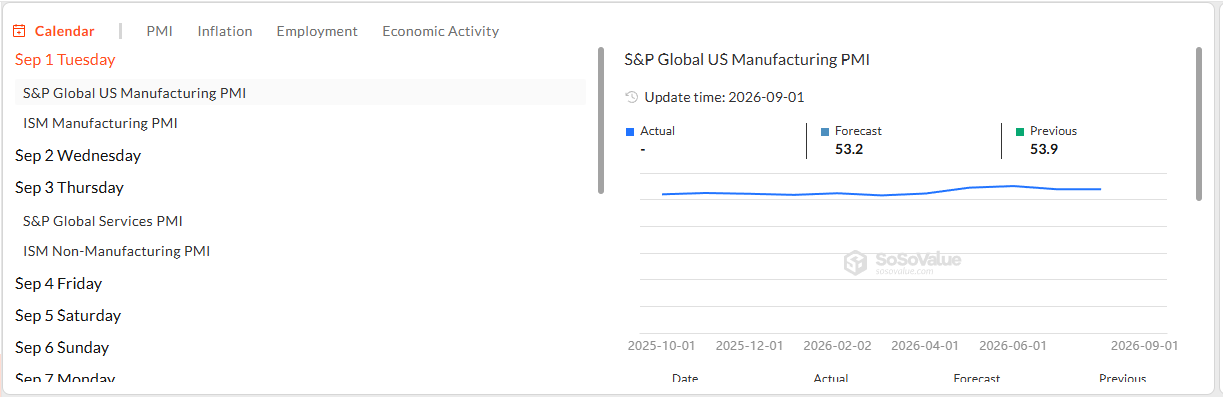
Watch these three dates over the next couple weeks: August nonfarm payrolls (Friday, September 4), August CPI (September 11), and the FOMC meeting (September 15-16). Between them, they'll basically decide where risk assets go for the rest of Q4.
The wildcard nobody can control:
- Energy prices are still exposed to Middle East tensions, something Warsh can't fix with rate policy
- If OPEC+ cuts output in September, energy costs could push headline PCE above 4% and leave the Fed with basically no choice but to hike
- Weak jobs data plus a supply-driven inflation shock is the textbook setup for stagflation, which is about the worst scenario any central bank can face
Conclusion
Don't treat the Jackson Hole speech as a one-off. It's a statement of how Warsh plans to run the Fed long-term: fewer promises upfront, more reliance on incoming data, and no problem publicly criticizing the institution he now runs. The market reacted this hard because the old assumption of an always-there Fed put just took a real hit.
The odds of a September hike are genuinely live, somewhere between 50-50 and 60-40 depending which source you trust, nothing here is settled. My own guess is Warsh waits for more data and pushes the decision to October or December, but I'd hold that loosely. A hot August CPI print could flip this fast.
Disclaimer: This content does not constitute investment, tax, legal, financial, or accounting advice. MEXC Blog provides this information for educational purposes only. Always do your own research, understand the risks, and invest responsibly.