

Is Bitcoin Real Money or Just Numbers on a Screen?
BitcoinWorld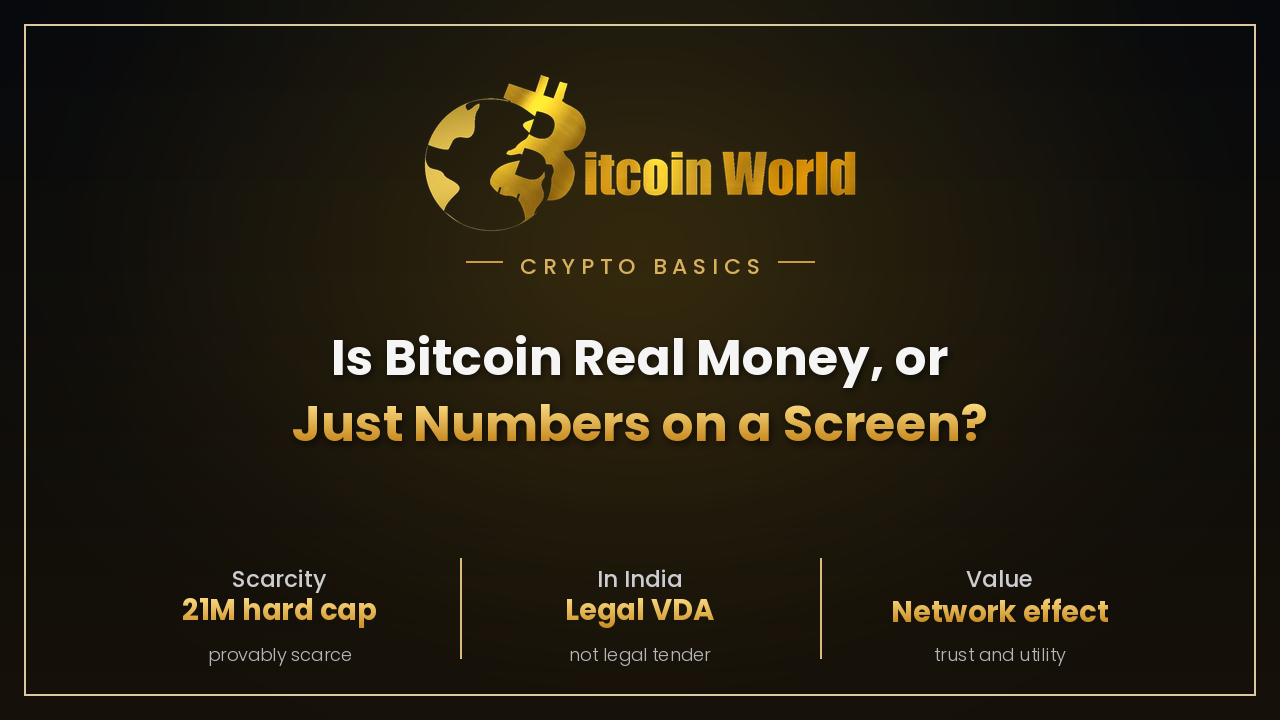
Is Bitcoin Real Money or Just Numbers on a Screen?
Is Bitcoin Real Money, or Just Numbers on a Screen?
Whether Bitcoin is real money or just numbers on a screen is a question that sounds dismissive but deserves a serious answer – because your bank balance is also just numbers on a screen, and yet nobody questions whether it’s real. The more useful question is whether Bitcoin meets the properties that make something function as money, and the honest answer is that it meets some convincingly and others partially. This article breaks down what money actually is, where Bitcoin fits, what gives it value, and what Indian users should understand about its legal and practical status.
Is Bitcoin Real Money, or Just Numbers on a Screen?
Bitcoin is real in the sense that it has economic value and can be transferred – but whether it qualifies as “money” depends on which definition of money you apply. Importantly, so is your bank balance.
- All digital money is “numbers on a screen”: Bank deposits, UPI balances, and FD amounts are all digital records – not fundamentally different in form.
- What makes something money: Economists typically define money by three functions – medium of exchange, store of value, and unit of account.
- Bitcoin’s score: Strong as a store of value and improving as a medium of exchange; weak as a unit of account for everyday pricing.
- Value is real: Bitcoin can be bought, sold, sent globally, and converted into INR – that economic utility is not imaginary.
How Does Bitcoin Meet the Classic Properties of Money?
Money is typically evaluated across several properties – Bitcoin scores differently on each.
- Scarcity: Strong – a hard cap of 21 million coins makes Bitcoin more provably scarce than any fiat currency.
- Divisibility: Strong – divisible to 8 decimal places (100 million satoshis per Bitcoin).
- Durability: Strong – Bitcoin is a digital record that doesn’t decay.
- Portability: Strong – transferable globally in minutes without physical movement.
- Verifiability: Strong – anyone can verify a transaction on the public blockchain.
- Acceptability: Partial – acceptance as payment is growing but far from universal.
- Price stability: Weak – Bitcoin’s price volatility limits its day-to-day usability as a medium of exchange.
What Actually Gives Bitcoin Its Value?
This is the question most skeptics are really asking, and the answer has multiple layers.
- Scarcity and fixed supply: No central bank can inflate it – 21 million is the limit.
- Network effect: Bitcoin is the most widely known, held, and traded cryptocurrency, and that network of users sustains its value.
- Decentralization: No government or company can shut it down or seize it without the private key.
- Trust and belief: Like all currencies, value ultimately rests on collective belief – but Bitcoin’s rules are enforced by code, not institutions.
What Is Bitcoin’s Legal and Practical Status in India?
For Indian users, the most practical question is what Bitcoin actually is under Indian law and in everyday life.
- Not legal tender: Bitcoin is not recognized as legal tender in India – it cannot be demanded as payment for debts.
- Not banned: Holding, buying, and selling Bitcoin is legal in India; there’s no prohibition.
- Classified as a VDA: The Income Tax Act treats Bitcoin as a Virtual Digital Asset (VDA), subject to 30% tax on gains and 1% TDS on transfers.
- Growing acceptance: A small but growing number of merchants and platforms globally accept Bitcoin for goods and services.
Frequently Asked Questions
Is Bitcoin considered real money in India?
Bitcoin is not legal tender in India and cannot be used to pay debts the way rupees can, but it is a legally recognized Virtual Digital Asset with real economic value that can be bought, sold, and taxed. Whether it’s “real money” depends on context – it functions as a store of value and can be converted to INR, but isn’t accepted for everyday transactions the way the rupee is. The Indian government treats it as a taxable asset, not a currency.
What gives Bitcoin value if it’s not backed by anything?
Bitcoin is backed by scarcity, code, and a global network of users – similar in principle to gold, which also has no cashflow backing its value. Its hard cap of 21 million coins, combined with growing demand, creates price pressure upward over time. Like all currencies, its value ultimately depends on collective trust and utility, but Bitcoin’s rules are enforced by transparent, auditable code rather than government promises.
Why can’t Bitcoin just be copied to create unlimited amounts?
Copying Bitcoin’s code creates a new, separate blockchain – not more Bitcoin on the original chain. The Bitcoin network itself enforces the 21 million cap through its consensus rules, and no single party has the authority to change those rules. Any attempt to create “more Bitcoin” outside the protocol simply creates a different asset, not additional Bitcoin.
Conclusion: Why “Just Numbers” Misses the Point
The question of whether Bitcoin is real money or just numbers on a screen misses the fact that all modern money is digital records – what matters is whether those records have reliable scarcity, transferability, and value. Bitcoin delivers on scarcity, durability, divisibility, and portability more robustly than most assets, while falling short on price stability for everyday use. For Indian users, the practical reality is that Bitcoin is a legally recognized, taxable asset with genuine economic value – not legal tender, not imaginary, and increasingly difficult to dismiss as “just numbers.”
This post Is Bitcoin Real Money or Just Numbers on a Screen? first appeared on BitcoinWorld.


추천 콘텐츠

Super Micro Computer (SMCI) Stock: $7B Capital Raise to Fund AI Server Production

Bitcoin-Linked Stock Trading Volume Halves as Spot Correction Cools Leverage Demand
Xenea Wallet Daily Quiz 12 June 2026: Win Coins


인기 뉴스
더보기
