

Otterly AI vs Peec AI: GEO Monitoring Tool Comparison
Google rankings used to be the only scoreboard that mattered. In 2026, a brand can hold the top organic position and still be invisible when someone asks ChatGPT, Perplexity, or Gemini for a recommendation. AI-generated answers now drive over 1.1 billion referral visits per month, and the brands appearing in those answers are not always the ones with the strongest SEO. Otterly AI and Peec AI both exist to solve this problem, but they solve it differently. Otterly AI is a full content intelligence platform that spans monitoring, auditing, and optimisation. Peec AI is a pure analytics platform that focuses on telling you exactly where you stand across AI engines with granular precision. This comparison breaks down both platforms across features, pricing, methodology, and use case fit so you can decide which one belongs in your marketing stack.
Comparison Table
What Is Otterly AI?
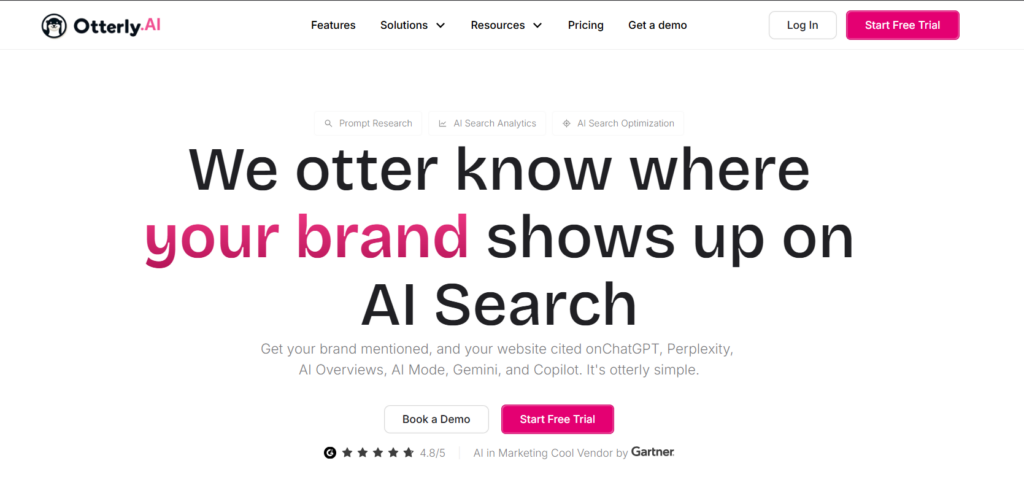
Otterly AI is an AI search monitoring and optimisation platform trusted by over 25,000 marketing professionals worldwide. It tracks how brands appear across ChatGPT, Perplexity, Gemini and other AI tools, making it one of the broadest multi-engine coverage platforms in the GEO space. Gartner recognised it as a Cool Vendor in AI for Marketing in 2025, and it holds a 4.8 out of 5 rating on G2.
What separates Otterly AI from a pure monitoring tool is the optimisation layer. The platform connects the dots between content auditing and AI visibility improvement through four integrated modules: AI Prompt Research, AI Search Analytics, Content Audit, and GEO Optimisation. A Bacula Enterprise case study published in June 2025 showed the platform helping the company claim the number one position in ChatGPT responses for highly specific B2B queries. For marketing teams who want to move from visibility tracking into actual content improvement, Otterly AI is the more complete solution.
Key Features:
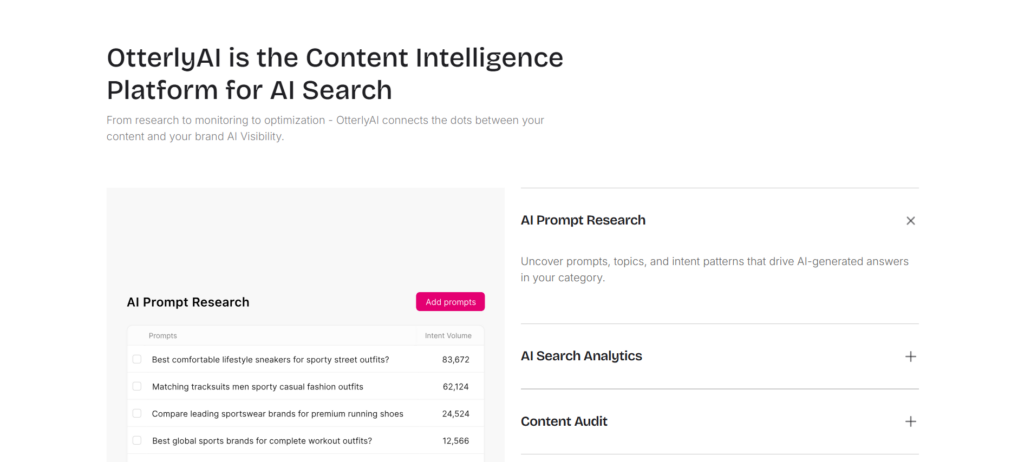
- AI Prompt Research — Surfaces the prompts, topics, and intent patterns driving AI-generated answers in any category, giving teams a research foundation for content strategy rather than guesswork about what AI engines are responding to.
- AI Search Analytics — Monitors brand mentions, citations, and competitive share of voice across ChatGPT, Perplexity, Google AI Overviews, Gemini, Copilot, and Google AI Mode with trend tracking over configurable time windows.
- Content Audit and Prediction — Crawls existing content to identify why AI engines skip specific pages, surfaces crawlability issues, and generates content briefs designed to turn invisible pages into AI-cited sources.
- GEO Optimization Engine — Provides smart recommendations that go beyond data reporting, showing teams specifically what to fix and how to fix it so that content becomes the answer AI engines surface for target prompts.
- Multi-Engine Coverage — Tracks six major AI platforms simultaneously with country and filter controls, giving global brands a single dashboard rather than fragmented views across separate tools.
What Is Peec AI?
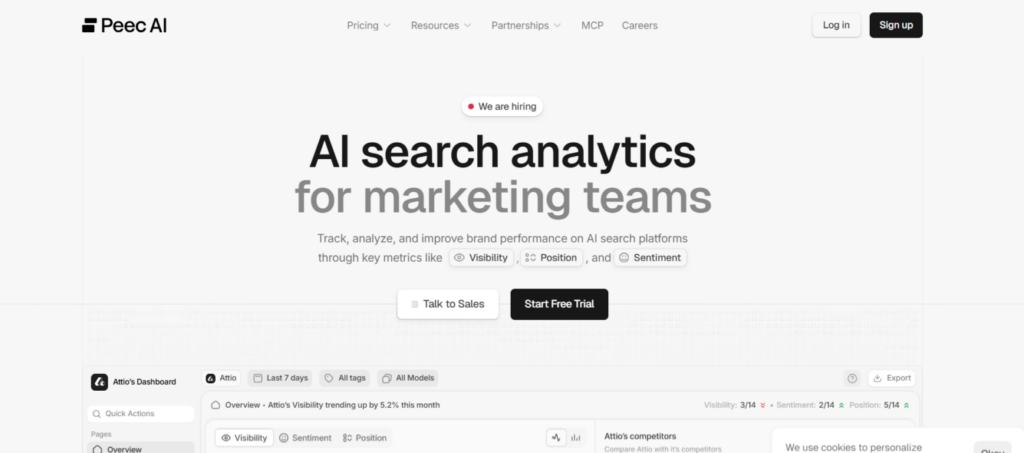
Peec AI is a Berlin-based AI search analytics platform that reached a $100 million-plus valuation in November 2025, less than a year after launching. The funding trajectory reflects how quickly the market recognised the problem it is solving: a pre-seed round in April 2025, a €5.2 million seed in July 2025 led by 20VC, and a $21 million Series A in November 2025 led by Singular. The platform had onboarded over 1,300 brands by November 2025 and was adding approximately 300 new customers per month, with clients including Wix, Chanel, Axel Springer, n8n, and ElevenLabs.
The core differentiator is methodology. Rather than querying AI platform APIs directly, Peec AI uses UI scraping technology that simulates actual browser sessions. This means the data reflects what real users see rather than what API sampling returns, which is a meaningful accuracy advantage when AI responses vary significantly based on how questions are phrased and which interface delivers them. The platform tracks 115-plus languages across multiple regions, making it particularly strong for European and global enterprise brands.
Key Features:
- UI Scraping Methodology — Simulates real user browser sessions rather than querying APIs, capturing the actual responses users see across ChatGPT, Perplexity, and Google AI Overviews with greater accuracy than API-based competitors.
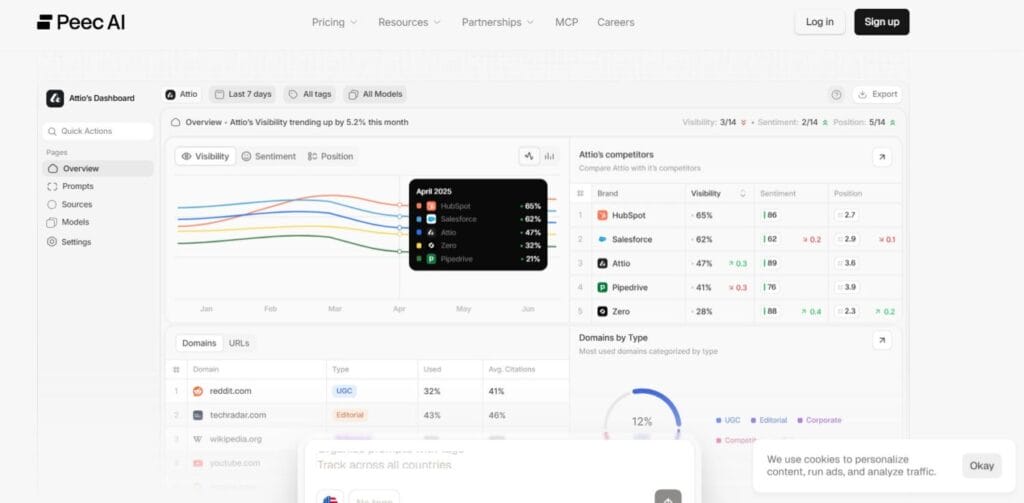
- Source Citation Analysis — Identifies not just whether a brand is mentioned but which specific URLs AI engines cite, categorising them by page type and ownership so teams can identify gap opportunities on third-party sites that mention competitors but not their brand.
- Competitive Share of Voice — Tracks brand visibility percentage against a configurable competitor set across regions, languages, and AI platforms, with industry ranking tables updated in near real time.
- Sentiment Analysis — Classifies brand mentions as positive, neutral, or negative within AI-generated responses, which moves the metric beyond raw appearance frequency into understanding how AI engines are actually framing a brand.
- Unlimited Team Seats — All Peec AI plans include unlimited users, which is a meaningful advantage for larger marketing teams and agencies managing multiple brands where per-seat pricing would otherwise make costs unpredictable.
Head-to-Head: Where They Differ
The most important difference between these two platforms is what they do after they show you the data. Otterly AI is built to close the loop between visibility measurement and content action. The Content Audit module tells you why AI skips your pages. The GEO Optimisation engine tells you what to do about it. Teams using Otterly AI can move from diagnosis to execution inside the same platform.
Peec AI is monitoring done exceptionally well, but monitoring only. Reviewers consistently note that Peec tells you where you stand without telling you how to improve. For teams with established content operations who simply need accurate, granular visibility data fed into their existing workflow, that is enough. For teams that need the optimisation layer included, Peec requires pairing with additional tools.
On data coverage, Peec AI’s UI scraping methodology and structured data labelling pipeline give it an accuracy edge for the platforms it covers. Its focus on web scraping, combined with optimised UI/UX design, ensures reliable data extraction and intuitive insights delivery. Otterly AI’s breadth advantage comes from covering six AI engines, including Google AI Mode and Gemini, which Peec AI offers as paid add-ons. Meanwhile, Peec AI’s support for 115+ languages remains difficult to match at its price point, particularly for multilingual enterprise brands.
On pricing, Peec AI starts at approximately €89 per month and is widely noted as more affordable than comparable platforms. Otterly AI has a free trial available and starts at a lower entry point, with scale-based pricing for volume.
Which One Should You Choose?
Choose Otterly AI if your team needs more than a visibility dashboard. If the question is not just “are we appearing in AI search” but “why aren’t we appearing and what do we do about it,” Otterly AI is the more complete answer. It is particularly well-suited for marketing teams and agencies that want a single platform covering prompt research, brand analytics, content diagnosis, and optimisation recommendations without stitching together multiple tools.
Choose Peec AI if accuracy and depth of monitoring are the priority, and your team has a separate content and optimisation function. The UI scraping methodology, 115-plus language support, sentiment analysis, and unlimited seats make it a strong choice for global enterprise brands and mid-market teams that need reliable, granular visibility data fed into an existing workflow. The more affordable pricing also makes it a better fit for teams running tight budgets who do not yet need the optimisation layer.
Conclusion
Both platforms solve a real problem that traditional SEO tools were never built to handle. The GEO monitoring category is still young, and the gap between monitoring and optimisation is the defining strategic question every marketing team needs to answer before choosing a tool. Otterly AI is the stronger choice for teams that want to act on what they find. Peec AI is the stronger choice for teams that want the most accurate and comprehensive picture of where they stand. Neither platform can guarantee AI citations, and neither replaces strong underlying content. But in a world where 40 to 60 percent of AI-cited domains change monthly, having continuous monitoring from either platform is significantly better than flying blind.
Frequently Asked Questions (FAQs)
Can Otterly AI or Peec AI guarantee my brand appears in ChatGPT responses?
No tool can guarantee AI citations because AI responses are non-deterministic and vary based on prompts, context, and model updates. Both platforms increase citation probability by helping teams understand and optimize what AI engines respond to, but outcomes depend on content quality and authority.
Which platform is better for agencies managing multiple client brands?
Otterly AI has a dedicated agency solution and is used by over 25,000 marketing professionals. Peec AI’s unlimited team seats make it cost-predictable for multi-brand setups. Otterly AI edges ahead for agencies that need optimization deliverables alongside reporting, not just monitoring dashboards.
Does Peec AI track Google AI Overviews?
Yes. Peec AI includes Google AI Overviews tracking alongside ChatGPT and Perplexity on base plans. Claude, Gemini, DeepSeek, Grok, and other platforms are available as paid add-ons ranging from €20 to €30 per model per month, which can make full multi-model coverage expensive.
How is GEO monitoring different from traditional SEO rank tracking?
Traditional SEO measures Google rankings and clicks. GEO monitoring measures how often your brand is mentioned or cited in AI-generated answers across platforms like ChatGPT and Perplexity. A brand can rank number one organically and still be invisible in AI search responses.
Which platform is more suitable for non-English markets?
Peec AI supports 115-plus languages and multi-region tracking, making it the stronger choice for brands operating in multiple languages or primarily in non-English markets. Otterly AI also supports multi-country monitoring but Peec AI’s language depth is its most distinctive competitive advantage.


You May Also Like

Pi Network Founders Take the Stage at Consensus 2026 Miami

Whale Bets Big On ZEC And HYPE With 10x Leverage




