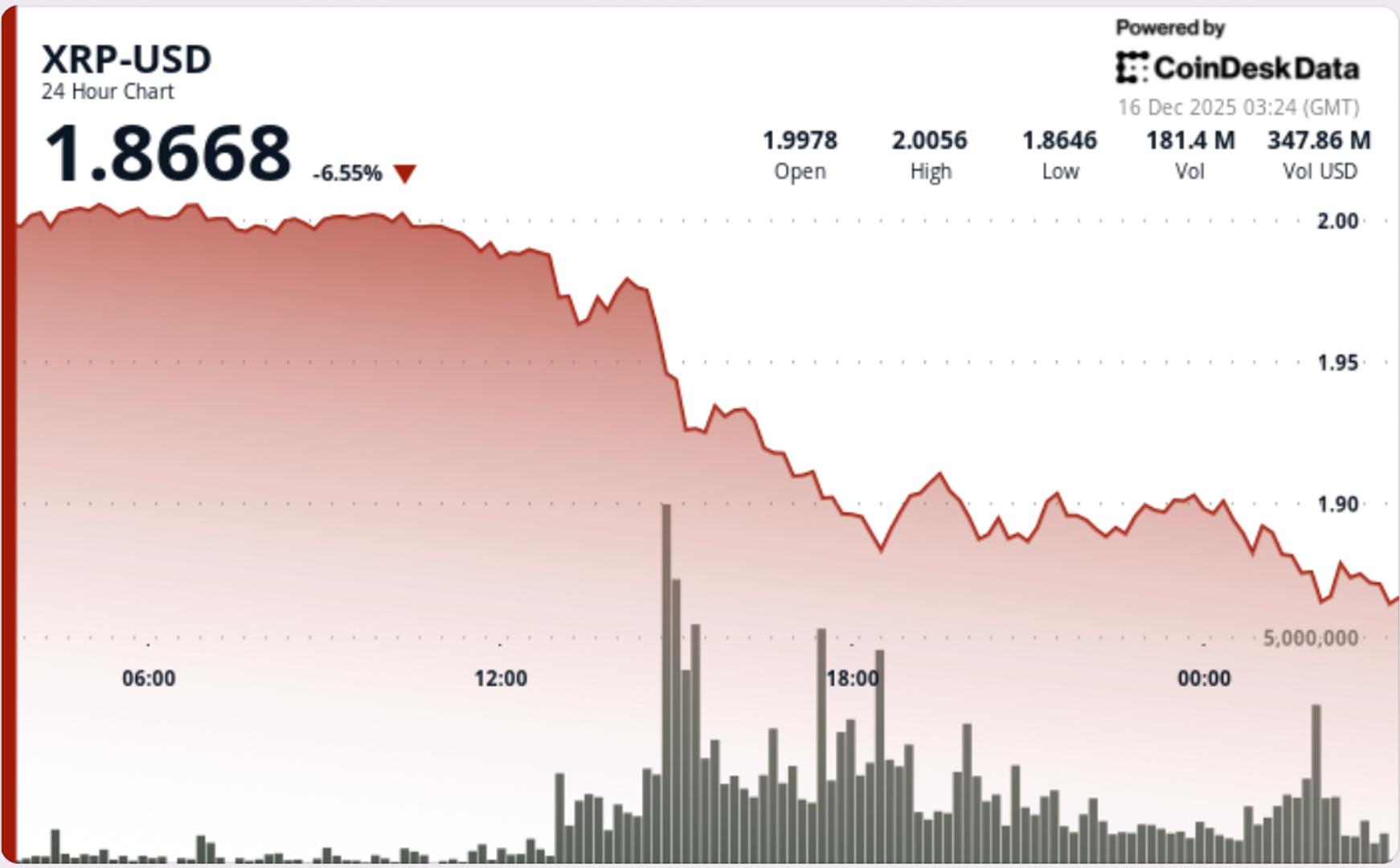
The market is grinding lower under seller control, and even though the XRP crypto price is weak, intraday charts suggest bears are starting to lose momentum.
Daily Chart (D1): Main Bias – Bearish, With Early Signs of Exhaustion
Trend & EMAs
– Price: $1.96
– EMA 20: $2.07
– EMA 50: $2.21
– EMA 200: $2.50
XRP is trading below all three major EMAs, and they are stacked bearishly (20 < 50 < 200). That is classic downtrend structure: every bounce so far has been sold into before it could even challenge the 50-day. The gap from price to the 20-day EMA (~$0.11) is not extreme, which shows the trend is steady rather than in full capitulation mode. Sellers are in control, but they are not panicking; they are methodically leaning on every rally.
RSI (14)
– RSI 14: 38.35
Daily RSI is below 40, aligned with a bearish regime, but not yet in classic oversold territory. That usually means momentum is negative, but there is still room for further downside before you would expect reflexive buying. In plain English, the trend is down, but the market has not reached a level where forced short covering or aggressive dip-buying is inevitable.
MACD
– MACD line: -0.06
– Signal line: -0.06
– Histogram: ~0
MACD on the daily is bearish but flat. Both lines are slightly below zero, and the histogram is essentially neutral. That matches the idea of a downtrend that is losing incremental downside momentum. Sellers are still in charge in terms of structure, but the push lower is slowing, which often comes before either a consolidation phase or a corrective bounce.
Bollinger Bands
– Middle band (20SMA): $2.09
– Upper band: $2.25
– Lower band: $1.93
– Price: $1.96 (near the lower band)
Price is hugging the lower Bollinger Band, just a few cents above $1.93. When price rides the lower band in a bearish regime, it is a sign that selling pressure is persistent. However, because the move is not sharply piercing the band, it also hints at a grind rather than a crash. This positioning usually favors sell-the-rip strategies, but it also warns bears that they are getting close to an area where short-term bounces can form from stretched conditions.
ATR (14)
– ATR 14: $0.09
Daily ATR at nine cents is modest for a coin near $2. Volatility is contained; the market is not in a blowout phase. That is consistent with a disciplined downtrend that has not yet flushed out late longs with a violent spike in volatility. The risk is that if a catalyst hits, cold volatility can quickly wake up and produce a sharp move in either direction.
Pivot Levels (D1)
– Pivot Point (PP): $1.98
– Resistance 1 (R1): $2.00
– Support 1 (S1): $1.95
XRP is trading just below the daily pivot at $1.98 and under the first resistance at $2.00, hovering closer to support at $1.95. Being pinned under the pivot tilts the intraday balance toward sellers, but the S1 level is close enough that short-term support is nearby. It is a compressed range: a decisive break below $1.95 would confirm sellers still have stamina, whereas reclaiming and holding above $1.98–$2.00 would signal the start of a relief attempt.
Daily takeaway: The main scenario is bearish. Trend and structure point down, but momentum is no longer accelerating. That leaves room for a countertrend bounce, yet the burden of proof is firmly on the bulls.
Hourly Chart (H1): Oversold Intraday, But Still in a Downtrend
Trend & EMAs (H1)
– Price: $1.96
– EMA 20: $1.99
– EMA 50: $2.00
– EMA 200: $2.04
– Regime: Bearish
On the hourly, XRP is below the 20, 50, and 200 EMAs, mirroring the daily bearish stack. Short-term rallies are being capped before price can even test the 50-hour EMA. This alignment shows that intraday flow is following the higher timeframe downtrend; there is no real sign of reclaiming control yet, just minor bounces into resistance.
RSI (14) – H1
– RSI 14: 28.59
Hourly RSI is deep in oversold territory. That usually means sellers have pushed too hard in the short run, and the fuel for further immediate downside is limited unless there is a fresh catalyst. This is where you often see short-covering rallies or at least sideways consolidation. However, oversold in a strong downtrend can stay oversold longer than many expect; it is a warning sign for bears, not an automatic buy signal.
MACD – H1
– MACD line: -0.01
– Signal line: 0.00
– Histogram: ~0
The hourly MACD is just below zero and almost flat. That fits with the idea of downside momentum stalling after a push lower. There is no strong bullish cross yet, but the lack of a clear negative expansion suggests that while the downtrend is intact, it is getting tired intraday.
Bollinger Bands – H1
– Middle band: $1.99
– Upper band: $2.01
– Lower band: $1.97
– Price: $1.96 (slightly under the lower band)
Price is sitting right around the lower hourly band, slightly underneath it. That lines up with the oversold RSI: short-term price is stretched to the downside. Historically, this kind of setup often produces small mean reversion moves back toward the middle band around $1.99, unless a strong trend day develops and price walks the band lower.
ATR (14) – H1
– ATR 14: $0.01
An ATR of just one cent on the hourly shows very tight intraday ranges. This is a sluggish tape: moves are small, liquidity providers are comfortable, and no one is panic-selling at this exact moment. However, it also means any sudden spike in volume can move price quickly because the normal move is so compressed.
Pivot Levels – H1
– Pivot Point (PP): $1.97
– Resistance 1 (R1): $1.98
– Support 1 (S1): $1.96
On the hourly, XRP is pressed right into S1 at $1.96, with the pivot just above at $1.97. Price is pinned to the lower side of the range. Staying under the pivot keeps the short-term bias bearish, but the proximity of S1 means local support is being tested repeatedly. A quick reclaim of $1.97–$1.98 would fit with the oversold narrative and could open a squeeze up toward the EMA cluster around $2.00–$2.04.
15-Minute Chart (M15): Execution Zone – Heavy Pressure, Potential for a Pop
Trend & EMAs (M15)
– Price: $1.96
– EMA 20: $1.99
– EMA 50: $1.99
– EMA 200: $2.00
– Regime: Bearish
The 15-minute chart reflects a compressed but clear downtrend. Price is below the 20, 50, and 200 EMAs, which are tightly clustered just under $2.00. That cluster is essentially a short-term supply zone. Every push into that region is likely to find sellers unless higher timeframes start to flip. For execution, this is where intraday traders typically look for either fade entries against pops or breakout confirmation if price can sustain above.
RSI (14) – M15
– RSI 14: 22.8
On the 15-minute chart, RSI is extremely oversold. That level is rarely sustainable without at least a pause. It shows locally one-sided selling, where short-term traders have mostly been hitting the bid. From an execution perspective, this is where chasing fresh shorts becomes increasingly risky and where snap-back moves can be violent, even if they only retrace a small part of the broader downtrend.
MACD – M15
– MACD line: -0.01
– Signal line: 0.00
– Histogram: ~0
On 15 minutes, MACD is slightly negative but flat, very similar to the hourly. The sell impulse has already played out, and momentum is now more about drift than drive. That often sets up a short-term inflection point: either a small bounce to reset indicators or a fresh spike in volume to reignite the trend.
Bollinger Bands – M15
– Middle band: $1.99
– Upper band: $2.01
– Lower band: $1.97
– Price: $1.96 (near or just under the lower band)
Price is pressing against the lower 15-minute band, echoing the hourly picture. Short-term, the market is stretched to the downside. Combined with the very low RSI, it is a classic setup for choppy, stop-hunting price action, with quick spikes up and down as late shorts and anxious longs get shaken out.
Pivot Levels – M15
– Pivot Point (PP): $1.97
– Resistance 1 (R1): $1.97
– Support 1 (S1): $1.96
On the micro timeframe, XRP is trading between S1 at $1.96 and the pivot or R1 cluster around $1.97. That is a very narrow battlefield. For scalpers, the key is which side breaks with volume: below $1.96 keeps the pressure on for another leg lower, while a clean move back through $1.97 starts to validate the oversold-bounce case.
Market Context: Risk-Off and Extreme Fear
Broader crypto market cap is around $3.15T, barely changed in the last 24 hours, while BTC dominance near 57% shows money crowding into the perceived safer end of the crypto spectrum. Altcoins, including XRP, are on the wrong side of this rotation.
The Crypto Fear & Greed Index at 16 (Extreme Fear) shows sentiment is washed out. In such environments, two things can coexist: structurally weak prices and sharp countertrend rallies. Extreme fear can mean real risk-off positioning, but it also tends to come before the most aggressive short squeezes once positioning gets one-sided enough.
Scenarios for the XRP Crypto Price
Bullish Scenario: Oversold Bounce and Trend Repair Attempt
For bulls, the path forward starts with a short-term relief rally born out of oversold intraday conditions.
Key elements of a constructive bullish path:
1. Hold $1.95–$1.96 support: This zone is the immediate battlefield. If price continues to defend it, hourly and 15-minute oversold conditions can fuel a pop higher.
2. Reclaim the daily pivot: A move back above $1.98–$2.00, with hourly closes holding above, would signal that short-term sellers are losing grip. That also lines up with the hourly pivot and R1, turning previous resistance into a potential base.
3. Test the EMA cluster: If price can sustain above $2.00, the next logical magnet is the intraday EMA confluence around $2.00–$2.04 and then the daily 20 EMA near $2.07–$2.10. A clean breakout and hold above the daily 20 EMA would be the first serious sign that the downtrend is transitioning into a broader consolidation.
In this bullish scenario, the initial move is a mean reversion bounce, not a trend reversal yet. Confirmation of something more structural would require:
- Daily RSI pushing back toward and above 45–50.
- MACD lines curling up and starting to cross toward the zero line.
- Price basing above the 20-day EMA instead of rejecting from it.
What invalidates the bullish scenario?
A decisive breakdown below $1.95 on strong volume, with hourly closes cementing that level as resistance, would show the oversold bounce has failed and the market is ready for another leg down. Continued rejection below $2.00 after multiple attempts would also weaken the bullish case, showing that sellers are still defending that level aggressively.
Bearish Scenario: Trend Resumes After Weak Bounce or Direct Breakdown
The dominant daily regime is still bearish, so the straightforward scenario is continuation lower, especially if any bounce stalls below the EMAs.
Bearish continuation could play out in two ways:
1. Direct breakdown: Price slices through $1.95 and holds below it, turning S1 into resistance. With intraday ATRs so tight, this might start slowly but can accelerate if stops begin to trigger beneath local lows.
2. Failing bounce setup: XRP first bounces off oversold intraday conditions into the $1.99–$2.04 resistance band, made up of EMAs plus pivot and R1, then stalls. If price repeatedly rejects from this cluster and rolls back over with hourly RSI failing to get back above 50, that would signal a typical bear-market rally: a chance for trapped longs to exit and for fresh shorts to position with defined risk.
In both bearish paths, the daily structure remains intact: price holds under the 20-day EMA, daily RSI stays capped below 45, and MACD remains negative. In that context, new lows become a matter of time rather than a surprise for the XRP crypto price.
What invalidates the bearish scenario?
Bears lose their clear edge if XRP can:
- Break and close multiple days above the 20-day EMA (around $2.07) and start using it as support.
- Push daily RSI back into the neutral 50–55 area, signaling that downside momentum has truly faded.
- Flip the hourly and 4H EMAs into a bullish stack (20 > 50 > 200) with volume picking up on up-moves rather than on dumps.
How to Think About Positioning, Risk, and Uncertainty
XRP’s current setup is a classic trend vs. mean reversion battleground. The daily chart is clear: the market is in a downtrend with all the structural hallmarks of weakness. The intraday charts, however, are shouting oversold, which is where traders often get chopped up the most by mixing timeframes without a plan.
- Trend followers will generally stay aligned with the daily bearish bias, focusing on selling rallies into resistance zones ($1.99–$2.10) rather than trying to pick the exact bottom.
- Mean reversion traders will see opportunity in the deeply oversold hourly and 15-minute RSIs, but the edge is only there if risk is tightly controlled and expectations are set for a bounce, not an immediate trend reversal.
- Long-term holders are in a phase where adding exposure purely on technicals is tricky: the chart is not washed out enough for capitulation, and the broader market is in Extreme Fear, which can persist longer than many people like.
Volatility is currently compressed (low ATR on all timeframes), which makes it easy to underestimate future risk. Tight ranges often come before large expansions, especially when sentiment is extreme and positioning crowded. Whether the next big move for the XRP crypto price is a short squeeze higher or a fresh leg lower will depend on how price reacts around the immediate pivot band ($1.95–$2.00) over the coming sessions.
In this type of environment, clarity comes from respecting the higher timeframe daily bias while using the shorter timeframes to refine timing, not to argue with the trend. The market is telling a coherent story: XRP is weak, but bears are starting to look overextended intraday. The next break of this tight range will reveal which side overplayed its hand.
If you want to monitor markets with professional charting tools and real-time data, you can open an account on Investing using our partner link:
Open your Investing.com account
This section contains a sponsored affiliate link. We may earn a commission at no additional cost to you.
Disclaimer: This analysis is for informational and educational purposes only and is not a recommendation to buy, sell, or hold any cryptocurrency or financial instrument. Markets are volatile and unpredictable; always conduct your own research and consider your risk tolerance before making trading decisions.
Source: https://en.cryptonomist.ch/2025/12/15/xrp-crypto-price-analysis-bearish/