Solana’s price action this year has followed a clear but uncomfortable pattern. After pushing to a new all-time high around the $296 region in January, the rallySolana’s price action this year has followed a clear but uncomfortable pattern. After pushing to a new all-time high around the $296 region in January, the rally

Why Has The Solana Price Been In A Steady Downtrend Since January?

2025/12/25 02:00

Solana’s price action this year has followed a clear but uncomfortable pattern. After pushing to a new all-time high around the $296 region in January, the rally quickly lost momentum and transitioned into a steady decline that has persisted for months. 

Many traders have attributed this weakness to a risk-off sentiment across crypto, but a deeper on-chain breakdown shared by crypto analyst Ardi on X suggests the story began well before the January peak and has more to do with who was buying and who was quietly exiting.

Distribution Was Already Underway Before The January Peak

Solana has been on a clear downtrend since September, when it reached a lower high of around $247 compared to its January 19 all-time high of $293. One of the most important insights from Ardi’s analysis is that Solana’s January all-time high did not mark the start of distribution but rather the culmination of it. 

The chart attached to his post shows that selling volume was already increasing months earlier, well ahead of October, meaning that large holders were positioning for exits long before price reached its final peak. From that perspective, the January high looks less like the beginning of a new expansion phase and more like the last push of a rally. 
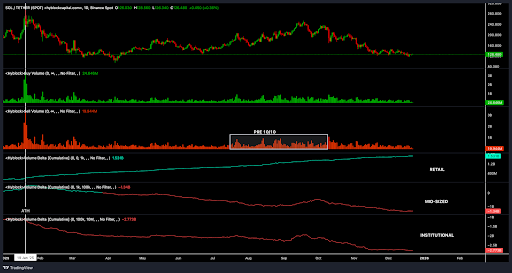
Solana

After that point, price action began forming lower highs, and each rebound attempt lacked the strength needed to reclaim the all-time high. Interestingly, Solana failed to reach a new all-time high, even as other large market cap cryptos like Bitcoin, Ethereum, XRP, and BNB pushed to new all-time highs during the year.

Another interesting feature of the data is the widening gap between retail behavior and that of larger players. Cumulative delta metrics on the chart show that retail-sized wallets have been consistently active throughout the year and are increasing their activity even as Solana’s price moved lower.

On the other hand, mid-sized and institutional wallets tell a very different story. Their activity has been trending downward for months, starting from the January peak and extending up until the time of writing.

Is Solana’s Price Becoming Dependent On Memecoin Activity?

Ardi’s analysis also raises a broader question about what is currently driving demand for Solana. Outside of retail activity on Solana itself, one of the few consistent sources of activity has been the memecoin sector. Successes and booms of meme coins like Cat in a Dogs World (MEW), Peanut the Squirrel (PNUT), and Fartcoin (FARTCOIN), which gained traction in the second half of 2024, contributed to Solana’s push to all-time highs during those periods.

Those meme coin successes culminated with the launch of the Official Trump ($TRUMP) token in January 2025 on Solana, which experienced eye-watering gains shortly after its launch. This, in turn, contributed to Solana’s all-time high in January. 

However, since then, the TRUMP token and other Solana-based meme coins have been trending downwards in recent months and no longer command the same level of attention or trading intensity they had this time last year. That has led to the view that Solana’s price is increasingly sensitive to the success of memecoins in its ecosystem. 

At the time of writing, Solana is trading at $121.50, down by about 58.6% from its January all-time high of $293.

Solana
Market Opportunity
WHY Logo
WHY Price(WHY)
$0.00000001619
$0.00000001619$0.00000001619
0.00%
USD
WHY (WHY) Live Price Chart
Disclaimer: The articles reposted on this site are sourced from public platforms and are provided for informational purposes only. They do not necessarily reflect the views of MEXC. All rights remain with the original authors. If you believe any content infringes on third-party rights, please contact service@support.mexc.com for removal. MEXC makes no guarantees regarding the accuracy, completeness, or timeliness of the content and is not responsible for any actions taken based on the information provided. The content does not constitute financial, legal, or other professional advice, nor should it be considered a recommendation or endorsement by MEXC.

You May Also Like

The Channel Factories We’ve Been Waiting For

The Channel Factories We’ve Been Waiting For

The post The Channel Factories We’ve Been Waiting For appeared on BitcoinEthereumNews.com. Visions of future technology are often prescient about the broad strokes while flubbing the details. The tablets in “2001: A Space Odyssey” do indeed look like iPads, but you never see the astronauts paying for subscriptions or wasting hours on Candy Crush.  Channel factories are one vision that arose early in the history of the Lightning Network to address some challenges that Lightning has faced from the beginning. Despite having grown to become Bitcoin’s most successful layer-2 scaling solution, with instant and low-fee payments, Lightning’s scale is limited by its reliance on payment channels. Although Lightning shifts most transactions off-chain, each payment channel still requires an on-chain transaction to open and (usually) another to close. As adoption grows, pressure on the blockchain grows with it. The need for a more scalable approach to managing channels is clear. Channel factories were supposed to meet this need, but where are they? In 2025, subnetworks are emerging that revive the impetus of channel factories with some new details that vastly increase their potential. They are natively interoperable with Lightning and achieve greater scale by allowing a group of participants to open a shared multisig UTXO and create multiple bilateral channels, which reduces the number of on-chain transactions and improves capital efficiency. Achieving greater scale by reducing complexity, Ark and Spark perform the same function as traditional channel factories with new designs and additional capabilities based on shared UTXOs.  Channel Factories 101 Channel factories have been around since the inception of Lightning. A factory is a multiparty contract where multiple users (not just two, as in a Dryja-Poon channel) cooperatively lock funds in a single multisig UTXO. They can open, close and update channels off-chain without updating the blockchain for each operation. Only when participants leave or the factory dissolves is an on-chain transaction…
Share
BitcoinEthereumNews2025/09/18 00:09
What is the Outlook for Digital Assets in 2026?

What is the Outlook for Digital Assets in 2026?

The post What is the Outlook for Digital Assets in 2026? appeared on BitcoinEthereumNews.com. The crypto market cap reached $4.3 trillion in 2025 as institutions
Share
BitcoinEthereumNews2025/12/25 03:23
Pudgy Penguins’ Non-Crypto Display Wraps Las Vegas Sphere, Potentially Elevating PENGU Brand Reach

Pudgy Penguins’ Non-Crypto Display Wraps Las Vegas Sphere, Potentially Elevating PENGU Brand Reach

The post Pudgy Penguins’ Non-Crypto Display Wraps Las Vegas Sphere, Potentially Elevating PENGU Brand Reach appeared on BitcoinEthereumNews.com. Pudgy Penguins,
Share
BitcoinEthereumNews2025/12/25 03:41