Changpeng “CZ” Zhao pushed back after a screenshot showing bitcoin at roughly $24,111 on Binance went viral on X, arguing the move was a microstructure glitch onChangpeng “CZ” Zhao pushed back after a screenshot showing bitcoin at roughly $24,111 on Binance went viral on X, arguing the move was a microstructure glitch on

CZ Responds After Bitcoin Briefly ‘Crashes’ To $24,000 On Binance

Changpeng “CZ” Zhao pushed back after a screenshot showing bitcoin at roughly $24,111 on Binance went viral on X, arguing the move was a microstructure glitch on a thin, newly listed BTC/USD1 pair rather than a broader market crash and that the exchange itself “is NOT involved in trades.”

Did Bitcoin Really Crash To $24,000?

The sharp wick appeared isolated to BTC/USD1, a market quoted in USD1, a stablecoin launched by Trump family-backed World Liberty Financial. Within seconds, the pair snapped back toward prevailing bitcoin prices above $87,000, according to exchange data cited by traders sharing the screenshot.

CZ’s explanation was straightforward: on an illiquid order book, a single aggressive order can print an extreme price before arbitrage closes the gap. “This actually shows the exchange is NOT involved in trades. Low liquidity on new pairs means one large market order can spike prices, but arbitrageurs quickly corrected it. No liquidations occurred, as this pair isn’t included in any index.”

The Binance founder shared a breakdown from Head of Business Development of Solv Protocol Catherine Chan who said the move was “a liquidity event,” not a bitcoin collapse. She tied the dislocation to a Binance-and-USD1 promotion offering a 20% fixed APY deposit deal that, she claimed, pushed users to swap USDT into USD1 and briefly drove USD1 to a premium.

“Many users swapped USDT → USD1, pushing USD1 to a 0.39% premium: huge for a stablecoin. Smart money borrowed USD1 on @lista_dao against SolvBTC or SolvBTC-BTCB smart lending markets (~0.5% APY). They either deposited USD1 directly or sold it slowly on spot to meet demand. Then someone thought: ‘Why not just sell via BTC/USD1?’ They used a market order. Problem: BTC/USD1 has very thin liquidity. That market order wiped out most buy orders, briefly causing a very low price,” Catherine explained.

“Arbitrage bots instantly bought it back,” she wrote. “No fundamentals changed. No mass liquidations.”

The episode also picked up a familiar edge of crypto paranoia. One user, Bera (@doomsdart), framed it as a coordinated signal: “Cz and Trump family are telling us what they’re gonna do to our coins. Get ready.” CZ’s reply, by contrast, suggested the opposite — that the speed of arbitrage, and the absence of cascading liquidations, is evidence the venue wasn’t “printing” a market-wide price at all.

For traders, the takeaway is less dramatic than the screenshot implied, but still relevant: new quote-asset pairs can be structurally fragile, and promotions that rapidly concentrate flow into a single stablecoin can leave unusually thin order books in their wake. In that kind of market, a single market order can create a headline before it creates a trend.

At press time, Bitcoin traded at $89,298.
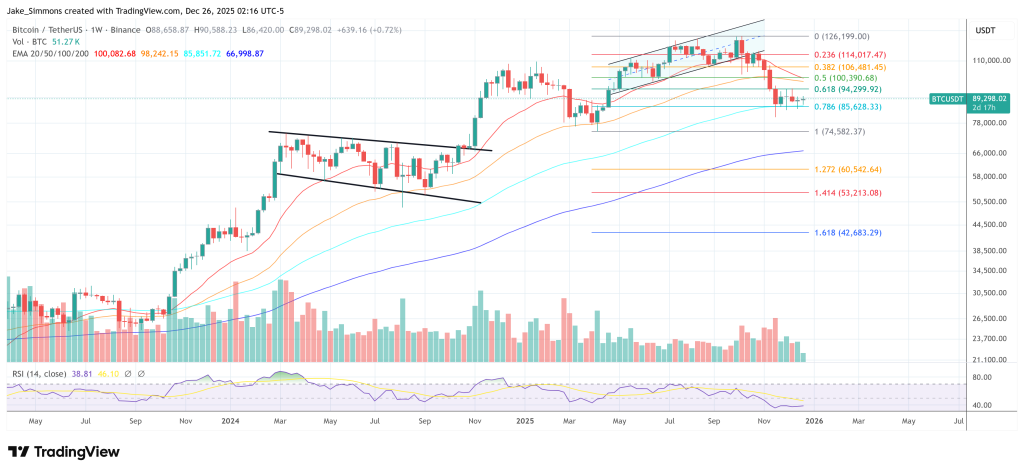
Bitcoin price chart
Market Opportunity
Movement Logo
Movement Price(MOVE)
$0.03518
$0.03518$0.03518
-7.78%
USD
Movement (MOVE) Live Price Chart
Disclaimer: The articles reposted on this site are sourced from public platforms and are provided for informational purposes only. They do not necessarily reflect the views of MEXC. All rights remain with the original authors. If you believe any content infringes on third-party rights, please contact service@support.mexc.com for removal. MEXC makes no guarantees regarding the accuracy, completeness, or timeliness of the content and is not responsible for any actions taken based on the information provided. The content does not constitute financial, legal, or other professional advice, nor should it be considered a recommendation or endorsement by MEXC.

You May Also Like

Trust Wallet’s Decisive Move: Full Compensation for $7M Hack Victims

Trust Wallet’s Decisive Move: Full Compensation for $7M Hack Victims

BitcoinWorld Trust Wallet’s Decisive Move: Full Compensation for $7M Hack Victims In a significant move for cryptocurrency security, Trust Wallet has committed
Share
bitcoinworld2025/12/26 17:40
Cashing In On University Patents Means Giving Up On Our Innovation Future

Cashing In On University Patents Means Giving Up On Our Innovation Future

The post Cashing In On University Patents Means Giving Up On Our Innovation Future appeared on BitcoinEthereumNews.com. “It’s a raid on American innovation that would deliver pennies to the Treasury while kneecapping the very engine of our economic and medical progress,” writes Pipes. Getty Images Washington is addicted to taxing success. Now, Commerce Secretary Howard Lutnick is floating a plan to skim half the patent earnings from inventions developed at universities with federal funding. It’s being sold as a way to shore up programs like Social Security. In reality, it’s a raid on American innovation that would deliver pennies to the Treasury while kneecapping the very engine of our economic and medical progress. Yes, taxpayer dollars support early-stage research. But the real payoff comes later—in the jobs created, cures discovered, and industries launched when universities and private industry turn those discoveries into real products. By comparison, the sums at stake in patent licensing are trivial. Universities collectively earn only about $3.6 billion annually in patent income—less than the federal government spends on Social Security in a single day. Even confiscating half would barely register against a $6 trillion federal budget. And yet the damage from such a policy would be anything but trivial. The true return on taxpayer investment isn’t in licensing checks sent to Washington, but in the downstream economic activity that federally supported research unleashes. Thanks to the bipartisan Bayh-Dole Act of 1980, universities and private industry have powerful incentives to translate early-stage discoveries into real-world products. Before Bayh-Dole, the government hoarded patents from federally funded research, and fewer than 5% were ever licensed. Once universities could own and license their own inventions, innovation exploded. The result has been one of the best returns on investment in government history. Since 1996, university research has added nearly $2 trillion to U.S. industrial output, supported 6.5 million jobs, and launched more than 19,000 startups. Those companies pay…
Share
BitcoinEthereumNews2025/09/18 03:26
Trust Wallet Hack Hits $7M: CZ Hints at Possible Insider Role

Trust Wallet Hack Hits $7M: CZ Hints at Possible Insider Role

CZ hinted at possible insider involvement in the Trust Wallet incident while assuring users that their funds would be reimbursed.
Share
CryptoPotato2025/12/26 16:48