

How Long Will The Bitcoin Bear Market Last? CryptoQuant Research Chief Predicts
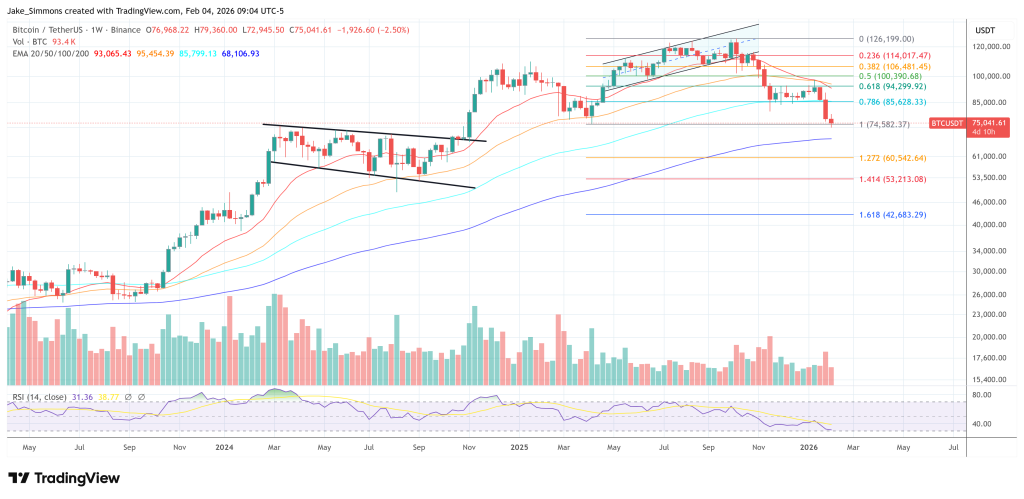
The Bitcoin drawdown below $75,000 has market participants debating a familiar question: how long does a bear market last when the data refuses to improve. CryptoQuant head of research Julio Moreno, speaking on The Milk Road Show on Feb. 2, argued that most major demand and liquidity indicators are still signaling weakness and that the bottoming process could take months, not weeks.
Bitcoin Bear Market Can’t Be Denied Anymore
Moreno’s core framework is CryptoQuant’s “Bull Score Index,” a composite of 10 metrics spanning on-chain valuation, liquidity conditions, market data, and a single technical trend input. “The index goes from zero to 100. Zero is the most bearish, 100 is the most bullish,” he said. “First the index is at zero, which is extremely bearish territory […] and it has been between like zero and 10 for the last maybe month and a half […] What it’s telling us is there’s too much weakness in either the data [or] in the markets.”
He pointed to how quickly the same index flipped in October, when a liquidation event accelerated the shift from bullish to bearish readings. In early October the index hit 80, “well inside bullish territory” before collapsing toward 20–30 in “a few days,” a move Moreno interpreted as a momentum failure that turned a late-cycle rally into a short-lived spike.
Moreno’s bigger point was about lead time. He said the index “tends to become […] bearish before there’s a big correction in prices,” framing it as an early-warning system rather than a lagging confirmation tool. On the show, he summarized the current regime bluntly: Bitcoin is “well in bear market,” and “the data is just not supportive of any meaningful reversal.”
On demand, Moreno highlighted US spot Bitcoin ETFs, which he said shifted into net selling in Q4 and remained a drag into early 2026. He cited year-to-date flows showing ETFs had sold more than 10,000 BTC in January, compared with purchasing 46,000 BTC in the same period a year earlier. “If ETFs are net sellers then it’s not supportive for prices,” he said, adding that any sustained recovery would likely require that demand to stabilize and grow again.
The same dynamic showed up in the Coinbase premium, the price spread between Coinbase and offshore exchanges such as Binance. Moreno described the premium as a proxy for US demand and said it flipped negative in November and has stayed negative “most of the time” since. Historically, he argued, bull markets have been “driven by […] higher US demand,” and the persistence of a discount suggests the US bid hasn’t returned, even after the drawdown.
Moreno also pointed to stablecoin liquidity as a missing tailwind. He tracked the 60-day change in USDT market cap, a proxy for fresh capital entering the trading ecosystem, and said growth has effectively stalled since mid-October. New issuance tends to land on exchanges, he explained, “and provides […] dry powder for then traders buying crypto,” tying stablecoin expansion directly to market-wide liquidity conditions.
Beyond ETFs and stablecoins, Moreno said CryptoQuant’s longer-term Bitcoin demand growth model is hovering near zero on a year-over-year basis. “What drives bull markets is this […] growth in demand, the demand waves,” he said, but since October that growth has slowed sharply. In his view, it helps explain why downside has persisted even as the market searches for a durable base.
Leverage positioning has also deteriorated. Moreno used perpetual futures funding rates as a read on the appetite to hold long exposure and said the one-year average funding rate trend is pointing lower: “less appetite to go long” while short-term funding flips need to be interpreted differently depending on whether the market is in a bull or bear regime.
When Will The Bitcoin Bear Market End?
For the technical component, Moreno emphasized Bitcoin’s one-year moving average, which he treats as a regime filter. “A good way to see the trend in the price is just looking at the one-year moving average,” he said, arguing it acts as support in bull markets and resistance once price breaks below. He noted Bitcoin crossed beneath it in early November and has failed to reclaim it, a pattern he said resembles early 2022.
On key levels, Moreno described the “trader on-chain realized price” — the estimated cost basis of active market participants — as overhead resistance around $89,000 and $79,000. His next price target is $70,000 as an intermediate marker and $56,000 as a deeper level tied to the same cost-basis framework.
Moreno closed with a warning about psychology as much as charting. “First of all you have to accept this. We are in a bear market. So plan accordingly,” he said. “There will be price rallies […] but don’t confuse that with the start of a bull market […] and […] don’t catch the falling knife […] the market’s bottom in months.”
As for duration, Moreno said he could see the first credible bottoming window emerging around Q3 2026, based on historical patterns and the fact that this downturn appears to have started earlier than some prior cycles. Whether that timeline holds, he suggested, will depend less on a single bounce and more on whether demand, US flows, and liquidity indicators stop flatlining and start turning back up.
At press time, BTC traded at $75,041.
You May Also Like

Cashing In On University Patents Means Giving Up On Our Innovation Future
Silver Price Crash Is Over “For Real This Time,” Analyst Predicts a Surge Back Above $90
