Bitcoin futures positioning among non-commercial traders is swinging sharply toward net long exposure, a move technical analyst Tom McClellan (editor of The McClellanBitcoin futures positioning among non-commercial traders is swinging sharply toward net long exposure, a move technical analyst Tom McClellan (editor of The McClellan

Bitcoin COT Data: Smart Money Goes Net Long With ‘Urgency’

2026/02/23 16:31
3 min read
For feedback or concerns regarding this content, please contact us at crypto.news@mexc.com

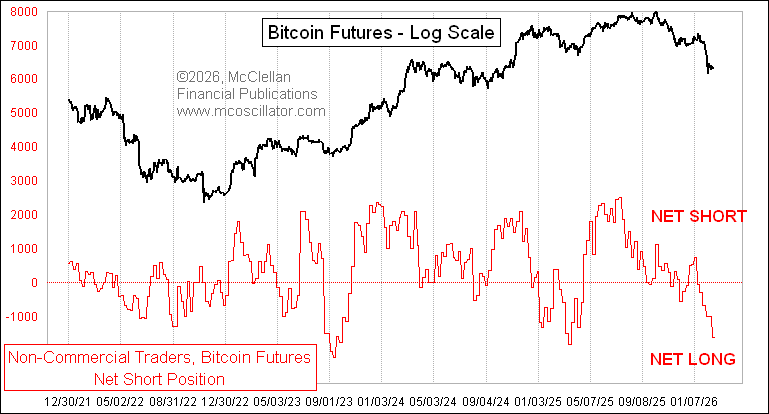
Bitcoin futures positioning among non-commercial traders is swinging sharply toward net long exposure, a move technical analyst Tom McClellan (editor of The McClellan Market Report) says has arrived “with some urgency” in the latest weekly Commitment of Traders (COT) report and one that has coincided with notable market outcomes in prior, similarly extreme episodes.

Sharing a chart of Bitcoin futures (price on a log scale) alongside non-commercial net positioning, McClellan argued that in Bitcoin’s case, large speculators effectively function as the “smart money” cohort, because the market lacks the typical commercial hedger presence seen in traditional commodity futures.

“The non-commercial traders of Bitcoin futures are usually the smart money,” McClellan wrote. “This week’s COT Report shows that they are moving net long with some urgency. Look back at what the last two similar excursions led to. But remember, this is ‘a condition, not a signal’.”
Bitcoin COT data

Why Non-Commercials Matter In Bitcoin Futures

McClellan later expanded on how he frames the CFTC’s weekly report, which breaks futures positioning into commercials, non-commercials, and non-reportables. In corn, for example, commercials might be producers or end users; in Bitcoin, he says that category is thin. “In Bitcoin, there are hardly any traders who qualify as Commercial traders,” McClellan wrote. “So in an unusual circumstance, the Non-commercial traders fill the role of being the smart money.”

That distinction matters because COT is not about absolute long or short interest, every futures contract has a long and a short by definition, but about who is on each side. “Every futures contract is simultaneously one long and one short position, held by different parties. So the number of longs will always equal the number of shorts,” he wrote. “What matters is who holds the positions.”

McClellan also cautioned against importing equity-market intuition about short interest into futures positioning. “So a large short position in a stock represents potential energy which could get converted into price movements via short covering,” he wrote. “COT data don’t do that. They just represent expert opinion.”

The core dispute in the X thread wasn’t whether COT can be useful, but how to interpret timing. Trader toni (@tonitrades_) agreed the dataset has value but questioned whether futures positioning simply follows spot momentum. “COT data has historically been a solid indicator, no argument there,” toni wrote. “But non-commercial positioning often lags spot market moves by weeks. By the time futures traders pile in, the initial momentum is usually priced in already.”

McClellan pushed back on that sequencing. “I think you meant that their positioning PRECEDES price moves sometimes by weeks,” he replied, underscoring his view that positioning extremes can show up ahead of meaningful market moves, though not on a predictable schedule.

That’s where the thread landed: with an emphasis on uncertainty. Jim Osman (@EdgeCGroup) summed it up succinctly: “Timing still uncertain.” McClellan agreed. “Exactly, hence my admonition.”

In his longer explanation, McClellan reiterated that most weeks the COT report has no actionable message, but that extremes can be informative with a crucial caveat. “A lot of the time there is no useful message in the COT data for each futures contract,” he wrote.

“But when an extreme develops like now in Bitcoin, then we can get useful information. But as with any overbought or oversold reading on any indicator, COT data only reflect a ‘condition’ not a signal. The data will not tell you when that condition is going to matter, only that it should matter, sometime.”

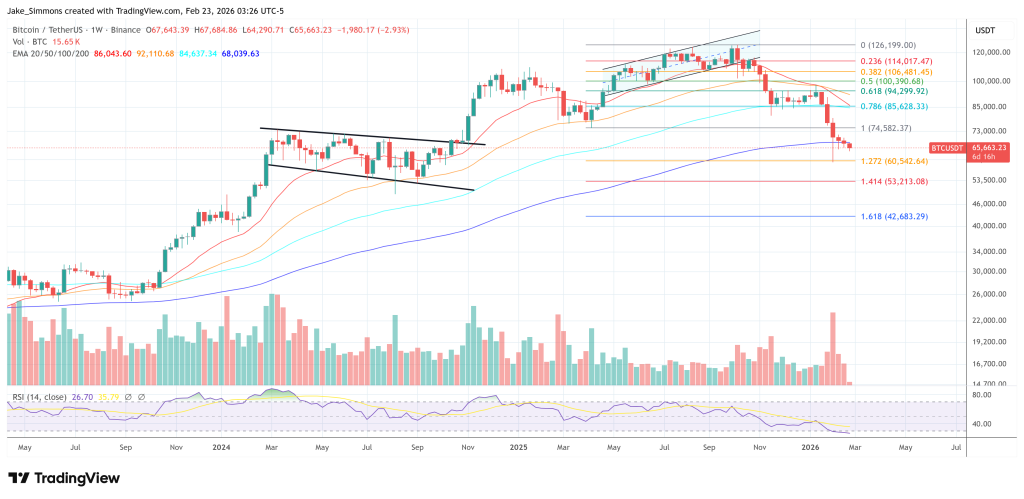
At press time, BTC traded at $65,663.
Bitcoin price chart
Market Opportunity
Cosplay Token Logo
Cosplay Token Price(COT)
$0.00091
$0.00091$0.00091
-0.65%
USD
Cosplay Token (COT) Live Price Chart
Disclaimer: The articles reposted on this site are sourced from public platforms and are provided for informational purposes only. They do not necessarily reflect the views of MEXC. All rights remain with the original authors. If you believe any content infringes on third-party rights, please contact crypto.news@mexc.com for removal. MEXC makes no guarantees regarding the accuracy, completeness, or timeliness of the content and is not responsible for any actions taken based on the information provided. The content does not constitute financial, legal, or other professional advice, nor should it be considered a recommendation or endorsement by MEXC.

You May Also Like

The Channel Factories We’ve Been Waiting For

The Channel Factories We’ve Been Waiting For

The post The Channel Factories We’ve Been Waiting For appeared on BitcoinEthereumNews.com. Visions of future technology are often prescient about the broad strokes while flubbing the details. The tablets in “2001: A Space Odyssey” do indeed look like iPads, but you never see the astronauts paying for subscriptions or wasting hours on Candy Crush.  Channel factories are one vision that arose early in the history of the Lightning Network to address some challenges that Lightning has faced from the beginning. Despite having grown to become Bitcoin’s most successful layer-2 scaling solution, with instant and low-fee payments, Lightning’s scale is limited by its reliance on payment channels. Although Lightning shifts most transactions off-chain, each payment channel still requires an on-chain transaction to open and (usually) another to close. As adoption grows, pressure on the blockchain grows with it. The need for a more scalable approach to managing channels is clear. Channel factories were supposed to meet this need, but where are they? In 2025, subnetworks are emerging that revive the impetus of channel factories with some new details that vastly increase their potential. They are natively interoperable with Lightning and achieve greater scale by allowing a group of participants to open a shared multisig UTXO and create multiple bilateral channels, which reduces the number of on-chain transactions and improves capital efficiency. Achieving greater scale by reducing complexity, Ark and Spark perform the same function as traditional channel factories with new designs and additional capabilities based on shared UTXOs.  Channel Factories 101 Channel factories have been around since the inception of Lightning. A factory is a multiparty contract where multiple users (not just two, as in a Dryja-Poon channel) cooperatively lock funds in a single multisig UTXO. They can open, close and update channels off-chain without updating the blockchain for each operation. Only when participants leave or the factory dissolves is an on-chain transaction…
Share
BitcoinEthereumNews2025/09/18 00:09
Nvidia (NVDA) vs AMD: The Ultimate AI Stock Showdown for 2025

Nvidia (NVDA) vs AMD: The Ultimate AI Stock Showdown for 2025

Nvidia (NVDA) dominates AI chips with superior margins and ecosystem. AMD challenges but trails. Compare both stocks to determine your best AI investment. The post
Share
Blockonomi2026/03/15 19:42
New Research Paper: Why Ripple Will Never Abandon XRP

New Research Paper: Why Ripple Will Never Abandon XRP

Crypto researcher SMQKE has shared excerpts from an academic publication to support the argument that XRP will remain integral to Ripple Labs’ operation. In a post
Share
Timestabloid2026/03/15 19:02