Dapp

Dapps are digital applications that run on a P2P network of computers rather than a single server, typically utilizing smart contracts to ensure transparency and uptime. In 2026, Dapps have achieved mass-market appeal through Account Abstraction, allowing for a "Web2-like" user experience with the security of Web3. This tag covers the entire ecosystem of decentralized software—from social media and productivity tools to governance platforms and identity management.

5033 Articles
Created: 2026/02/02 18:52
Updated: 2026/02/02 18:52
Shiba Inu Price Prediction; Pepe Latest News & Where To Invest Today For Potential 100x Returns

Shiba Inu Price Prediction; Pepe Latest News & Where To Invest Today For Potential 100x Returns

The post Shiba Inu Price Prediction; Pepe Latest News & Where To Invest Today For Potential 100x Returns appeared on BitcoinEthereumNews.com. Shiba Inu price prediction and the latest news on PEPE indicate the growing need for change in the meme scene. This is where Layer Brett($LBRETT), a new Layer 2 crypto project blending meme appeal with real utility, comes in.  With its presale underway, $LBRETT is currently priced at $0.058. It’s capturing market attention, aiming to disrupt the meme token landscape while offering substantial staking rewards up to 727% APY for early participants. Analysts predict $LBRETT could see explosive gains. Layer Brett: Where meme meets mechanism Layer Brett outpaces many existing meme tokens by focusing on a Layer 2 blockchain architecture for Ethereum. Why settle for slower, costlier transactions? $LBRETT offers near-instant speeds, processing 10,000 transactions per second (TPS) with gas fees as low as $0.0001.  This technical foundation provides true scalability, differentiating it from utility-free origins like the original Brett or much of the PEPE ecosystem. The project also features gamified staking and an evolving ecosystem, a real game-changer. This superior approach impacts future price prediction models. Layer Brett is a next-generation Layer 2 memecoin built on Ethereum, fusing meme culture with real blockchain utility. It isn’t just another memecoin; it’s purpose-built for performance, scale, and user rewards. $LBRETT escapes the congestion and high gas fees of Ethereum Layer 1, delivering a faster, more cost-effective blockchain experience. The project notes: “The network processes transactions off-chain.” Users connect their MetaMask or Trust Wallet, choose ETH, USDT, or BNB for payment, then buy and stake $LBRETT directly through the dApp. This simple setup unlocks amplified staking rewards, leveraging Layer 2’s efficiency.  With transparent tokenomics and a capped supply of 10 billion $LBRETT tokens, the project offers a controlled growth trajectory. Staking is on-chain, requires no KYC, and assets remain in complete control. This ensures user autonomy. Shiba Inu price prediction and market…

Author: BitcoinEthereumNews
Dogecoin News Today: DOGE ETF Approved As Prices Could Be Heading To $1

Dogecoin News Today: DOGE ETF Approved As Prices Could Be Heading To $1

Currently priced at $0.058, this ERC-20 token is a Layer 2 crypto built to fuse meme culture with genuine blockchain utility. It aims to offer high-speed, low-cost transactions. This isn't just hype.

Author: Cryptodaily
Solana News: Why SOL Holders Are Turning To Layer Brett As Analysts Predict This Trending Meme To Surge

Solana News: Why SOL Holders Are Turning To Layer Brett As Analysts Predict This Trending Meme To Surge

Recent Solana news indicates growing investor interest; however, there is also increasing interest in newer tokens. Layer Brett ($LBRETT) tokens are currently priced at $0.058. Solana holders are increasingly eyeing this trending meme coin, a new Ethereum Layer 2 protocol, as analysts predict a significant surge.

Author: Cryptodaily
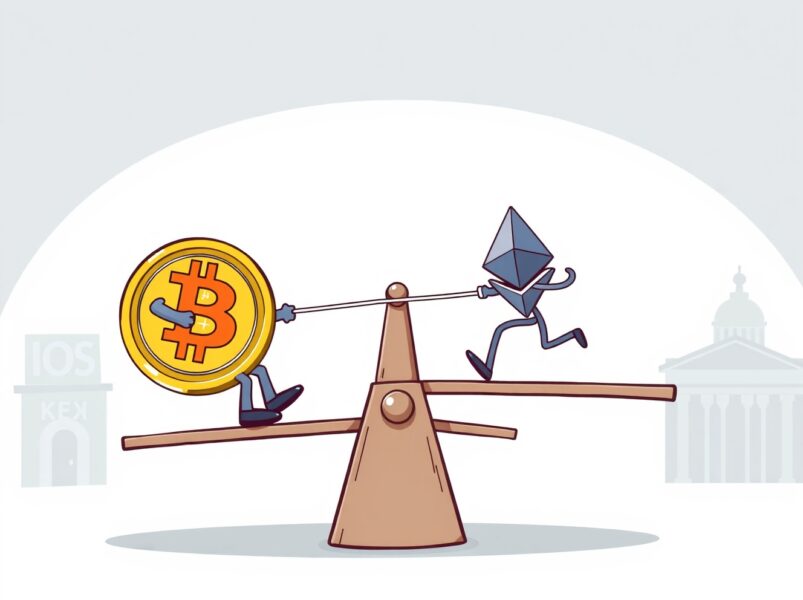
Crucial ETH/BTC Ratio: Why Ethereum Struggles Against Bitcoin’s Dominance

Crucial ETH/BTC Ratio: Why Ethereum Struggles Against Bitcoin’s Dominance

BitcoinWorld Crucial ETH/BTC Ratio: Why Ethereum Struggles Against Bitcoin’s Dominance The cryptocurrency market is a dynamic landscape, and one of the most closely watched metrics by investors is the ETH/BTC ratio. This ratio measures Ethereum’s value relative to Bitcoin, offering insights into which of these crypto giants is currently outperforming the other. Recently, however, this crucial indicator has faced significant headwinds. Despite a wave of institutional interest in Ethereum and ETH itself reaching impressive new all-time highs, the ETH/BTC ratio has notably failed to reclaim the critical 0.05 level. This persistent struggle raises important questions for investors and market watchers alike. What exactly is holding Ethereum back from truly breaking free of Bitcoin’s gravitational pull? Understanding the ETH/BTC Ratio: A Key Metric for Investors The ETH/BTC ratio is more than just a number; it’s a barometer for market sentiment and capital flow between the two largest cryptocurrencies. When the ratio rises, it suggests that capital is flowing from Bitcoin into Ethereum, indicating stronger confidence or higher growth expectations for ETH. Conversely, a falling ratio often points to Bitcoin’s relative strength or a broader market shift towards the perceived safety of BTC. Understanding this dynamic is vital for anyone navigating the crypto space. It helps investors gauge potential shifts in market leadership and adjust their portfolios accordingly. Historical Performance: Why Has the ETH/BTC Ratio Faced Resistance? Looking back at history provides crucial context for the current performance of the ETH/BTC ratio. On-chain analyst James Check highlighted that Ethereum has only outperformed Bitcoin during roughly 15% of its existence. Its most significant bull runs, where ETH truly shone, occurred between 2015 and 2017. This period was characterized by groundbreaking innovations like the introduction of smart contracts and the explosive ICO boom, which were unique to Ethereum at the time. However, since 2020, Bitcoin has largely maintained a relative advantage. This suggests that while Ethereum brings innovation, Bitcoin often retains its position as the market’s primary store of value and first mover. The recent struggle below 0.05 continues this trend, even as Ethereum’s ecosystem expands. The Paradox of Institutional Interest: What’s Holding ETH Back? It seems counterintuitive, doesn’t it? Ethereum is attracting substantial institutional interest, with new investment products and corporate adoption on the rise. Yet, the ETH/BTC ratio remains stubbornly below 0.05. This paradox can be attributed to several factors. Firstly, institutional capital often prioritizes established assets with clear regulatory pathways, and Bitcoin, as the pioneer, still holds an edge in this regard. Secondly, while institutional demand for ETH is growing, it might not yet be strong enough to consistently outpace Bitcoin’s broader market dominance or absorb profit-taking pressure. Moreover, the sheer size and liquidity of Bitcoin’s market mean it can often absorb large inflows without significant price impact on the ratio, while Ethereum’s movements are more reactive. Expert Outlook: What’s Next for the ETH/BTC Ratio? So, what does the future hold for the ETH/BTC ratio? Analysts offer mixed perspectives. Jake Kennish from Nansen, a crypto data analytics firm, predicted that Ethereum might be due for a short-term correction. As ETH hovers near its previous all-time highs, some consolidation is natural before a potential new peak. He suggested it could take several weeks or even months for Ethereum to establish a truly new price ceiling and, consequently, influence the ratio more significantly. Investors should watch for catalysts such as major Ethereum network upgrades (like the upcoming Dencun or future Pectra upgrades), which could inject new life and utility into the ecosystem, potentially boosting the ETH/BTC ratio. Navigating the Market: Actionable Insights for Investors For investors, understanding the current state of the ETH/BTC ratio offers valuable insights. Diversify Wisely: Don’t put all your eggs in one basket. While Ethereum has immense potential, Bitcoin’s stability often provides a foundational layer for crypto portfolios. Monitor Key Events: Keep an eye on Ethereum’s development roadmap, especially major upgrades. These can be significant catalysts for price action and ratio shifts. Analyze Market Sentiment: Understand whether the broader market is in a “risk-on” phase (favoring altcoins like ETH) or a “risk-off” phase (favoring Bitcoin). Long-Term Vision: Both assets have strong fundamentals. Short-term fluctuations in the ETH/BTC ratio should be viewed within a broader, long-term investment strategy. Remember, market analysis is crucial, and staying informed about both Bitcoin and Ethereum’s individual trajectories is key. Summary: The Enduring Battle for Crypto Dominance The ongoing struggle of the ETH/BTC ratio below 0.05 highlights the complex dynamics at play within the cryptocurrency market. Despite Ethereum’s innovative strength and growing institutional appeal, Bitcoin’s historical dominance and market depth continue to exert significant influence. While experts predict potential short-term corrections for ETH, the long-term outlook remains tied to Ethereum’s ability to deliver on its technological promises and attract sustained, deep institutional capital. For now, the battle for crypto dominance continues, making the ETH/BTC ratio a fascinating indicator to watch. Frequently Asked Questions (FAQs) Q1: What does the ETH/BTC ratio signify? A1: The ETH/BTC ratio indicates Ethereum’s value relative to Bitcoin. A rising ratio suggests Ethereum is outperforming Bitcoin, while a falling ratio means Bitcoin is showing stronger relative performance. It helps investors understand capital flow between the two assets. Q2: Why is the ETH/BTC ratio struggling to reclaim 0.05? A2: The ETH/BTC ratio is struggling due to several factors, including Bitcoin’s historical dominance since 2020, its perceived status as a safer institutional asset, and the market’s absorption of new ETH supply or profit-taking. Despite institutional interest in ETH, it hasn’t yet translated into sustained outperformance against BTC. Q3: Has Ethereum ever significantly outperformed Bitcoin? A3: Yes, Ethereum significantly outperformed Bitcoin during its early years, particularly between 2015 and 2017. This period was driven by the introduction of smart contracts and the ICO boom, which were revolutionary developments unique to Ethereum. Q4: What role does institutional interest play in the ETH/BTC ratio? A4: While institutional interest in Ethereum is growing, it’s not always enough to consistently boost the ETH/BTC ratio above key resistance levels. Institutional capital often flows into Bitcoin first due to its established nature and regulatory clarity. However, sustained institutional adoption of Ethereum could become a long-term catalyst. Q5: What factors could help improve the ETH/BTC ratio in the future? A5: Future Ethereum network upgrades (like Dencun or Pectra), increased utility and adoption of decentralized applications (dApps), and a broader market shift towards “risk-on” assets could potentially help improve the ETH/BTC ratio. Continued, deep institutional investment into Ethereum-specific products would also be a significant driver. Did this analysis of the ETH/BTC ratio help you understand the market better? Share your thoughts and this article with your network on social media to spark further discussion about the future of Ethereum and Bitcoin! To learn more about the latest crypto market trends, explore our article on key developments shaping Ethereum price action. This post Crucial ETH/BTC Ratio: Why Ethereum Struggles Against Bitcoin’s Dominance first appeared on BitcoinWorld.

Author: Coinstats
A Blockchain Platform Where DApps Can Achieve High-Speed And Low-Latency Interactions

A Blockchain Platform Where DApps Can Achieve High-Speed And Low-Latency Interactions

The post A Blockchain Platform Where DApps Can Achieve High-Speed And Low-Latency Interactions appeared on BitcoinEthereumNews.com. IOST (Internet of Services Token) is a cryptocurrency and blockchain platform designed to provide a scalable and efficient infrastructure for building decentralized applications (DApps). IOST tries to address some of the scalability and performance challenges faced by existing blockchain networks by introducing innovative consensus mechanisms and technologies.  Proof of Believability It uses a unique consensus mechanism called “Proof of Believability” (PoB), which aims to improve network scalability while maintaining security and decentralization. PoB enables faster transaction confirmation times and higher throughput compared to some traditional blockchain networks, making IOST suitable for high-frequency transactions. Moreover, IOST implements sharding, a technique that divides the network into smaller shards to process transactions in parallel, further enhancing scalability. Gas-free transactions IOST introduces a concept called “Gas-Free Services,” allowing DApp users to interact with DApps without paying transaction fees. Developers can choose to subsidize user transactions. The platform also supports decentralized identity solutions, enabling users to have control over their personal data and digital identities. IOST is the native utility token of the IOST platform. It is used for transactions, staking, voting, and participating in the platform’s ecosystem. IOST token holders can participate in network governance and consensus by staking tokens and voting for validators. Disclaimer. This article is for informational purposes only and should not be viewed as an endorsement by CoinIdol. They are not a recommendation to buy or sell cryptocurrency. Readers should do their research before investing in funds. Source: https://coinidol.com/iost-internet-of-services-token/

Author: BitcoinEthereumNews
Cardano, Pi Network Or Layer Brett; Which Of These Is Set For 40x Gains In 2025?

Cardano, Pi Network Or Layer Brett; Which Of These Is Set For 40x Gains In 2025?

The post Cardano, Pi Network Or Layer Brett; Which Of These Is Set For 40x Gains In 2025? appeared on BitcoinEthereumNews.com. Crypto News 14 September 2025 | 19:30 As altcoins seem to be rallying again, investors are in search of the next big opportunity. Everyone wants a coin that can turn $1,000 into $50,000 in a few months, and names like Cardano (ADA) and Pi Network (PI) are popping up. Both coins have recorded significant growth in the past, and analysts are tipping them for gains this year. However, a new Ethereum-based meme coin called Layer Brett (LBRETT) is crafting a strong narrative on presale. After raising over $3.5 million in a couple of weeks, LBRETT is going viral, causing analysts to tip it for 40x gains in the coming months. How does Layer Brett stand out compared to established altcoins like PI and ADA? Let’s find out. Layer Brett could deliver 40x gains in 2025 Currently in presale, Layer Brett is being called the most exciting meme coin of 2025. But since it’s not the only presale meme coin, why is Layer Brett getting such optimistic narratives? Unlike typical meme projects that rely only on hype, Layer Brett combines viral meme branding with Ethereum Layer-2 scalability. The platform supports traders looking for faster and cheaper transactions, setting it apart from many competitors in the meme coin space that lack utility and focus only on social media hype. Additionally, Layer Brett supports developers with a scalable platform that lets them host decentralized applications (dApps) and smart contracts. The strong Layer Brett staking APY of over 700% also attracts investors looking to earn passive income while holding their LBRETT tokens for potential post-launch gains. Analysts are already suggesting that Brett’s presale trajectory mirrors early Shiba Inu or Dogecoin, which produced life-changing returns for those who entered early. The combination of a low market cap, meme virality, and various use cases for traders…

Author: BitcoinEthereumNews
Solana Holders Looking For The Next 100x Investment Back This Trending Meme Coin After Global Attention

Solana Holders Looking For The Next 100x Investment Back This Trending Meme Coin After Global Attention

The post Solana Holders Looking For The Next 100x Investment Back This Trending Meme Coin After Global Attention appeared first on Coinpedia Fintech News Crypto investors are always chasing the next big thing, and right now, Solana holders are scouting fresh opportunities beyond the established giants. While Solana has had an impressive run, many believe its growth ceiling may be nearing. This has led attention to a surprising contender: Layer Brett ($LBRETT), a meme coin fused with Ethereum Layer …

Author: CoinPedia
Ethereum Foundation’s Privacy Team Rebrands as PSE, Unveils End-to-End Onchain Privacy Roadmap

Ethereum Foundation’s Privacy Team Rebrands as PSE, Unveils End-to-End Onchain Privacy Roadmap

The Ethereum Foundation’s Privacy & Scaling Explorations team rebranded as Privacy Stewards for Ethereum (PSE), unveiling an ambitious roadmap to make privacy the default rather than exception across Ethereum’s technical stack. The transformation shifts focus from cryptography exploration to problem-first solutions addressing Ethereum’s surveillance vulnerabilities. PSE’s new mission centers on three core tracks: private writes to make on-chain actions as cheap and seamless as public ones, private reads enabling surveillance-free blockchain queries, and private proving for accessible data verification. The initiative follows Vitalik Buterin’s April advocacy for privacy as essential to Ethereum’s survival as a global settlement infrastructure. The roadmap warns that without robust privacy protections, Ethereum risks becoming “the backbone of global surveillance rather than global freedom.” PSE emphasizes that institutions and users will migrate elsewhere if private transactions, identity, and data remain compromised by public blockchain transparency. From Cryptography Lab to Privacy Stewardship Mission PSE abandoned its previous approach of pursuing “cool tech” for concrete problem-solving focused on ecosystem outcomes rather than internal projects. The rebrand includes website updates to pse.dev and restructured team goals with particular emphasis on subtraction by default and problem-driven resource allocation. The strategy involves continuous problem mapping, execution decisions across lead-support-monitor engagement levels, and public communication through newsletters, community calls, and working groups. PSE draws inspiration from Protocol and EcoDev announcement simplicity while addressing feedback from Vitalik Buterin, Silviculture Society, and EF management. Key initiatives include PlasmaFold development for private transfers using PCD and folding, targeting proof-of-concept by Devconnect. The team continues to develop the Kohaku privacy wallet, focusing on zk account recovery frameworks and keystore implementation for stealth addresses. Private governance efforts focus on a “State of private voting 2025” report while collaborating with Aragon on protocol integrations. The Institutional Privacy Task Force launches with the EF EcoDev Enterprise team to unblock adoption through privacy specifications and proof-of-concepts. Another key aspect of this new direct is PSE’s data portability. It tracks advances in TLSNotary development for production-ready zkTLS protocols, while building SDKs that enable seamless integration across mobile, server, and browser platforms. Additionally, network privacy initiatives include Private RPC working groups, ORAM solution integration for privacy-preserving state reads, and sphinx mixing protocol implementation for broadcast privacy. The team has stated that it will methodically study ORAM and PIR state-of-the-art techniques while translating research into practical wallet and browser experiences. Industry Experts Warn Public Ledgers Threaten Mass Adoption The privacy push addresses growing concerns from industry veterans about Ethereum’s transparency model. In an interview with Cryptonews in August, British Gold Trust’s Petro Golovko argues public blockchains expose salaries, business deals, and balance sheets, making crypto “unusable for regular people and impossible for institutions.“ Golovko compares current blockchain transparency to the pre-SSL internet, when users refused to enter credit card numbers due to a lack of encryption. He maintains that crypto remains stuck in this vulnerable phase, preventing the scaling that transformed e-commerce into a $6 trillion industry. Institutional adoption concerns center on the exposure of trade secrets and the competitive disadvantage resulting from visible treasury movements. Golovko warns that no board will approve systems exposing supply chains or financial operations globally, limiting crypto to speculation rather than serious commerce. Vitalik Buterin’s April privacy advocacy stemmed from similar concerns about AI-driven surveillance and data misuse eroding personal autonomy. His roadmap outlined four areas for enhancing privacy: anonymous payments, application-level privacy, secure data access, and network obfuscation. The Ethereum co-founder advocated for wallets to integrate tools like Railgun and Privacy Pools, creating “shielded balances” that enable private-by-default transactions. He emphasized that separate addresses per dApp would eliminate traceable links between applications while maintaining usability. European regulatory pressure adds urgency to the development of privacy. Community member Eugenio Reggianini outlined GDPR compliance practices that require personal data to remain off-chain, with blockchain nodes relaying only encrypted references or proofs, rather than identifiable information. Looking forward, the team aims to accelerate ecosystem adoption through community initiatives with privacy and robust security at the center of its decentralized identity systems

Author: CryptoNews
Best Crypto Presale to Look Out for: Nexchain Leads, Bitcoin Hyper Follows While Remittix Stagnates

Best Crypto Presale to Look Out for: Nexchain Leads, Bitcoin Hyper Follows While Remittix Stagnates

Nexchain leads the list of the best crypto presales to buy right now, with Bitcoin Hyper gaining momentum while Remittix stalls. Explore token presales, updates, and utility in this detailed breakdown.

Author: Blockchainreporter
This New Crypto Coin Could Be the Next to Hit $1, Mutuum Finance (MUTM) Might Outperform Solana (SOL)

This New Crypto Coin Could Be the Next to Hit $1, Mutuum Finance (MUTM) Might Outperform Solana (SOL)

The post This New Crypto Coin Could Be the Next to Hit $1, Mutuum Finance (MUTM) Might Outperform Solana (SOL) appeared on BitcoinEthereumNews.com. Every bull cycle produces one breakout token that goes from obscurity to headlines with a simple milestone: hitting $1. Ripple’s XRP and Solana (SOL) both had their moments, starting from cents before surging to mainstream recognition. Now, analysts are asking: which new crypto coin could be next to hit $1? All eyes are on Mutuum Finance (MUTM), a DeFi token priced at just $0.035. With strong mechanics, security credentials, and a roadmap designed for growth, many believe it could not only reach $1 but also outperform Solana’s trajectory in terms of percentage gains. Solana (SOL) Solana remains one of the most respected networks in crypto space. It powers decentralized applications (dApps), NFTs, and DeFi projects at lightning speed, with lower fees than Ethereum. Recently, institutional flows have strengthened its position: Today, 13 public companies collectively hold 8.9 million SOL, a stash valued at roughly $1.8 billion, underscoring Solana’s growing presence in institutional portfolios. This momentum is being reinforced by Forward Industries, which is rolling out a dedicated Solana treasury strategy with backing from Galaxy Digital and Jump Crypto. At the same time, SOL Strategies is preparing to debut as the first Solana treasury firm listed on Nasdaq, a move that brings Wall Street credibility to the blockchain and signals the next phase of mainstream recognition for Solana. At around $208 per token, Solana has already delivered life-changing gains for early investors. But its massive market cap now makes another 100x move highly unlikely. The room for exponential growth belongs to smaller, cheaper tokens that are just beginning their journey. Why Investors Look for the “Next Solana” Investors chasing 100x returns know history won’t repeat exactly. Solana went from under $5 to over $200 because it was early, fast, and built a vibrant ecosystem before competitors could catch up. Today, its…

Author: BitcoinEthereumNews