

Coinbase's x402 payment protocol has surpassed 100 million transactions on the Base network just nine months after its launch, according to data from Chainalysis. The milestone highlights the rapid grCoinbase's x402 payment protocol has surpassed 100 million transactions on the Base network just nine months after its launch, according to data from Chainalysis. The milestone highlights the rapid gr
AI-Powered Payments Surpass 100 Million Transactions on Base: Are Stablecoins Becoming the Infrastructure of the AI Economy?

重點摘要
Coinbase's x402 protocol has surpassed 100 million transactions on the Base network in just nine months. It enables AI agents to make autonomous stablecoin payments for digital services without human approval, signaling the rise of machine-to-machine commerce powered by blockchain.
Coinbase's x402 payment protocol has surpassed 100 million transactions on the Base network just nine months after its launch, according to data from Chainalysis. The milestone highlights the rapid growth of automated payment systems that enable AI agents to interact with digital services directly on blockchain networks.
Unlike traditional cryptocurrency transactions initiated by humans, x402 is designed to allow AI agents to make autonomous stablecoin payments in exchange for data, API access, computing resources, and other digital services without requiring manual approval for each transaction.
The protocol's growth is fueling expectations of an emerging economic model in which AI agents can independently buy, sell, and exchange services with one another through blockchain-based payment rails. In this vision, stablecoins serve as the native medium of exchange, enabling machine-to-machine commerce at internet scale.
Key Takeaways
- Coinbase's x402 protocol has surpassed 100 million transactions on the Base blockchain.
- AI agents can autonomously make stablecoin payments without requiring human approval for every transaction.
- The early surge was partly driven by enthusiasm surrounding the PING token ecosystem, but transaction activity has remained strong beyond the initial hype cycle.
- The percentage of transactions exceeding $1 increased from 49% to 95% over the past year.
- Stablecoins are increasingly emerging as a foundational payment layer for the AI economy.
- Both Coinbase and Circle believe AI agents will play an increasingly important role within blockchain ecosystems and digital commerce.
What Is x402 and Why Is It Gaining Attention?
The rapid rise of artificial intelligence over the past two years has created a new challenge for the internet: how can AI agents pay for the services they use without requiring humans to manually approve every transaction?
Built on the HTTP 402 standard, x402 allows applications, software, and AI agents to make direct payments using stablecoins while accessing digital resources. Instead of creating accounts, entering credit card information, or waiting for human approval, a system can automatically send the required payment and immediately gain access to a service.
This represents a fundamentally different approach from traditional internet payment models.
HTTP 402 and the Vision of Native Internet Payments
HTTP 402 is an internet response status code originally designed to mean "Payment Required."
Although it has existed since the early days of the internet, HTTP 402 has rarely been used in practice because traditional payment infrastructure has never been flexible enough to support real-time microtransactions.
Historically, websites and online services have relied on:
- Credit cards
- Bank accounts
- Digital wallets
- Subscription-based payment systems
While these methods work well for humans, they are poorly suited for autonomous AI systems and software agents.
x402 was created to transform HTTP 402 into a practical payment mechanism powered by blockchain technology and stablecoins.
How Can AI Agents Spend Money on Their Own?
The most distinctive feature of x402 is its ability to enable autonomous payments by AI agents.
For example, an AI agent conducting market research may need to:
- Purchase real-time financial data
- Access specialized APIs
- Rent computing power from a cloud service provider
- Pay to use another AI model
Rather than sending a request to a human for approval, the AI agent can automatically pay the required amount in stablecoins through x402 and continue its task immediately.
The entire process is nearly fully automated and can be completed within seconds.
Stablecoins Are the Critical Missing Piece
For this model to work, the system requires an asset that can be transferred quickly, remain price-stable, and be easily integrated into software applications.
Stablecoins satisfy all of these requirements.
Compared with traditional fiat payment systems, stablecoins offer several advantages:
- Operate 24/7
- Independent of banking hours
- Can be programmed directly into applications
- Support near-instant cross-border payments
- Low transaction costs
Because of these characteristics, stablecoins are increasingly emerging as the ideal payment medium for autonomous AI systems.
As AI agents become more capable and independent, the combination of blockchain-based payments and stablecoins could form the foundation of a new machine-to-machine economy, where software systems can buy, sell, and exchange digital services without human intervention.
More Than 100 Million Transactions in Just Nine Months
According to a report from Chainalysis, the x402 protocol surpassed 100 million transactions on the Base network just nine months after launch. This represents a remarkable growth rate for a relatively new payment protocol, especially considering that automated payments between AI agents are still in their early stages of development.
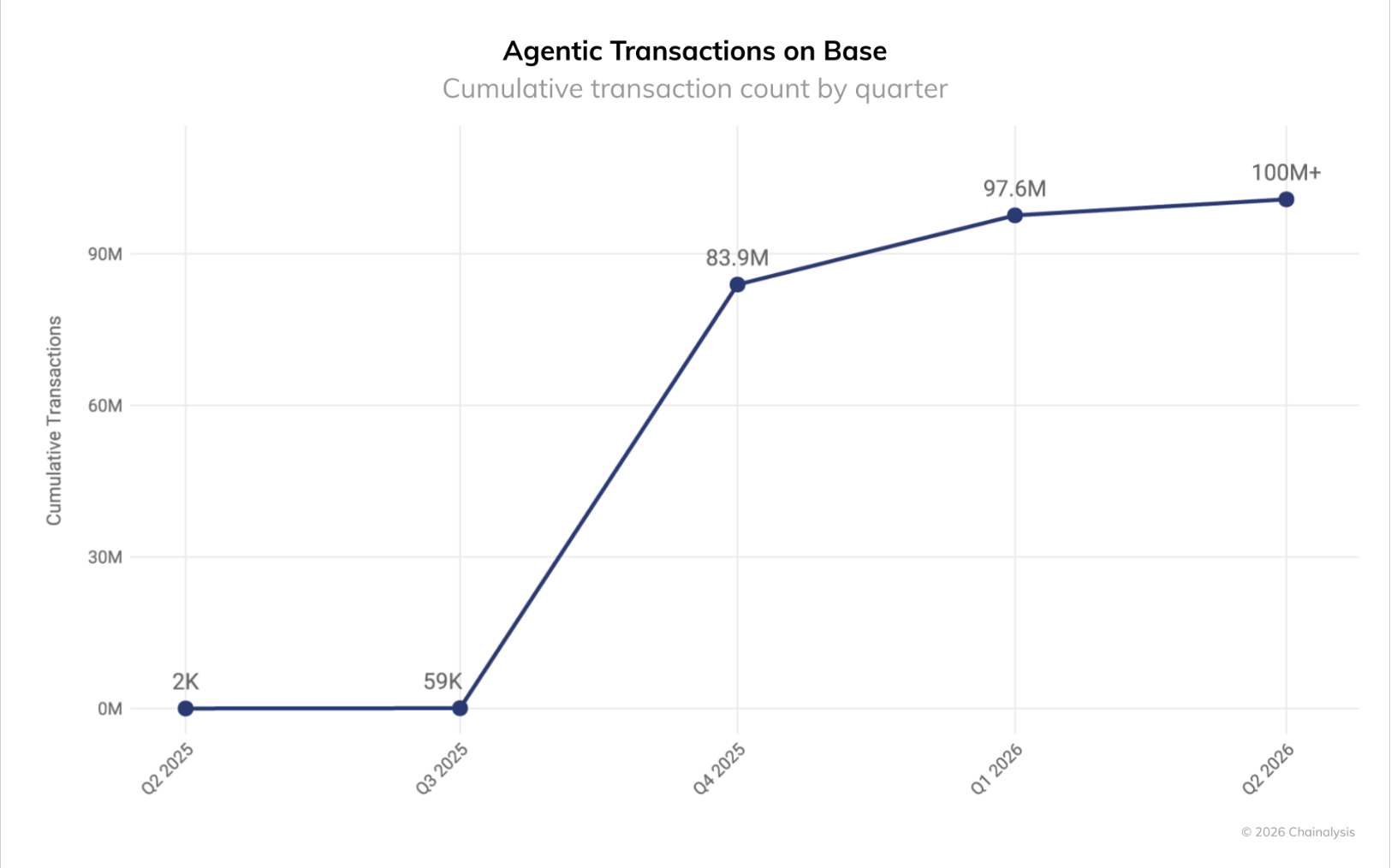
What makes this milestone particularly significant is not merely the number of transactions, but the nature of those transactions. Unlike much of today's blockchain activity—which is centered around digital asset trading, speculation, or DeFi—many x402 transactions are tied to real-world service consumption.
These transactions commonly involve:
- Accessing paid APIs.
- Purchasing real-time data.
- Paying for AI services.
- Utilizing cloud computing resources.
- Interactions between AI agents.
- Automated applications operating on blockchain networks.
In other words, x402 is demonstrating that blockchain can serve not only as infrastructure for digital asset transfers but also as a payment layer for an emerging digital economy.
Another noteworthy aspect is that a large portion of these transactions are executed automatically by software rather than humans. This suggests that the concept of machine-to-machine payments is gradually moving from theory into practical implementation.
If this trend continues, the number of transactions initiated by AI systems could eventually surpass those generated by traditional users, creating an entirely new growth engine for blockchain networks and stablecoins.
PING Was the Initial Catalyst
Although x402 is attracting attention because of its potential role in the AI economy, its first major growth driver was actually the PING project.
PING adopted a pay-to-mint model, requiring users to pay 1 USDC through x402 to mint tokens. This mechanism quickly generated a massive volume of transactions on Base as users rushed to participate and acquire newly issued tokens.
At its peak, transaction activity surged dramatically, helping x402 reach a scale that many blockchain projects take years to achieve.
More important, however, is what happened after the PING frenzy faded.
Typically, projects fueled by token speculation experience sharp declines in activity once the initial excitement and FOMO disappear. According to Chainalysis data, x402 did not follow that pattern.
After the PING hype cooled:
- Transaction volume declined but did not collapse.
- Network activity remained significantly higher than pre-PING levels.
- New use cases continued to emerge.
- Demand for automated payments persisted.
This suggests that PING served primarily as an onboarding catalyst, helping users discover the protocol, while x402's long-term value lies in its ability to support automated blockchain-based payments.
That is an encouraging sign because it indicates that the protocol's growth is not entirely dependent on a short-lived speculative trend.
Transaction Quality Is Improving
Beyond raw growth, another metric attracting significant attention from analysts is transaction quality.
According to Chainalysis:
- In early 2025, only about 49% of transactions exceeded $1 in value.
- By 2026, that figure had increased to approximately 95%.
At first glance, this may appear to be a minor statistical change. However, within the blockchain industry, it can signal the maturation of an entire ecosystem.
During the early stages of most protocols, transaction activity is often dominated by:
- Test transactions.
- Tiny micropayments.
- System validation and debugging.
- Speculative or spam-related activity.
When the proportion of transactions above $1 rises significantly, it suggests that users and applications are increasingly utilizing the protocol for economically meaningful activities.
This trend points to three important developments:
Growing Real-World Demand
Users are no longer merely experimenting with the technology. They are beginning to pay for actual digital services and resources.
AI Agents Are Performing More Complex Tasks
Higher transaction values may indicate that AI agents are purchasing more sophisticated services, such as premium datasets, advanced AI models, or higher-cost computing resources.
The Ecosystem Is Maturing
A growing share of higher-value transactions is often a sign that a platform is transitioning from an experimental phase into practical adoption.
For Coinbase and the Base ecosystem, this may be an even more meaningful indicator than the 100 million transaction milestone itself. A network generates sustainable value only when activity is driven by genuine utility rather than speculation alone.
If current trends continue, x402 could become one of the first large-scale examples demonstrating that AI agents are not merely operating on blockchain networks—they are beginning to create a genuine digital economy powered by stablecoins and automated payments.
Stablecoins Are Becoming the Fuel of the AI Economy
If x402 serves as the payment infrastructure for AI agents, then stablecoins are the fuel that powers the entire system.
The rapid growth of x402 highlights an important trend: as AI becomes increasingly autonomous, these systems require a payment method that is native to the digital environment. At the moment, stablecoins are emerging as a near-perfect solution.
Why Does AI Need a Native Internet Currency?
Traditional financial systems were designed for humans.
When people want to pay for a service, they typically need to:
- Log into an account.
- Enter payment information.
- Confirm the transaction.
- Wait for processing and settlement.
This workflow is suitable for human behavior but poorly suited for AI systems.
An AI agent may need to perform thousands of transactions every day to:
- Purchase data.
- Rent computing resources.
- Access APIs.
- Use other AI models.
- Pay for storage or data-processing services.
If every payment requires human approval, the benefits of AI automation are largely eliminated.
This is why AI requires a monetary system that can be programmed directly into software and operate entirely autonomously.
Stablecoins Solve AI's Payment Problem
Stablecoins possess several characteristics that make them particularly well-suited for AI-driven commerce.
Stable Value
Unlike Bitcoin and many other cryptocurrencies that can experience significant price fluctuations, stablecoins are generally pegged to the U.S. dollar or other reserve assets.
This stability allows AI systems to estimate costs, allocate budgets, and make financial decisions more predictably.
24/7 Availability
AI agents do not recognize weekends, holidays, or business hours.
An AI system may need to make payments at any moment, and blockchain-based stablecoins enable continuous operation without relying on banking schedules.
Programmability
Payments can be embedded directly into software logic, allowing AI agents to automatically pay for services whenever they are required.
This level of automation is difficult to achieve efficiently using traditional payment systems.
Stablecoins Could Become the "API of Money"
Many technology experts believe stablecoins are evolving in a way similar to how APIs transformed the internet.
Before APIs became widespread, integrating software systems was often complicated and inefficient. APIs enabled applications to communicate with one another automatically and at scale.
Stablecoins could play a similar role for money.
In the future:
- AI agents may pay other AI agents.
- Applications may purchase data automatically.
- Software could rent computing power on demand.
- Digital services could charge per request or per use.
All of these interactions can be facilitated through programmable payments executed on blockchain networks.
In this sense, stablecoins are gradually evolving beyond crypto assets and becoming a foundational financial layer for the next generation of the internet.
Why Are Coinbase and Circle Betting on AI Agents?
It is no coincidence that both Coinbase and Circle are investing heavily in payment infrastructure designed for AI.
Both companies see enormous potential in the convergence of artificial intelligence and blockchain technology.
According to Brian Armstrong, future AI agents will likely need the ability to own wallets, hold assets, and make payments just like humans. If the number of AI agents grows into the millions or billions, they could become the largest category of blockchain users in the world.
Similarly, Jeremy Allaire has argued that stablecoins are ideally suited for the AI economy because they offer global accessibility, low transaction costs, and seamless software integration.
From the perspective of Coinbase and Circle, the future of blockchain extends far beyond cryptocurrency investors—it may increasingly revolve around autonomous AI systems.
AI Agents Could Create Massive Stablecoin Demand
If AI becomes an active participant in the digital economy, payment activity could grow exponentially.
A single AI agent might:
- Access hundreds of APIs daily.
- Rent computing power in real time.
- Purchase datasets from multiple providers.
- Interact with dozens of digital services simultaneously.
Each of these actions can generate a payment transaction.
If millions of AI agents operate concurrently, the resulting stablecoin transaction volume could eventually exceed the scale of today's cryptocurrency economy.
This is why many analysts view AI as one of the most significant long-term growth drivers for stablecoins over the next decade.
A Blockchain-Based AI Economy Is Beginning to Emerge
The data surrounding x402 suggests that an entirely new economic model may be taking shape.
During the early years of blockchain, most activity centered around:
- Cryptocurrency trading.
- Digital asset speculation.
- DeFi applications.
- NFTs and GameFi.
The next wave of adoption may come from AI agents.
In this emerging economy, AI systems are no longer merely tools that assist humans. Instead, they become economic participants capable of making decisions and executing transactions independently.
Potential scenarios envisioned by industry observers include:
- AI purchasing data to improve analytical capabilities.
- AI renting servers to complete complex tasks.
- AI paying for access to specialized AI models.
- AI purchasing digital services from providers around the world.
- AI agents transacting directly with other AI agents.
In this environment, blockchain serves as the settlement layer, while stablecoins become the default medium of exchange.
From Experimentation to Real-World Adoption
The fact that x402 has surpassed 100 million transactions demonstrates that the concept of an AI-driven economy is no longer purely theoretical.
Although still in its early stages, on-chain data suggests that an increasing number of software systems are beginning to use blockchain networks to pay for real-world services.
If this trend continues, the combination of AI, stablecoins, and blockchain could create an entirely new digital economic layer—one in which a substantial portion of online transactions are performed not by humans, but by autonomous AI systems operating across the internet.
This is why many analysts view the growth of x402 as more than just a Coinbase or Base success story. It may represent one of the earliest signals that a true AI economy is beginning to emerge on blockchain infrastructure.
Frequently Asked Questions (FAQ)
What is x402?
x402 is a payment protocol developed by Coinbase that enables AI agents, applications, and software systems to automatically make stablecoin payments in order to access digital resources, APIs, data services, and other online infrastructure.
Why did x402 surpass 100 million transactions?
The protocol's rapid growth has been driven by increasing demand for automated payments, growing activity from AI agents, and early adoption through applications such as PING. Together, these factors helped accelerate transaction volume across the Base network.
How can AI agents make payments on their own?
AI agents can use stablecoins to send payments directly on blockchain networks without requiring human approval for each transaction. This allows them to autonomously purchase data, access APIs, rent computing resources, and pay for digital services as needed.
What role do stablecoins play in the AI ecosystem?
Stablecoins provide a payment mechanism that is:
- Price-stable.
- Programmable.
- Available 24/7.
- Globally accessible.
- Easy to integrate into software systems.
These characteristics make them particularly well-suited for autonomous AI-driven transactions.
How does Base benefit from this trend?
The growth of x402 increases:
- Transaction volume on Base.
- On-chain economic activity.
- Demand for blockchain infrastructure.
- Adoption of stablecoin-based payments.
As more AI applications utilize x402, Base could become a key platform for machine-to-machine commerce.
Could AI become the largest user of blockchain?
This remains a forward-looking prediction rather than a certainty. However, many industry leaders believe that as AI agents become more autonomous and widespread, they could eventually account for a significant share of blockchain activity, potentially surpassing traditional human-driven usage in certain sectors.
Why are stablecoins considered important for the future AI economy?
Unlike traditional payment systems, stablecoins can be embedded directly into software and operate continuously without relying on banks or manual approval processes. This makes them a natural fit for an economy where AI systems interact, transact, and exchange services autonomously.
What makes machine-to-machine payments different from traditional payments?
Traditional payments are designed for humans and often involve manual steps such as authentication and approval. Machine-to-machine payments allow software systems and AI agents to exchange value automatically, enabling real-time transactions without human intervention.
Does x402 prove that an AI economy already exists?
Not entirely, but it provides early evidence that elements of an AI-driven economy are beginning to emerge. The protocol's transaction growth suggests that software applications and AI systems are increasingly using blockchain-based payments for real-world services rather than purely speculative activities.
Why is the x402 milestone significant for the broader blockchain industry?
The success of x402 demonstrates a potential new use case for blockchain technology beyond trading, DeFi, and digital assets. It highlights how blockchain and stablecoins could serve as foundational infrastructure for an emerging economy powered by autonomous AI agents and automated digital commerce.
Disclaimer: The information provided here is for informational purposes only and should not be considered financial, investment, legal, or professional advice. Always conduct your own research, consider your financial situation, and, if necessary, consult with a licensed professional before making any decisions.
市場機遇
Gensyn實時價格 (AI)
--
----
USD
Gensyn (AI) 實時價格圖表
描述:幣圈脈動基於 AI 技術與公開信息,第一時間呈現最熱代幣趨勢。如果想了解更多專業解讀與深度分析,請訪問新手學院。
本頁面分享的文章均源自公開平台,僅供參考。該內容不代表 MEXC 的立場或觀點。所有版權歸 Nguyen Rin Hoang 所有。如果您認為任何內容侵犯了第三方的權益,請聯絡 service@support.mexc.com 以便及時刪除。 MEXC 不保證任何內容的準確性、完整性或及時性,且不對基於所提供信息而採取的任何行動負責。本內容不構成財務、法律或其他專業建議,亦不應被解釋為 MEXC 的推薦或認可。如需專家見解和深入分析,請造訪 MEXC 學院。
學習更多 Gensyn 知識
查看更多
零閾值,零滑點:如何在 MEXC 交易美股股票合約
近期,AI 概念股大幅飆升,科技巨頭估值屢創新高,使美股市場成為全球投資者關注的焦點。然而,多數幣種用戶面臨開戶流程繁瑣、資金門檻高等重大障礙,幾乎無法透過傳統方式進入美股市場。 為填補關鍵市場空白,MEXC 推出股票合約,讓幣種用戶以低門檻與直觀的交易介面無縫參與美股投資,從而把握全球優質資產的成長機會。 MEXC 股票合約的核心競爭優勢 MEXC 股票合約透過以下核心競爭優勢,建立了獨特的市場
2026/07/28

【美股投資指南】明星股票:從太空探索科技公司到特斯拉,了解熱門精選
親愛的 MEXC 用戶, 上週,我們完成了美股的完整認知框架:從基礎到進階,再到深度分析。本週,我們將深入熱門資產與行業賽道,幫助您識別值得關注的投資機會。 今日直播: 什麼是太空探索技術公司?太空探索技術公司會成為全球最有價值的公司嗎?其歷史、使命與 2026 年 IPO 的完整分析 本週美股財報:微軟、元宇宙、蘋果與亞馬遜面臨 AI 支出考驗,聯準會利率決議逼近 特斯拉 2026 年第二季財報
2026/07/28

CXMT(688825.SH)股票:中國 DRAM 冠軍在上海首秀大漲
CXMT(688825.SH)股票已成為中國半導體板塊中最大的市場話題之一。 長鑫記憶體科技(ChangXin Memory Technologies),又稱為 CXMT 或 長鑫科技,於 2026 年 7 月 27 日在上海科創板開始交易。IPO 發行價為每股人民幣 8.66 元。根據 China.org.cn 轉載的新華社行情報告,該股在首個交易日收盤報人民幣 49 元,較 IPO 發行價上漲
2026/07/27
Gensyn 最新動態
查看更多
三星第二季獲利飆升19倍,但股價下跌:為何AI記憶體股面臨更高門檻
三星電子最近指引其2026年第二季營收約為171兆韓元,營業利潤為89.4兆韓元,較一年前驚人地增加了19倍。從帳面上看,這是迄今為止AI記憶體週期中最強勁的獲利信號之一。
然而,市場拒絕將其視為簡單的財報優於預期來交易。三星股價盤中跌幅高達10.1%,在韓國收盤下跌6.9%,並拖累SK海力士、美光和西部數據等同業。給交易員的信號非常明確:投資者不再只是詢問AI記憶體需求是否強勁。他們現在質疑,在經歷歷史性的全行業漲勢後,當前的記憶體定價、擴大的利潤率以及激進的AI資本支出(Capex)能否持續維持。
2026/07/08

SK海力士對決美光:即將到來的SKHY上市如何重新定價AI記憶體與HBM領導地位
SK海力士備受矚目的納斯達克上市(股票代碼:SKHY)勢必將改變美國投資者評估AI記憶體股的方式。多年來,美光科技(MU)一直是交易DRAM、NAND以及由AI推動的資料中心需求時,首選的美國上市代理標的。與此同時,SK海力士鞏固了其作為高頻寬記憶體(HBM)主導力量的聲譽,儘管其主要在韓國上市,使得海外投資者更難參與投資。
隨著SKHY美國存託憑證(ADR)的推出,這種可及性差距正在迅速縮小。這不僅僅是一個早期成長故事進入市場——SK海力士是在AI大幅漲勢之後登場,並帶著其在HBM領域的主導地位敘事。對交易者而言,真正的問題不在於哪家公司「更好」。相反,關鍵在於識別更優的交易佈局:市場會因為SK海力士在HBM的主導地位和新獲得的流動性而給予獎勵,還是繼續堅持選擇美光科技經證實的美國市場通路和創紀錄的獲利?
2026/07/08

MEXC 鏈上日報:Robinhood Chain 每日 DEX 交易量突破 5.6 億美元
Robinhood Chain 的生態系統飆升,每日去中心化交易所(DEX)交易量超過 5.6 億美元,同時機構對去中心化金融(DeFi)和跨鏈基礎設施的採用加速。與此同時,監管機構推進加密貨幣立法,交易所的 BTC/ETH 儲備降至多年低點,而人工智慧(AI)基礎設施投資仍是市場的主要敘事。
2026/07/10


熱門
目前熱門備受市場關注的加密貨幣
加密貨幣價格
按交易量計算交易量最大的加密貨幣