Key takeaways
Perpetual futures on tokenized real-world assets have gone from a negligible category in late 2025 to roughly $470 billion in monthly volume by June 2026, more than five times January's level. In the week ending July 31, RWA perps hit $61.7 billion across Hyperliquid and Binance, equal to 99.2% of Bitcoin perpetual volume on those venues, and early data for the following week showed them overtaking Bitcoin by about 9%. Tokenized equities lead the category at 57.8% of volume, with SpaceX alone generating around $66 billion in June and semiconductor names including Micron, Intel, and SK Hynix close behind.
Overview
While crypto spot trading fell to its lowest level of 2026, a market that did not meaningfully exist six months ago has grown large enough to rival Bitcoin. Perpetual futures on tokenized real-world assets, contracts that let traders take leveraged positions on stocks, commodities, indices, and pre-IPO shares without owning the underlying, reached roughly $470 billion in monthly volume in June according to The Block, up from about $85 billion in January.
The category crossed a threshold in late July. Data provider Talos recorded $61.7 billion in combined seven-day RWA perpetual volume on Hyperliquid and Binance for the week ending July 31, equal to 99.2% of Bitcoin perpetual volume on those two venues, with early data for the following week putting RWA perps at $37.2 billion and roughly 9% ahead of Bitcoin. On Hyperliquid, RWA perps recorded $25.1 billion during the week of July 13 to 19, about 52% of the platform's $48.2 billion weekly total and more than every other perpetual category combined, the first time RWA derivatives had topped the board on that exchange. DWF Ventures put RWA perps at 37% of all digital-asset perpetual futures volume at a point in July, more than double the share four months earlier.
This article covers what the numbers actually say and why they differ across providers, which assets are driving the growth, why traders are choosing tokenized perps over the underlying markets, how the venue competition is shaping up, and the concentration and regulatory risks the category is carrying as it scales.
1. Reading the Numbers
CoinDesk Research reported RWA perpetual volume on centralized exchanges surging 57% to a record $311 billion in June, with Binance holding 78.6% of that category at $245 billion, followed by OKX at 10.7% and Gate at 3.90%. The Block put June volume across major exchanges at roughly $470 billion. The gap is Hyperliquid, a decentralized venue that sits outside a centralized-exchange dataset and carries a substantial share of the category. CoinDesk Markets separately pegged May at $211 billion as a record at the time, while quarterly figures from the same period show growth from $12.37 billion in Q4 2025 to $202.67 billion in Q2 2026, roughly a sixteen-fold increase. Comparisons across these series work only within a single provider's methodology.
What every series agrees on is the trajectory and its steepness. The category grew from negligible in late 2025 to hundreds of billions monthly within two quarters, and the growth accelerated rather than plateaued through July. Underlying that trading activity, the on-chain value of real-world assets excluding stablecoins has reached approximately $36.8 billion according to RWA.xyz.
2. What Traders Are Actually Buying
The composition of the category has shifted meaningfully as it has grown. Commodities dominated early, accounting for between 70% and 95% of RWA perp volume across various periods, but equities have taken over. Talos's breakdown for late July put tokenized equity contracts at 57.8% of tracked volume against 28.2% for commodities, with index futures, ETFs, foreign exchange contracts, and pre-IPO instruments making up the remainder. Equity perps surged 121% month-over-month to $54 billion in May, and tokenized stock perp volume rose roughly sevenfold between January and June.
Pre-IPO exposure has been the standout driver. SpaceX generated approximately $66 billion in perpetual volume in June, the largest single contributor to the category, giving traders a route to a company whose shares public markets simply do not offer. DWF Ventures noted demand for private-company exposure extending to names including OpenAI and Anthropic alongside SpaceX, which describes a market forming around assets that have no conventional retail access point at all.
Semiconductor names have supplied the other half of the equity story. Micron, SanDisk, Intel, and SK Hynix have drawn steady demand, reflecting the same AI-linked equity interest that has driven volatility in public markets through 2026. That overlap is not incidental: SK Hynix and Micron are central to the AI capital expenditure trade that produced violent swings on the KOSPI in July, and tokenized perps let traders express views on those names around the clock rather than only during Seoul or New York hours.
3. Why Tokenized Perps Instead of the Underlying
Traditional brokerages trade US equities during limited hours, close at 4pm Eastern, and shut entirely on weekends, while these contracts trade continuously. DWF Ventures identified weekend trading as a primary growth driver, since a trader who wants to react to Friday-evening news has no venue in conventional markets and every venue in crypto. Access is the second factor. Hundreds of millions of investors outside the United States want exposure to US equities and commodities without a US brokerage relationship or the KYC processes that gate one, and tokenized perps route around that requirement entirely. Leverage completes the picture, letting traders take a directional position with a fraction of the notional capital that buying the underlying would require.
Circle chief executive Jeremy Allaire framed the shift in a July 24 post, arguing that growing RWA trading on Hyperliquid signals crypto markets moving away from speculating on endogenous digital commodities. The reading is that speculative appetite has not left crypto so much as changed what it is pointed at, migrating from tokens whose value derives from crypto-native narratives toward instruments tracking assets with earnings, supply chains, and external price discovery.
4. The Venue Competition
Trading has concentrated sharply. Binance, Hyperliquid, and OKX together account for more than 80% of tokenized stock perpetual futures volume, with Binance alone holding roughly half. Binance's dominance in the centralized-exchange slice runs higher still at 78.6% in June, and its share of the broader RWA trading category has been around 60% against a market approaching $1 trillion in annual volume.
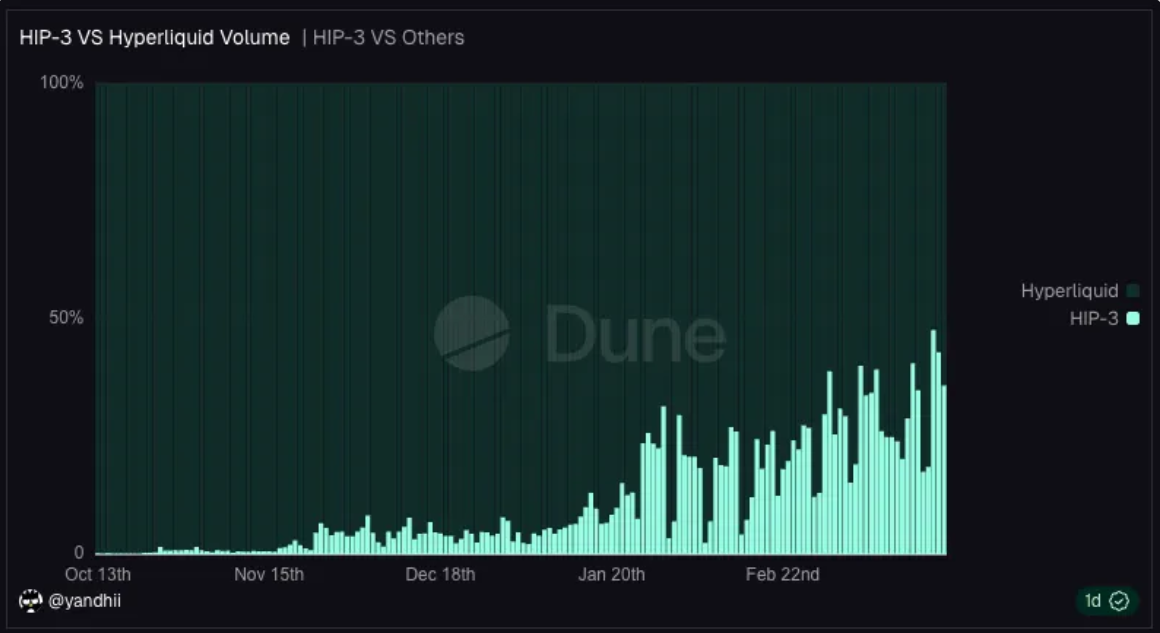
Hyperliquid has emerged as the decentralized counterweight, and its HIP-3 framework is the mechanism. HIP-3 markets let liquidity and risk parameters be configured within the exchange's architecture, compressing the time required to list a new underlying and offering unified cross-margin so idle collateral supports multiple positions. Monthly RWA perp volume through HIP-3 rose from $12.65 billion in Q4 2025 to $130.87 billion in Q1 2026, and the framework accounted for roughly 28.6% of monthly RWA perp volume by March. DWF Ventures identified DEXs including the Hyperliquid-based TradeXYZ as leading the category's growth.
Regulated venues have moved on a separate track. Kraken launched what it described as the first regulated tokenized equity perpetual futures on February 24, offering up to 20x leverage across more than 110 countries, and Coinbase followed on March 20 with 10x on single stocks and 20x on ETF contracts settled in USDC. Ondo Perps entered on July 7 with a differentiated collateral model that accepts tokenized stock and ETF holdings directly as margin, so a holder of tokenized Tesla can open a leveraged position without selling, running on the Ondo Network execution layer the company unveiled on July 27. Like most of these venues, Ondo Perps is restricted to non-US investors on regulatory grounds.
DWF Ventures expects competition to intensify around backend capabilities rather than front-end features, naming liquidity depth, speed in listing new markets, pricing infrastructure, and regulatory approvals as the contested ground.
5. The Risks Scaling With It
Oracle concentration is the most immediate structural vulnerability. Pyth handles more than half of the market's price feeds, which means a disruption to a single network could cascade through billions of dollars in open positions across multiple venues simultaneously. A perpetual contract on a tokenized equity is only as reliable as the price it marks against, and a market this concentrated in its pricing infrastructure has a single point of failure that its trading volume distribution disguises.
Regulatory frameworks remain unsettled in most jurisdictions. Nearly every major venue restricts these products from US investors, which places the fastest-growing category in crypto derivatives largely outside the regulatory perimeter of the country whose equities dominate the underlying basket. European conditions shifted in the same period, with MiCA's transitional period ending July 1 and triggering USDT delistings across EU exchanges, while tokenized equity volumes surged 288% to a record $11.3 billion. Rules that arrive after a market reaches scale tend to arrive abruptly.
Whether the category consolidates into regulated infrastructure or remains an offshore market serving investors that traditional finance gates out is the question the next few quarters will settle. The volume growth has already outrun the regulatory conversation.
Frequently Asked Questions
What are RWA perpetual futures? RWA perps are derivative contracts that track the price of tokenized real-world assets such as stocks, ETFs, commodities, indices, and pre-IPO shares. They let traders take leveraged long or short positions without owning the underlying asset, and unlike conventional futures they have no expiry date, so a position can be held indefinitely as long as it stays funded.
How big is the RWA perpetual futures market? Monthly volume reached approximately $470 billion in June 2026 across major exchanges more than five times January's roughly $85 billion.
Have RWA perps overtaken Bitcoin? On two venues, briefly. Talos recorded $61.7 billion in RWA perp volume across Hyperliquid and Binance for the week ending July 31, equal to 99.2% of Bitcoin perpetual volume on those platforms, with early data for the next week showing RWA perps about 9% ahead.
Which assets drive RWA perp volume? Tokenized equities lead at 57.8% of tracked volume, with commodities at 28.2%. SpaceX generated roughly $66 billion in June as the single largest contributor, followed by semiconductor names including Micron, SanDisk, Intel, and SK Hynix. Pre-IPO exposure to private companies has been a major driver.
Why trade tokenized stock perps instead of buying the stock? They trade 24/7 including weekends, when traditional equity markets are closed, and they require no US brokerage account or associated KYC, which matters for the large population of non-US investors seeking US equity exposure. Leverage allows a position at a fraction of the capital required to buy the underlying.
Can US investors trade RWA perps? Generally no. Most major venues, including Ondo Perps, restrict these products to investors outside the United States on regulatory grounds, which places most of the category outside the US regulatory perimeter despite US equities dominating the underlying basket.
Disclaimer: This article is for informational purposes only and does not constitute financial, investment, or trading advice. Digital assets are volatile and you may lose capital. Conduct your own research before making any decision.